Results by title
1296 books match the query 'Women authors' and 3 start with q

Quiet Armor
PoemsStevie Edwards
Northwestern University Press, 2023
New poetry from Stevie Edwards, author of Sadness Workshop
Quiet Armor, the third full-length collection from poet Stevie Edwards, examines how capitalism and patriarchy impact romantic relationships and, more broadly, intimacy. Edwards considers the ways in which confessional performances of vulnerability can be coercive, whether popular culture encourages men to seek validation through sexual excess and aggression, and how we encourage women to be complicit in figurative and literal violence against other women.
Drawing on historical and mythological figures—including Medusa, Persephone, Shakespeare’s Lavinia, Saint Agatha, and Saint Christina—Edwards builds a fierce investigation into how rape culture has shaped the literary canon, academia, and the world at large. She brings readers into the quiet and intimate spaces we create despite trauma—or perhaps even because of it. Ultimately, Quiet Armor seeks to reclaim positive intimacy, showing us not only the desperate battles but also the healing embraces. All the while, these poems ask us: What does the end of rape culture look like? How do we get there?
[more]

Quite Mad
An American Pharma MemoirSarah Fawn Montgomery
The Ohio State University Press, 2018
Diagnosed with severe anxiety, PTSD, and OCD in her early twenties, Sarah Fawn Montgomery spent the next ten years seeking treatment and the language with which to describe the indescribable consequences of her mental illness. Faced with disbelief, intolerable side effects, and unexpected changes in her mental health as a result of treatment, Montgomery turned to American history and her own personal history—including her turbulent childhood and the violence she faced as a young woman—to make sense of the experience.
Blending memoir with literary journalism, Montgomery’s Quite Mad: An American Pharma Memoir examines America’s history of mental illness treatment—lobotomies to sterilization, the rest cure to Prozac—to challenge contemporary narratives about mental health. Questioning what it means to be a woman with highly stigmatized disorders, Montgomery also asks why mental illness continues to escalate in the United States despite so many “cures.” Investigating the construction of mental illness as a “female” malady, Montgomery exposes the ways current attitudes towards women and their bodies influence madness as well as the ways madness has transformed to a chronic Illness in our cultural imagination. Montgomery’s Quite Mad is one woman’s story, but it offers a beacon of hope and truth for the millions of individuals living with mental illness and issues a warning about the danger of diagnosis and the complex definition of sanity.
Blending memoir with literary journalism, Montgomery’s Quite Mad: An American Pharma Memoir examines America’s history of mental illness treatment—lobotomies to sterilization, the rest cure to Prozac—to challenge contemporary narratives about mental health. Questioning what it means to be a woman with highly stigmatized disorders, Montgomery also asks why mental illness continues to escalate in the United States despite so many “cures.” Investigating the construction of mental illness as a “female” malady, Montgomery exposes the ways current attitudes towards women and their bodies influence madness as well as the ways madness has transformed to a chronic Illness in our cultural imagination. Montgomery’s Quite Mad is one woman’s story, but it offers a beacon of hope and truth for the millions of individuals living with mental illness and issues a warning about the danger of diagnosis and the complex definition of sanity.
[more]
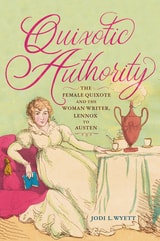
Quixotic Authority
The Female Quixote and the Woman Writer, Lennox to AustenJodi L. Wyett
University of Delaware Press, 2026
Quixotic Authority reveals how deeply absorbed reading was inextricable from and essential to British women's professional writing and cultural commentary from the mid-eighteenth to the mid-nineteenth century. The trope of quixotism, what we might today call "fangirling," had distinctly gendered implications, as the female quixote was almost exclusively associated with uncritical, overly absorptive novel reading, and often portrayed as a self-centered, deluded, ill-educated home-wrecker who must be reformed or punished. But what do we make of the fact that women wrote most of the depictions of female quixotes in novels of this period? Jodi Wyett shows that authors such as Charlotte Lennox and Jane Austen wrote quixote narratives to assert their own professional cachet as well as validate the passion and intelligence of women novel readers. Harnessing the power of the genre, they debunked proscriptive contemporary discourse denigrating both women and the novel. This book redefines the female quixote as a fierce fangirl both modeled in fiction and embodied by her creators.
[more]