Results by title
1441 books match the query 'World' and 2 start with q
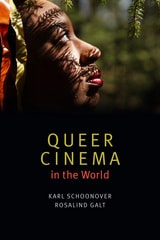
Queer Cinema in the World
Karl Schoonover and Rosalind Galt
Duke University Press, 2016
Proposing a radical vision of cinema's queer globalism, Karl Schoonover and Rosalind Galt explore how queer filmmaking intersects with international sexual cultures, geopolitics, and aesthetics to disrupt dominant modes of world making. Whether in its exploration of queer cinematic temporality, the paradox of the queer popular, or the deviant ecologies of the queer pastoral, Schoonover and Galt reimagine the scope of queer film studies. The authors move beyond the gay art cinema canon to consider a broad range of films from Chinese lesbian drama and Swedish genderqueer documentary to Bangladeshi melodrama and Bolivian activist video. Schoonover and Galt make a case for the centrality of queerness in cinema and trace how queer cinema circulates around the globe–institutionally via film festivals, online consumption, and human rights campaigns, but also affectively in the production of a queer sensorium. In this account, cinema creates a uniquely potent mode of queer worldliness, one that disrupts normative ways of being in the world and forges revised modes of belonging.
[more]
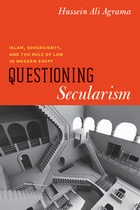
Questioning Secularism
Islam, Sovereignty, and the Rule of Law in Modern EgyptHussein Ali Agrama
University of Chicago Press, 2012
The central question of the Arab Spring—what democracies should look like in the deeply religious countries of the Middle East—has developed into a vigorous debate over these nations’ secular identities. But what, exactly, is secularism? What has the West’s long familiarity with it inevitably obscured? In Questioning Secularism, Hussein Ali Agrama tackles these questions. Focusing on the fatwa councils and family law courts of Egypt just prior to the revolution, he delves deeply into the meaning of secularism itself and the ambiguities that lie at its heart.
Drawing on a precedent-setting case arising from the family law courts —the last courts in Egypt to use Shari‘a law—Agrama shows that secularism is a historical phenomenon that works through a series of paradoxes that it creates. Digging beneath the perceived differences between the West and Middle East, he highlights secularism’s dependence on the law and the problems that arise from it: the necessary involvement of state sovereign power in managing the private spiritual lives of citizens and the irreducible set of legal ambiguities such a relationship creates. Navigating a complex landscape between private and public domains, Questioning Secularism lays important groundwork for understanding the real meaning of secularism as it affects the real freedoms of a citizenry, an understanding of the utmost importance for so many countries that are now urgently facing new political possibilities.
[more]