Results by title
22279 books match the query 'Social Science' and 128 start with q
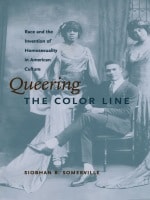
Queering the Color Line
Race and the Invention of Homosexuality in American CultureSiobhan B. Somerville
Duke University Press, 2000
At about the same time that the 1896 Supreme Court Plessy v. Ferguson decision hardened the racialized boundary between black and white, prominent trials were drawing the public’s attention to emerging categories of sexual identity. Somerville argues that these concurrent developments were not merely parallel but in fact inextricably interrelated and that the discourses of racial and sexual “deviance” were used to reinforce each other’s terms. She provides original readings of such texts as Havelock Ellis’s late nineteenth-century work on “sexual inversion,” the 1914 film A Florida Enchantment, the novels of Pauline E. Hopkins, James Weldon Johnson’s Autobiography of an Ex-Coloured Man, and Jean Toomer’s fiction and autobiographical writings, including Cane. Through her analyses of these texts and her archival research, Somerville contributes to the growing body of scholarship that focuses on discovering the intersections of gender, race, and sexuality.
Queering the Color Line will have broad appeal across disciplines including African American studies, gay and lesbian studies, literary criticism, cultural studies, cinema studies, and gender studies.
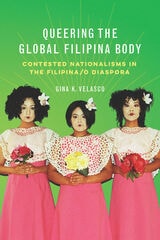
Queering the Global Filipina Body
Contested Nationalisms in the Filipina/o DiasporaGina K. Velasco
University of Illinois Press, 2020
Using a queer diasporic analysis, Velasco examines the politics of nationalism within Filipina/o American cultural production to consider an essential question: can a queer and feminist imagining of the diaspora reconcile with gendered tropes of the Philippine nation? Integrating a transnational feminist analysis of globalized gendered labor with a consideration of queer cultural politics, Velasco envisions forms of feminist and queer diasporic belonging, while simultaneously foregrounding nationalist movements as vital instruments of struggle.
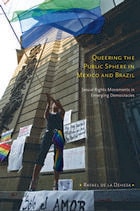
Queering the Public Sphere in Mexico and Brazil
Sexual Rights Movements in Emerging DemocraciesRafael de la Dehesa
Duke University Press, 2010
De la Dehesa studied the archives of activists, social-movement organizations, political parties, religious institutions, legislatures, and state agencies, and he interviewed hundreds of individuals, not only LGBT activists, but also feminists, AIDS and human-rights activists, party militants, journalists, academics, and state officials. He marshals his prodigious research to reveal the interplay between evolving representative institutions and LGBT activists’ entry into the political public sphere in Latin America, offering a critical analysis of the possibilities opened by emerging democratic arrangements, as well as their limitations. At the same time, exploring activists’ engagement with the international arena, he offers new insights into the diffusion and expression of transnational norms inscribing sexual rights within a broader project of liberal modernity. Queering the Public Sphere in Mexico and Brazil is a landmark examination of LGBT political mobilization.
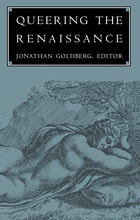
Queering the Renaissance
Jonathan Goldberg, ed.
Duke University Press, 1994
The presence of contemporary history can be felt throughout the volume, beginning with an investigation of the uses of Renaissance precedents in the 1986 U.S. Supreme Court decision Bowers v. Hardwick, to a piece on the foundations of 'our' national imaginary, and an afterword that addresses how identity politics has shaped the work of early modern historians. The volume examines canonical and noncanonical texts, including highly coded poems of the fifteenth-century Italian poet Burchiello, a tale from Marguerite de Navarre's Heptameron, and Erasmus's letters to a young male acolyte. English texts provide a central focus, including works by Spenser, Shakespeare, Bacon, Donne, Beaumont and Fletcher, Crashaw, and Dryden. Broad surveys of the complex terrains of friendship and sodomy are explored in one essay, while another offers a cross-cultural reading of the discursive sites of lesbian desire.
Contributors. Alan Bray, Marcie Frank, Carla Freccero, Jonathan Goldberg, Janet Halley, Graham Hammill, Margaret Hunt, Donald N. Mager, Jeff Masten, Elizabeth Pittenger, Richard Rambuss, Alan K. Smith, Dorothy Stephens, Forrest Tyler Stevens, Valerie Traub, Michael Warner
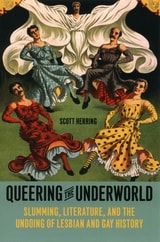
Queering the Underworld
Slumming, Literature, and the Undoing of Lesbian and Gay HistoryScott Herring
University of Chicago Press, 2007
In this major rethinking of American literature and culture, Scott Herring explores how a key group of authors manipulated this genre to paradoxically evade the confines of sexual identification. Queering the Underworld examines a range of writers, from Jane Addams and Willa Cather to Carl Van Vechten and Djuna Barnes, revealing how they fulfilled the conventions of slumming literature but undermined its goals, and in the process, queered the genre itself. Their work frustrated the reader’s desire for sexual knowledge, restored the inscrutability of sexual identity, and cast doubt on the value of a homosexual subculture made visible and therefore subject to official control.
Herring is persuasive and polemical in connecting these writers to ongoing debates about lesbian and gay history and politics, and Queering the Underworld will be widely read by students and scholars of literature, history, and sexuality.

Queerly Centered
LGBTQA Writing Center Directors Navigate the WorkplaceTravis Webster
Utah State University Press, 2021

Queers Read This!
LGBTQ Literature NowRamzi Fawaz and Shante Pradigm Smalls, special issue editors
Duke University Press, 2018
Contributors: Aliyyah Abdur-Rahman, Cynthia Barounis, Tyler Bradway, Ramzi Fawaz, Jennifer James, Martin Joseph Ponce, Natalie Prizel, Shanté Paradigm Smalls, Samuel Solomon.
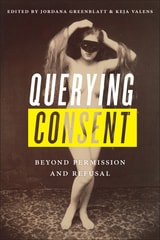
Querying Consent
Beyond Permission and RefusalJordana Greenblatt, Keja Valens
Rutgers University Press, 2018
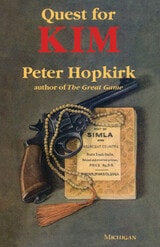
Quest for Kim
In Search of Kipling's Great GamePeter Hopkirk
University of Michigan Press, 1999
"This is a fascinating, brilliantly written book, as interesting in its description of the author's journeys as it is in its investigation of the reality that lies behind 'the finest novel in the English language with an Indian theme,'" as Kim has been described by Nirad Chaudhuri." --T. J. Binyon, Times Literary Supplement
"In an original combination of autobiography, travel writing, and literary detective work, Hopkirk manages accessibly to tell the story of Kim and his own obsession with it. Hopkirk illustrates how creatively and thoroughly the reading of a work of fiction can shape a whole life's experience." -- John R. Bradley, Independent on Sunday
". . . a reminder of just how absorbing was the world Kipling knew, and how fabulous was his transformation of it into literature." --Richard Bernstein, New York Times
Peter Hopkirk has traveled widely over many years in the regions where his books are set--Central Asia, Russia, China, India, Pakistan, and the Middle East. His nearly twenty years with The Times included work as an Asian affairs specialist. His previous books include The Great Game, Foreign Devils on the Silk Road, Trespassers on the Roof of the World, Setting the East Ablaze, and Our Secret Service East of Constantinople. His works have been translated into twelve languages.
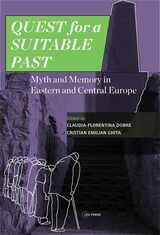
Quest for a Suitable Past
Myth and Memory in Central and Eastern EuropeLucian Boia
Central European University Press, 2017
Questioning Rebound
People and Environmental Change in the Protohistoric and Early Historic AmericasEmily Lena Jones and Jacob L. Fisher
University of Utah Press, 2022
The extent of human impact on world environments is undeniable. At scales ranging from local to global, investigations continue to demonstrate that the ecosystems to which we currently belong are structured by human behavior. Catastrophic events such as war, disaster, disease, or economic decay have, at various times throughout history, led to the human abandonment of particular environments. What happens to a human-structured environment when the manner in which people use it abruptly changes? In Questioning Rebound, authors Emily Lena Jones and Jacob L. Fisher explore the archaeological record of the Americas during the period immediately following European contact, a time when the human footprint on the land abruptly shifted. During this era of disease-driven mortality, genocide, incarceration, and forced labor of Indigenous peoples, American landscapes changed in fundamental ways, producing short-lived ecosystems that later became the basis of myths regarding the natural state of environments across the Americas.
Questioning Rebound explores the record and the causes of environmental change during the period following European contact, featuring case studies throughout the Americas. While both the record for and the apparent causes of the changes in the human footprint vary, the record of post- contact environmental change consistently reflects the impacts of past social upheaval.
Questioning Secularism
Islam, Sovereignty, and the Rule of Law in Modern EgyptHussein Ali Agrama
University of Chicago Press, 2012
Questioning the Super-Rich
Jennifer Smith Maguire and Paula Serafini, special issue editors
Duke University Press, 0
Contributors. Jonathan Beaverstock, Roger Burrows, Aeron Davis, Sarah Hall, Caroline Knowles, Jo Littler, Joanne Roberts, Elisabeth Schimpföss, Paula Serafini, Jennifer Smith Maguire
Questions About Questions
Inquiries into the Cognitive Bases of SurveysJudith M. Tanur
Russell Sage Foundation, 1992
Questions Of Modernity
Timothy Mitchell
University of Minnesota Press, 2000
Well-known contributors offer an illuminating look at how modernity develops in non-Western contexts.
Modernity has always laid claim to universal certainty—which meant assigning a different and lesser significance to anything deemed purely local, non-Western, or lacking a universal expression. This book makes those very non-Western, non-universal elements the tools for fashioning a more complex, rigorous, and multifaceted understanding of how the modern comes about. Focusing on the making of modernity outside the West, eight leading anthropologists, historians, and political theorists explore the production of new forms of politics, sensibility, temporality, and selfhood in locations ranging from nineteenth-century Bengal to contemporary Morocco.
Topics include the therapeutics of colonial medical practice, the multiple registers of popular film, television serials and their audiences, psychiatrists and their patients, the iconic figure of the young widow, and the emergence of new political forms beyond the grasp of civil society. Contributors: Lila Abu-Lughod, Columbia U; Dipesh Chakrabarty, U of Chicago; Partha Chatterjee, Centre for Studies in Social Sciences, Calcutta; Veena Das, U of Delhi; Nicholas B. Dirks, Columbia U; Stefania Pandolfo, UC Berkeley; and Gyan Prakash, Princeton U.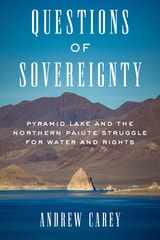
Questions of Sovereignty
Pyramid Lake and the Northern Paiute Struggle for Water and RightsAndrew W. Carey
University of Nevada Press, 2027
Questions of Sovereignty examines the enduring struggle of the Pyramid Lake Paiute Tribe to assert and exercise sovereignty in defense of its most sacred homeland: Pyramid Lake. At the center of this story is a century-long fight over water, law, and survival that reveals how Indigenous nations navigate a political landscape in which tribal sovereignty is both recognized and continually challenged.
Indian tribes retain inherent powers of self-governance, yet those powers are often tested when they conflict with powerful state, federal, and private interests. Using the Pyramid Lake Paiute experience as a case study, author Andrew W. Carey demonstrates how tribal sovereignty functions in practice.
At the heart of the narrative is water—the lifeblood of Pyramid Lake and the Truckee River system that feeds it. Decades of diversion and development left the lake in ecological and cultural crisis. As competing interests sought control of the region’s water, the tribe engaged in legal and political battles to secure the resources essential to its survival.
Spanning late twentieth-century litigation and negotiations into the twenty-first century, Questions of Sovereignty reveals how the Pyramid Lake Paiute Tribe used law, governance, and persistence to protect its homeland. In doing so, it offers a powerful example of Indigenous resilience and a deeper understanding of sovereignty as a living force shaping environmental justice and tribal self-determination.
Quetzalcoatl and the Irony of Empire
Myths and Prophecies in the Aztec TraditionDavid Carrasco
University of Chicago Press, 1992
"This book, rich in ideas, constituting a novel approach . . . represents a stimulating and provocative contribution to Mesoamerican studies. . . . Recommended to all serious students of the New World's most advanced indigenous civilization."—H. B. Nicholson, Man
Quetzalcoatl and the Irony of Empire
Myths and Prophecies in the Aztec Tradition, Revised EditionDavíd Carrasco
University Press of Colorado, 2000
- American Anthropologist
"A must for both professional and serious non-professional students in Mesoamerica. Those who are interested in complex society and urbanism in general, as well as students of comparative religion, will find it stimulating. Most importantly, for anyone interested in the history of ideas, the book illuminates the tremendously powerful impact and role of a complex deity/mythico-historical figure in shaping one of the world's great pristine civilizations."
- Queen's Quarterly
Quiché Rebelde
Religious Conversion, Politics, and Ethnic Identity in GuatemalaBy Ricardo Falla
University of Texas Press, 2001
Since the arrival of the Spanish in the sixteenth century, the Maya population of Guatemala has been forced to adapt to extraordinary challenges. Under colonial rule, the Indians had to adapt enough to satisfy the Spanish while resisting those changes not necessary for survival, applying their understanding of the world to the realities they confronted daily. Despite the major changes wrought in their way of life by centuries of submission, the Maya have managed to regenerate, and thus maintain, their self-identity.
Among the major challenges they have faced has been the imposition of outside religions. Quiché Rebelde examines what happened when Acción Católica came into the Guatemalan municipio of San Antonio Ilotenango, Quiché, to convert its inhabitants.
Ricardo Falla, a Guatemalan Jesuit priest and anthropologist, analyzes the movement's origins and why some people became part of it while others resisted. He shows how religion was used as another tool to readapt to the changing environment—natural, economic, political, and social. His work is the first major empirical study of how change occurred in a Maya community with no serious loss of Maya identity—and how the process of conversion is related to more general processes of cultural change that actually strengthen ethnic identity.
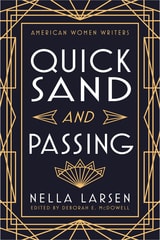
Quicksand and Passing
Larsen, Nella
Rutgers University Press, 1986
"Quicksand and Passing are novels I will never forget. They open up a whole world of experience and struggle that seemed to me, when I first read them years ago, absolutely absorbing, fascinating, and indispensable." —Alice Walker
"A tantalizing mix of moral fable and sensuous colorful narrative, exploring female sexuality and racial solidarity."—Women's Studies International Forum
Rutgers' all-time bestselling book, Nella Larsen's novels Quicksand (1928) and Passing (1929) document the historical realities of Harlem in the 1920s and shed a bright light on the social world of the black bourgeoisie. The novels' greatest appeal and achievement, however, is not sociological, but psychological. As noted in the editor's comprehensive introduction, Larsen takes the theme of psychic dualism, so popular in Harlem Renaissance fiction, to a higher and more complex level, displaying a sophisticated understanding and penetrating analysis of black female psychology.
Passing is now a major motion picture written, produced, and directed by Rebecca Hall. It premiered at Sundance in 2021 and is available on Netflix.
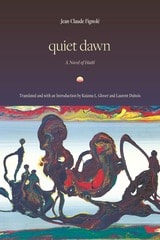
Quiet Dawn
Jean-Claude Fignolé. Translated and with an Introduction by Kaiama L. Glover and Laurent Dubois.
Duke University Press, 2025
Quiet Methodologies
Humility in the HumanitiesSuzanne Bost
University of Minnesota Press, 2025
Reimagining humanities scholarship with humility and inclusive attention
How might foregrounding the writings of colonized peoples transform the ways we work in the humanities? In an era dominated by loud political rhetoric, Suzanne Bost advocates for quieter modes of scholarship: intellectual humility rather than ego, collaboration and conversation rather than singular argumentation, continual reflection and revision rather than defensiveness, and a willingness to believe in different ways of being and knowing rather than adhering to academic norms. With Quiet Methodologies, she demonstrates practical decolonial scholarship and proposes alternative approaches for fostering meaningful engagement.
Turning to feminist, queer, and decolonial writings from Gloria Anzaldúa, Alexis Pauline Gumbs, Audre Lorde, and many others, Bost reflects on what we do when we work with literature, culture, and ideas. She weaves together multiple voices, methods of writing, and culturally diverse epistemologies and uses creative devices such as collage, her own original poetry, revision, lists, images, and conversation to disengage academic thought and writing from colonial theories and archives that have passed as neutral. Eschewing conventional monograph formats, her work embraces a reciprocal and heterogeneous learning process with profound ethical implications.
Part of a movement of reimagining research and education through care, Quiet Methodologies is a powerful exploration of the possibilities of criticism during crises. It encourages readers to be visionary and pragmatic, challenging current conditions and offering alternative ideas for the future of the humanities.
Retail e-book files for this title are screen-reader friendly with images accompanied by short alt text and/or extended descriptions.
Quiet Revolution
Struggle for the Democratic Party and the Shaping of Post-Reform PoliticsByron E. Shafer
Russell Sage Foundation, 1983

Quinceañera Style
Social Belonging and Latinx Consumer IdentitiesBy Rachel Valentina González
University of Texas Press, 2019
Winner of the Emily Toth Award for Best Single Work in Women's Studies, Popular Culture Association
Co-winner of the Elli Kongas Maranda Prize, Women's Section of the American Folklore Society (AFS)
A dynamic study of social negotiation and consumerism in the coming-of-age quinceañera celebration and the impact of normalizing spectacles of luxury.
Quinceañera celebrations, which recognize a girl’s transition to young womanhood at age fifteen, are practiced in Latinx communities throughout the Americas. But in the consumer-driven United States, the ritual has evolved from a largely religious ceremony to an elaborate party where social status takes center stage. Examining the many facets of this contemporary debut experience, Quinceañera Style reports on ethnographic fieldwork in California, Texas, the Midwest, and Mexico City to reveal a complex, compelling story. Along the way, we meet a self-identified transwoman who uses the quinceañera as an intellectual space in her activist performance art. We explore the economic empowerment of women who own barrio boutiques specializing in the quinceañera’s many accessories and made-in-China gowns. And, of course, we meet teens themselves, including a vlogger whose quince-planning tips have made her an online sensation.
Disrupting assumptions, such as the belief that Latino communities in the United States can’t desire upward mobility without abandoning ethnoracial cultural legacies, Quinceañera Style also underscores the performative nature of class and the process of constructing a self in the public, digital sphere.
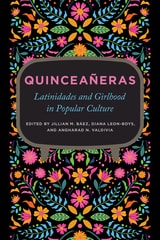
Quinceañeras
Latinidades and Girlhood in Popular CultureEdited by Jillian M. Báez, Diana Leon-Boys, and Angharad N. Valdivia
University of Illinois Press, 2026
Jillian M. Báez, Diana Leon-Boys, and Angharad N. Valdivia edit a collection that draws on the expanding field of girlhood studies to examine the increasing visibility of the event and the figure of the quinceañera herself in pop culture. The contributors focus on quinceañeras as a trope for English-language media’s treatment of Latina girlhoods and Latinx cultures but also examine how use of the quinceañera charts deepening openness and inclusivity within Latinx culture.
Timely and thought-provoking, Quinceañeras provides an interdisciplinary exploration of a celebration and its central figure within studies of Latina/o/x identity, race, class, gender, and sexuality.
Contributors: Sonya M. Alemán, Jillian M. Báez, Ariana A. Cano, Dolores Inés Casillas, Mari Castañeda, Michael Anthony DeAnda, Kelly Ferguson, Litzy Galarza, Rachel González-Martin, Jillian Hernandez, Karla Larrañaga, Diana Leon-Boys, Stephanie Melissa Pérez, Angharad N. Valdivia, and Claudia Evans-Zepeda
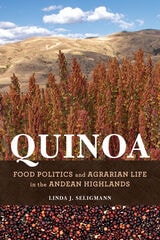
Quinoa
Food Politics and Agrarian Life in the Andean HighlandsLinda J. Seligmann
University of Illinois Press, 2023
The untold story behind the popular health food, Quinoa illuminates how Indigenous communities have engaged with the politics and policies surrounding their production of a traditional and minor crop that became a global foodstuff.
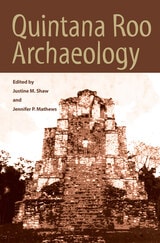
Quintana Roo Archaeology
Edited by Justine M. Shaw and Jennifer P. Mathews
University of Arizona Press, 2005
The first volume devoted to the archaeology of Quintana Roo, this book reveals a long tradition of exploration and discovery in the region and an increasingly rich recent history of study. Covering a time span from the Formative period through the early twentieth century, it offers a sampling of recent and ongoing research by Mexican, North American, and European archaeologists. Each of the chapters helps to integrate sites within and beyond the borders of the modern state, inviting readers to consider Quintana Roo as part of an interacting Maya world whose boundaries were entirely different from today’s. In taking in the range of the region, the authors consider studies in the northern part of the state resulting from modern development around Cancún; the mid-state sites of Muyil and Yo’okop, both of which witnessed continual occupations from the Middle Preclassic through the Postclassic; and new data from such southern sites as Cerros, Lagartera, and Chichmuul. The contributions consider such subjects as ceramic controversies, settlement shifts, site planning strategies, epigraphic and iconographic materials, the impact of recent coastal development, and the interplay between ancient, historic, and modern use of the region. Many of the chapters confirm the region as a cultural corridor between Cobá and the southern lowland centers and address demographic shifts of the Terminal Classic through Postclassic periods, while others help elucidate some of Peter Harrison’s Uaymil Survey work of the 1970s.
Quintana Roo Archaeology unfolds a rich archaeological record spanning 2,500 years, depicting the depth and breadth of modern archaeological studies within the state. It is an important touchstone for Maya and Mesoamerican archaeologists, demonstrating the shifting web of connections between Quintanarooense sites and their neighbors, and confirming the need to integrate this region into a broader understanding of the ancient Maya.
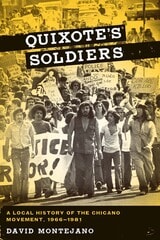
Quixote's Soldiers
A Local History of the Chicano Movement, 1966–1981By David Montejano
University of Texas Press, 2010