Results by title
63 books match the query '1835-1910' and 2 start with r
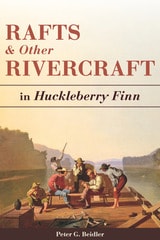
Rafts and Other Rivercraft
in Huckleberry FinnPeter G. Beidler
University of Missouri Press, 2018
The raft that carries Huck and Jim down the Mississippi River is often seen as a symbol of adventure and freedom, but the physical specifics of the raft itself are rarely considered. Peter Beidler shows that understanding the material world of Huckleberry Finn, its limitations and possibilities, is vital to truly understanding Mark Twain’s novel. He illustrates how experts on Twain’s works have misinterpreted important aspects of the story due to their unfamiliarity with the various rivercraft that figure in the book.
Huck and Jim’s little raft is not made of logs, as it is often depicted in illustrations, but of sawn planks, and it was originally part of a much larger raft. Beidler explains why this matters and describes the other rivercraft that appear in the book. He gives what will almost certainly be the last word on the vexed question of whether the lengthy “raft episode,” removed at the publisher’s suggestion from the novel, should be restored to its original place.
Huck and Jim’s little raft is not made of logs, as it is often depicted in illustrations, but of sawn planks, and it was originally part of a much larger raft. Beidler explains why this matters and describes the other rivercraft that appear in the book. He gives what will almost certainly be the last word on the vexed question of whether the lengthy “raft episode,” removed at the publisher’s suggestion from the novel, should be restored to its original place.
[more]
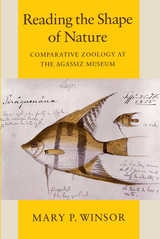
Reading the Shape of Nature
Comparative Zoology at the Agassiz MuseumMary P. Winsor
University of Chicago Press, 1991
Reading the Shape of Nature vividly recounts the turbulent early history of the Museum of Comparative Zoology at Harvard and the contrasting careers of its founder Louis Agassiz and his son Alexander. Through the story of this institution and the individuals who formed it, Mary P. Winsor explores the conflicting forces that shaped systematics in the second half of the nineteenth century. Debates over the philosophical foundations of classification, details of taxonomic research, the young institution's financial struggles, and the personalities of the men most deeply involved are all brought to life.
In 1859, Louis Agassiz established the Museum of Comparative Zoology to house research on the ideal types that he believed were embodied in all living forms. Agassiz's vision arose from his insistence that the order inherent in the diversity of life reflected divine creation, not organic evolution. But the mortar of the new museum had scarcely dried when Darwin's Origin was published. By Louis Agassiz's death in 1873, even his former students, including his son Alexander, had defected to the evolutionist camp. Alexander, a self-made millionaire, succeeded his father as director and introduced a significantly different agenda for the museum.
To trace Louis and Alexander's arguments and the style of science they established at the museum, Winsor uses many fascinating examples that even zoologists may find unfamiliar. The locus of all this activity, the museum building itself, tells its own story through a wonderful series of archival photographs.
[more]