Results by title
805 books match the query '18th Century' and 37 start with r
READING LONDON
URBAN SPECULATION AND IMAGINATIVE GOVERNMENT EIGHTEENTH-CENTURY LITERATUREERIK BOND
The Ohio State University Press, 2007
Rape Of Clarissa
Writing, Sexuality, and Class Struggle in Samuel RichardsonTerry Eagleton
University of Minnesota Press, 1982
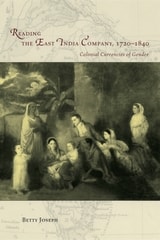
Reading the East India Company 1720-1840
Colonial Currencies of GenderBetty Joseph
University of Chicago Press, 2003
Drawing on the British East India Company's records as well as novels, memoirs, portraiture and guidebooks, Joseph shows how the company's economic and archival practices intersected to produce colonial "fictions" or "truth-effects" that strictly governed class and gender roles—in effect creating a "grammar of power" that kept the far-flung empire intact. And while women were often excluded from this archive, Joseph finds that we can still hear their voices at certain key historical junctures. Attending to these voices, Joseph illustrates how the writing of history belongs not only to the colonial project set forth by British men, but also to the agendas and mechanisms of agency—of colonized Indian, as well as European women. In the process, she makes a valuable and lasting contribution to gender studies, postcolonial theory, and the history of South Asia.
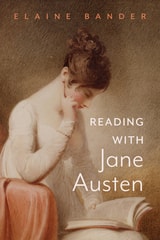
Reading with Jane Austen
Elaine Bander
Bucknell University Press, 2026
Jane Austen has more readers today than at any time in history. Many of Austen’s legions of fans, however, came to her novels after first seeing films or other adaptations made for twenty-first-century audiences. Austen herself conversely spent her literary career undermining romantic clichés and rethinking novel conventions. Confident that she and her contemporaries shared a common reading culture, Austen deliberately constructed her novels to set readerly expectations, only to disrupt or confound those expectations by challenging her readers’ assumptions and values. In Reading with Jane Austen, Elaine Bander carefully rereads the great author’s novels—beginning with her late work of juvenilia, “Catharine, or The Bower,” and ending with her final fragment, “Sanditon”—against the rich context of late Georgian literary and intellectual culture. In doing so, Bander invites us into the transformative experience that Austen intentionally designed for her earliest readers, adding new layers of appreciation for those who love her work.
Published by Bucknell University Press. Distributed worldwide by Rutgers University Press.
Elaine Bander speaking at the Atwater Library in Quebec (https://youtu.be/UeEjFOfp9cQ?si=Wv2hsLxkGK157WZI)
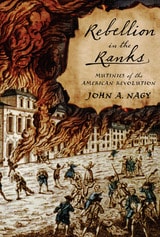
Rebellion in the Ranks
Mutinies of the American RevolutionJohn A. Nagy
Westholme Publishing, 2007
How General Washington Avoided the Peril From Within His Own Forces
"It gives me great pain to be obliged to solicit the attention of the honorable Congress to the state of the army...the greater part of the army is in a state not far from mutiny...I know not to whom to impute this failure, but I am of the opinion, if the evil is not immediately remedied and more punctuality observed in future, the army must absolutely break up."—George Washington, September 1775
Mutiny has always been a threat to the integrity of armies, particularly under trying circumstances, and since Concord and Lexington, mutiny had been the Continental Army's constant traveling companion. It was not because the soldiers lacked resolve to overturn British rule or had a lack of faith in their commanders. It was the scarcity of food—during winter months it was not uncommon for soldiers to subsist on a soup of melted snow, a few peas, and a scrap of fat—money, clothing, and proper shelter, that forced soldiers to desert or organize resistance. Mutiny was not a new concept for George Washington. During his service in the French and Indian War he had tried men under his command for the offense and he knew that disaffection and lack of morale in an army was a greater danger than an armed enemy.
In Rebellion in the Ranks: Mutinies of the American Revolution, John A. Nagy provides one of the most original and valuable contributions to American Revolutionary War history in recent times. Mining previously ignored British and American primary source documents and reexamining other period writings, Nagy has corrected misconceptions about known events, such as the Pennsylvania Line Mutiny, while identifying for the first time previously unknown mutinies. Covering both the army and the navy, Nagy relates American officers' constant struggle to keep up the morale of their troops, while highlighting British efforts to exploit this potentially fatal flaw.
Regulating Confusion
Samuel Johnson and the CrowdThomas Reinert
Duke University Press, 1996
Ambivalent about the disruption, confusion, perplexity, and boundless variety apparent in the London of his day, Johnson was committed to the conventions of moral reflection but also troubled by the pressure to adopt the perspective of the crowd and the language of social theory. Regulating Confusion explores the consequences of his ambivalence and his attempt to order the chaos. It discusses his critique of moral generalizations, concept of moral reflection as a symbolic gesture, and account of what happens to the notion of character when individuals, having lost the support of moral convention, become faces in a crowd. Reflecting generally on the relationship between skepticism and political ideology, Reinert also discusses Johnson’s political skepticism and the forms of speculation and action it authorized.
Challenging prevalent psychologizing and humanistic interpretations, Regulating Confusion leaves behind the re-emergent view of Johnson as a reactionary ideologue and presents him in a theoretically sophisticated context. It offers his style of skepticism as a model of poise in the face of confusion about the nature of political truth and personal responsibility and demonstrates his value as a resource for students of culture struggling with contemporary debates about the relationship between literature and politics.
Religious Liberty and the American Founding
Natural Rights and the Original Meanings of the First Amendment Religion ClausesVincent Phillip Muñoz
University of Chicago Press, 2022
The Founders understood religious liberty to be an inalienable natural right. Vincent Phillip Muñoz explains what this means for church-state constitutional law, uncovering what we can and cannot determine about the original meanings of the First Amendment’s Religion Clauses and constructing a natural rights jurisprudence of religious liberty.
Drawing on early state constitutions, declarations of religious freedom, Founding-era debates, and the First Amendment’s drafting record, Muñoz demonstrates that adherence to the Founders’ political philosophy would lead neither to consistently conservative nor consistently liberal results. Rather, adopting the Founders’ understanding would lead to a minimalist church-state jurisprudence that, in most cases, would return authority from the judiciary to the American people. Thorough and convincing, Religious Liberty and the American Founding is key reading for those seeking to understand the Founders’ political philosophy of religious freedom and the First Amendment Religion Clauses.
Republicanism, Religion, and the Soul of America
Ellis Sandoz
University of Missouri Press, 2006
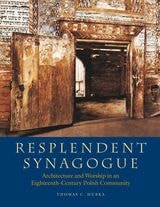
Resplendent Synagogue
Architecture and Worship in an Eighteenth-Century Polish CommunityThomas C. Hubka
Brandeis University Press, 2022
Thomas C. Hubka, an architectural historian, immersed himself in medieval and early modern Jewish history, religion, and culture to prepare for this remarkable study of the eighteenth-century Polish synagogue in the town of Gwozdziec, now in present-day Ukraine. Because the Gwozdziec Synagogue, like so many others, was destroyed by the Nazis, this book revives a spiritual community lost to history. Hubka selected the Gwozdziec Synagogue because of the completeness of its photographic and historical records. Graced with nearly two hundred historical photographs, architectural drawings, maps, diagrams, and color illustrations, Resplendent Synagogue vividly recreates the spiritual heart of a once-vibrant Jewish population. Hubka demonstrates that while the architectural exterior of the synagogue was largely the product of non-Jewish, regional influences, the interior design and elaborate wall-paintings signified a distinctly Jewish art form. The collaboration of Jewish and Gentile builders, craftsmen, and artists in the creation of this magnificent wooden structure attests to an eighteenth-century period of relative prosperity and communal well-being for the Jews of Gwozdziec. Part of a tradition that was later abandoned by Eastern European Jewish communities in the nineteenth and twentieth centuries, this truly resplendent synagogue exemplified a high point in Jewish architectural art and religious painting.
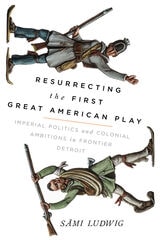
Resurrecting the First Great American Play
Imperial Politics and Colonial Ambitions in Frontier DetroitSämi Ludwig
University of Wisconsin Press, 2020
Sämi Ludwig contends that Ponteach's literary and artistic merits are worthy of further exploration. He investigates questions of authorship and analyzes the play's content, embracing its many contradictions as enriching windows into the era. In this way, he suggests using Ponteach as a tool to better understand British imperialism in North America and the emerging theatrical forms of the Young Republic.
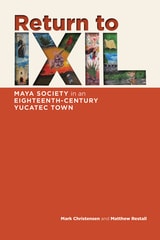
Return to Ixil
Maya Society in an Eighteenth-Century Yucatec TownMark Z. Christensen
University Press of Colorado, 2019
Supplemented with additional archival research, the wills provide new and detailed descriptions of various aspects of life in eighteenth-century Ixil. In each chapter, authors Mark Christensen and Matthew Restall examine a different dimension of Ixil’s colonial history, including the role of notaries, Maya participation in a coastal militia, economy and modes of production, religious life and records, and the structures and patterns of familial relationships. These details offer insight into the complex network of societies in colonial Yucatan, colonial Mesoamerica, and colonial Latin America.
Including an appendix presenting the original Maya texts as well as translations by Christensen and Restall, Return to Ixil not only analyzes the largest body of substantive wills in any Mayan language known today but also provides a rare closeup view of the inner workings of a colonial Maya town and the communal and familial affairs that made up a large part of the Maya colonial experience. It will be of great interest to Mayanists as well as to students and scholars of history, anthropology, ethnohistory, linguistics, and social history.
The publication of this book is supported in part byBrigham Young University and Penn State University.
Revisiting Richardson
Rebecca Anne Barr
Bucknell University Press, 2025
Published by Bucknell University Press. Distributed by Rutgers University Press.
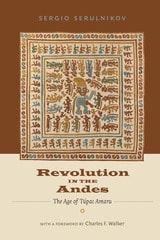
Revolution in the Andes
The Age of Túpac AmaruSergio Serulnikov
Duke University Press, 2013
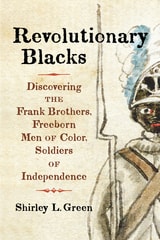
Revolutionary Blacks
Discovering the Frank Brothers, Freeborn Men of Color, Soldiers of IndependenceShirley L. Green
Westholme Publishing, 2026
In Revolutionary Blacks: Discovering the Frank Brothers, Freeborn Men of Color, Soldiers of Independence historian Shirley L. Green takes the reader on a journey based on her family’s history, rooted in its oral tradition. Putting together the pieces of this puzzle through archival research, interviews, and DNA evidence, the author authenticates and expands the family’s oral history. In addition to providing context and substance to the Black experience during the war years, the author underscores the significant distinction between free Blacks in military service and those who had been enslaved, and how they responded in different ways to the harsh realities of racism. An original and important contribution to American history, Revolutionary Blacks presents a complex account of Black life during the Revolutionary Era and demonstrates that free men of color shared with white soldiers the desire to improve their condition in life and to maintain their families safely in postcolonial North America.
Revolutionary News
The Press in France, 1789–1799Jeremy D. Popkin
Duke University Press, 1990
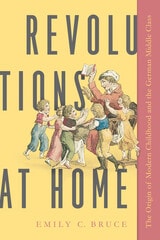
Revolutions at Home
The Origin of Modern Childhood and the German Middle ClassEmily C. Bruce
University of Massachusetts Press, 2021
Revolutions at Home analyzes a rich set of documents created for and by young Germans to show that children were central to reinventing their own education between 1770 and 1850. Through their reading and writing, they helped construct the modern child subject. The active child who emerged at this time was not simply a consequence of expanding literacy but, in fact, a key participant in defining modern life.
Rewriting Crusoe
The Robinsonade across Languages, Cultures, and MediaJakub Lipski
Bucknell University Press, 2020
Published by Bucknell University Press. Distributed worldwide by Rutgers University Press.
Rewriting the Mechanic
Text, Technology, and the Body in the Eighteenth CenturyEmily M. West
Bucknell University Press, 2027
In the eighteenth century, “technology” didn’t name a particular device or a process. It referred instead to written accounts of the mechanical arts, a now-obsolete category encompassing the wide range of work done by hand, from baking bread to building ships. Rewriting the Mechanic examines how these written descriptions, circulating across genres in eighteenth-century Britain, transformed certain mechanical arts by imagining them as newly innovative, authoritative, and able to make speculative possibilities real—as what we now call technological. Reversing the familiar story in which literature simply reflects technological change, West draws on the work of Robert Hooke, Aphra Behn, Daniel Defoe, Maria Edgeworth, and Jane Austen to demonstrate the influence of literary techniques on ideas about masculinity, power, and the body, and how these texts helped to bring the very idea of technological modernity into being.
Published by Bucknell University Press. Distributed worldwide by Rutgers University Press.
Rhetoric and the Republic
Politics, Civic Discourse, and Education in Early AmericaMark Garrett Longaker
University of Alabama Press, 2007
Rhetoric on the Margins of Modernity
Vico, Condillac, MonboddoCatherine L. Hobbs
Southern Illinois University Press, 2002
Changes in English studies today, particularly the rise of cultural studies, have forced reexaminations of historical genealogies. Three complex figures whose places are currently being reassessed include the Neapolitan Giambattista Vico (1668 –1744), the Frenchman Etienne de Condillac (1714 –1780), and the Scotsman James Burnet(t), Lord Monboddo (1714 –1799) in our histories of communication, linguistics, English studies, and now rhetoric.
In Rhetoric on the Margins of Modernity: Vico, Condillac, Monboddo, Catherine L. Hobbs focuses primarily on these three key figures in whose work rhetoric and linguistics intertwine as they respond to emerging attitudes and values of science and philosophy in the eighteenth century. Through her examination of works of Vico, Condillac, Monboddo and other marginal figures, Hobbs presents a different and more nuanced view of the transformation of rhetoric from classical to modern.
In order to redefine each figure’s position, Hobbs brings together the histories of linguistics, literature, rhetoric, and communication, rather than leaving them isolated in separate disciplines. She examines each figure’s theory of language origin and development as it has motivated their rhetorical theories. The result is Rhetoric on the Margins of Modernity: Vico, Condillac, Monboddo, an original and significant account of the formation of modern rhetoric.
Rhetoric, Independence, and Nationhood, 1760–1800, Volume II
Stephen E Lucas
Michigan State University Press, 2022

Rhythmic Gesture in Mozart
Le Nozze di Figaro and Don GiovanniWye Jamison Allanbrook
University of Chicago Press, 1984

Robert de Cotte and the Perfection of Architecture in Eighteenth-Century France
Robert Neuman
University of Chicago Press, 1994
After describing de Cotte's training and the professional context in which he worked, Neuman offers a thorough survey of de Cotte's output. For each commission, he recreates the actual design process, showing how de Cotte manipulated an accepted vocabulary of architectural forms to meet the patron's specific requirements. De Cotte's own drawings, many reproduced here for the first time, and quotations from a wide variety of contemporary writings vividly supplement the case histories. Beautifully illustrated, Neuman's much-needed book reveals de Cotte as an innovative and strikingly modern architect.
Robinson Crusoe after 300 Years
Andreas K. E. Mueller
Bucknell University Press, 2021
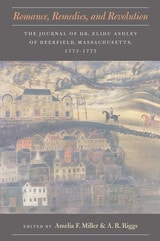
Romance, Remedies, and Revolution
The Journal of Dr. Elihu Ashley of Deerfield, Massachusetts, 1773-1775Edited by Amelia F. Miller and A. R. Riggs
University of Massachusetts Press, 2007
With flashes of humor and close attention to detail, Ashley describes a broad range of activities and experiences in the small village of Deerfield and the surrounding towns of the Connecticut River valley. Articulate as well as observant, this former schoolteacher conveys a sense of immediacy that brings even the most mundane daily events to life. He discusses medical theory and practice, revolutionary politics, farming, his family, his circle of friends, and amusements ranging from singing and dancing to sleigh riding and bouts of drunkenness. He also writes about his love life, including a dalliance with the older sister of his fiancee, Polly Williams, while the latter is away visiting relatives in the Berkshires.
For Ashley, personal relationships and politics were the prominent issues of 1773 and 1774, as events in Massachusetts drew the province toward rebellion. He discusses the gathering of angry mobs in response to the so-called Intolerable Acts, the stoppage of the courts in Hampshire County, the anarchy that ensued, and the persecution of loyalists, with or without the sanction of law. When the revolution breaks out in April 1775, he describes the departure of companies of minutemen as they set out for Boston to challenge the British Army.
Six months later, in November 1775, the journal abruptly ends. By then, however, Elihu Ashley had already bequeathed to posterity an extraordinary firsthand account of life in rural New England in the years immediately preceding the War of Independence.
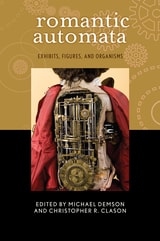
Romantic Automata
Exhibitions, Figures, OrganismsMichael Demson
Bucknell University Press, 2020
Recent scholarship in post-humanism, post-colonialism, disability studies, post-modern feminism, eco-criticism, and radical Orientalism has significantly affected the critical discourse on this topic. In engaging with the work and thought of Coleridge, Poe, Hoffmann, Mary Shelley, and other Romantic luminaries, the contributors to this collection open new methodological approaches to understanding human interaction with technology that strives to simulate, supplement, or supplant organic life.
Published by Bucknell University Press. Distributed worldwide by Rutgers University Press.
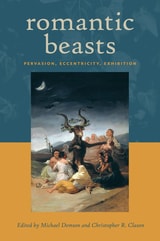
Romantic Beasts
Pervasion, Eccentricity, ExhibitionMichael Demson
Bucknell University Press, 2025
Published by Bucknell University Press. Distributed worldwide by Rutgers University Press.

Romantic Globalism
British Literature and Modern World Order, 1750–1830Evan Gottlieb
The Ohio State University Press, 2014
Although modern media tend to represent globalization as an essentially contemporary phenomenon, many scholars now agree that its fundamental dynamics—especially its characteristic annulment of spatial and temporal differences—have been present for several centuries. Moreover, the last decades of the eighteenth century and the first of the nineteenth century saw the convergence of a number of world-changing socio-political developments in the Western world. Romantic Globalism is significant because it is the first extended scholarly study that brings together these lines of inquiry. In so doing, Romantic Globalism not only charts a new course of study for British Romanticism but also suggests how the Romantics’ visions of globality might still be valuable to us today.
Romantic Women Writers
Voices and CountervoicesPaula R. Feldman and Theresa M. Kelley
Brandeis University Press, 1995
Romanticism’s Other Minds
Poetry, Cognition, and the Science of SociabilityJohn Savarese
The Ohio State University Press, 2020
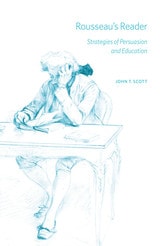
Rousseau's Reader
Strategies of Persuasion and EducationJohn T. Scott
University of Chicago Press, 2020
In Rousseau’s Reader, John T. Scott looks at the different strategies Rousseau used to engage and persuade the readers of his major philosophical works, including the Social Contract, Discourse on Inequality, and Emile. Considering choice of genre; textual structure; frontispieces and illustrations; shifting authorial and narrative voice; addresses to readers that alternately invite and challenge; apostrophe, metaphor, and other literary devices; and, of course, paradox, Scott explores how the form of Rousseau’s writing relates to the content of his thought and vice versa. Through this skillful interplay of form and content, Rousseau engages in a profoundly transformative dialogue with his readers.
While most political philosophers have focused, understandably, on Rousseau’s ideas, Scott shows convincingly that the way he conveyed them is also of vital importance, especially given Rousseau’s enduring interest in education. Giving readers the key to Rousseau’s style, Scott offers fresh and original insights into the relationship between the substance of his thought and his literary and rhetorical techniques, which enhance our understanding of Rousseau’s project and the audiences he intended to reach.
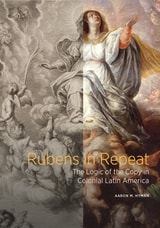
Rubens in Repeat
The Logic of the Copy in Colonial Latin AmericaAaron M. Hyman
J. Paul Getty Trust, The, 2021
Winner of the Latin American Studies Association's 2022 Best Book in Colonial Latin American Studies.
This book examines the reception in Latin America of prints designed by the Flemish artist Peter Paul Rubens, showing how colonial artists used such designs to create all manner of artworks and, in the process, forged new frameworks for artistic creativity.
Peter Paul Rubens (1577–1640) never crossed the Atlantic himself, but his impact in colonial Latin America was profound. Prints made after the Flemish artist’s designs were routinely sent from Europe to the Spanish Americas, where artists used them to make all manner of objects.
Rubens in Repeat is the first comprehensive study of this transatlantic phenomenon, despite broad recognition that it was one of the most important forces to shape the artistic landscapes of the region. Copying, particularly in colonial contexts, has traditionally held negative implications that have discouraged its serious exploration. Yet analyzing the interpretation of printed sources and recontextualizing the resulting works within period discourse and their original spaces of display allow a new critical reassessment of this broad category of art produced in colonial Latin America—art that has all too easily been dismissed as derivative and thus unworthy of sustained interest and investigation. This book takes a new approach to the paradigms of artistic authorship that emerged alongside these complex creative responses, focusing on the viceroyalties of New Spain and Peru in the seventeenth and eighteenth centuries. It argues that the use of European prints was an essential component of the very framework in which colonial artists forged ideas about what it meant to be a creator.
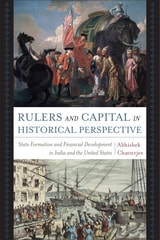
Rulers and Capital in Historical Perspective
State Formation and Financial Development in India and the United StatesAbhishek Chatterjee
Temple University Press, 2017
Rulers and Capital in Historical Perspective explains why modern banking and credit systems emerged in the nineteenth century only in certain countries that then subsequently industrialized and became developed.
Tracing the contemporaneous cases of India and the United States over time, Abhishek Chatterjee identifies the factors that were crucial to the development and regulation of a modern banking and credit system in the United States during the first third of the nineteenth century. He contrasts this situation with India’s, where the state never formally incorporated a sophisticated private credit system, and thus relegated it to the sphere of the informal economy.
Chatterjee identifies certain features in both societies, often—though not always—associated with colonialism, that tended to restrict the formation of modern institutionalized money and credit markets. Rulers and Capital in Historical Perspective demonstrates thatnotwithstanding the many other differences between the North American colonies (prior to independence), and India, the same facets of their relationships with Great Britain prevented the emergence of a modern banking system in the two respective societies.
Russia Reads Rousseau, 1762-1825
Thomas Barran
Northwestern University Press, 2002

Russia and Iran, 1780-1828
Muriel Atkin
University of Minnesota Press, 1980
Russia and Iran, 1780–1828 was first published in 1980. Minnesota Archive Editions uses digital technology to make long-unavailable books once again accessible, and are published unaltered from the original University of Minnesota Press editions.
Modern Russo-Iranian relations date from the late eighteenth century, when after several centuries of commercial and diplomatic contact, the two nations entered a period of extended warfare for possession of the Caucasian borderlands, disputed territory that eventually fell to Russia. In her history of that struggle, Muriel Atkin reasseses the motives of major figures on both sides and views the Iranians with more sympathy than Western and Russian historians have usually accorded them. Russia embarked on her course in the Caucasus for reasons connected with defense or trade, and with a longterm imperial goal based on uncritical acceptance of prevailing European doctrines of empire. The new dynasty in Iran, on the other hand, had to fend off Russian attack and secure the borderlands in order to justify its basic claim to power. In the end, the wars brought major disruption to the already unstable borderlands, and left Iran with a discredited government and a controversy over reforms and relations with the West that would continue to cause turmoil in subsequent generations.
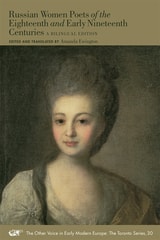
Russian Women Poets of the Eighteenth and Early Nineteenth Centuries
A Bilingual EditionEdited and Translated by Amanda Ewington
Iter Press, 2014
—Marcus C. Levitt
Professor, Department of Slavic Languages, University of Southern California

Russians in Alaska
1732-1867Lydia Black
University of Alaska Press, 2004
Black's work challenges the standard perspective on the Russian period in Alaska as a time of unbridled exploitation of Native inhabitants and natural resources. Without glossing over the harsher aspects of the period, Black acknowledges the complexity of relations between Russians and Native peoples.
She chronicles the lives of ordinary men and women, the merchants and naval officers, laborers and clergy, who established Russian outposts in Alaska. These early colonists carried with them the Orthodox faith and the Russian language; their legacy endures in architecture and place names from Baranof Island to the Pribilofs.
This deluxe volume features fold-out maps and color illustrations of rare paintings and sketches from Russian, American, Japanese, and European sources, many have never before been published. An invaluable source for historians and anthropologists, this accessible volume brings to life a dynamic period in Russian and Alaskan history. A tribute to Black's life as a scholar and educator, Russians in Alaska will become a classic in the field.