Results by title
1713 books match the query '21st Century' and 83 start with r
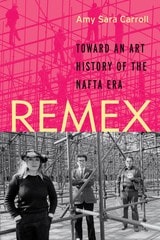
REMEX
Toward an Art History of the NAFTA EraBy Amy Sara Carroll
University of Texas Press, 2017
REMEX presents the first comprehensive examination of artistic responses and contributions to an era defined by the North American Free Trade Agreement (1994–2008). Marshaling over a decade’s worth of archival research, interviews, and participant observation in Mexico City and the Mexico–US borderlands, Amy Sara Carroll considers individual and collective art practices, recasting NAFTA as the most fantastical inter-American allegory of the turn of the millennium. Carroll organizes her interpretations of performance, installation, documentary film, built environment, and body, conceptual, and Internet art around three key coordinates—City, Woman, and Border. She links the rise of 1990s Mexico City art in the global market to the period’s consolidation of Mexico–US border art as a genre. She then interrupts this transnational art history with a sustained analysis of chilanga and Chicana artists’ remapping of the figure of Mexico as Woman.
A tour de force that depicts a feedback loop of art and public policy—what Carroll terms the “allegorical performative”—REMEX adds context to the long-term effects of the post-1968 intersection of D.F. performance and conceptualism, centralizes women artists’ embodied critiques of national and global master narratives, and tracks post-1984 border art’s “undocumentation” of racialized and sexualized reconfigurations of North American labor pools. The book’s featured artwork becomes the lens through which Carroll rereads a range of events and phenomenon from California’s Proposition 187 to Zapatismo, US immigration policy, 9/11 (1973/2001), femicide in Ciudad Juárez, and Mexico’s war on drugs.
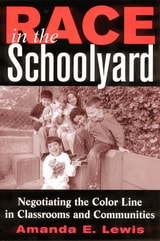
Race in the Schoolyard
Negotiating the Color Line in Classrooms and CommunitiesLewis, Amanda E
Rutgers University Press, 2003
"Race in the Schoolyard is a wonderful book for social scientists studying race, education, and childhood studies. The book showcases the talents of a gifted fieldworker whose theoretically rich work sits on the cutting edge of a growing body of scholarship examining the social worlds of children. School officials, parents, and, most especially, a new generation of teachers will benefit from these lessons on race."-American Journal of Sociology
"Instructors may recommend this book to students to whom the topic is surely vital and engrossing and for whom the text will be lively and engaging."-Contemporary Sociology
"Lewis moves beyond traditional research methods used to examine achievement gaps and differences in test scores to look closely at the realities of schooling. I highly recommend this work for every person involved in teaching and learning."-Multicultural Review
"Through eloquent case studies of three California elementary schools-a white-majority 'good' school, a mostly minority 'tough' school, and an integrated 'alternative' school-[Lewis] demonstrates that schools promote racial inequalities through their daily rituals and practices. Even the notion of a "color-blind" America-an especially popular ideal in the white school-perpetuates racism, Lewis argues, because it denies or dismisses the very real constraints that schools place on minorities. Lewis is nevertheless an optimist, insisting that schools can change ideas of race. . . . Highly recommended. Undergraduate collections and above."-Choice
"In this pioneering ethnography in elementary schools, Lewis shows brilliantly how racism is taught and learned in the small places of everyday life."-Joe Feagin, University of Florida and author of Racist America
"A wonderful and timely book. Ethnographically rich, theoretically sophisticated, and clearly written, this book addresses the ubiquitous issue of race in all its complexity."-Michèle Foster, author of Black Teachers on Teaching
"A compelling ethnography of the racial landscape of contemporary schools."-Barrie Thorne, author of Gender Play: Girls and Boys in School
Could your kids be learning a fourth R at school: reading, writing, 'rithmatic, and race?
Race in the Schoolyard takes us to a place most of us seldom get to see in action¾ our children's classrooms¾ and reveals the lessons about race that are communicated there. Amanda E. Lewis spent a year observing classes at three elementary schools, two multiracial urban and one white suburban. While race of course is not officially taught like multiplication and punctuation, she finds that it nonetheless insinuates itself into everyday life in schools.
Lewis explains how the curriculum, both expressed and hidden, conveys many racial lessons. While teachers and other school community members verbally deny the salience of race, she illustrates how it does influence the way they understand the world, interact with each other, and teach children. This eye-opening text is important reading for educators, parents, and scholars alike.
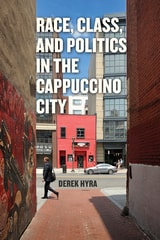
Race, Class, and Politics in the Cappuccino City
Derek S. Hyra
University of Chicago Press, 2017
Race, Class, and Politics in the Cappuccino City is an in-depth ethnography of this gilded ghetto. Derek S. Hyra captures here a quickly gentrifying space in which long-time black residents are joined, and variously displaced, by an influx of young, white, relatively wealthy, and/or gay professionals who, in part as a result of global economic forces and the recent development of central business districts, have returned to the cities earlier generations fled decades ago. As a result, America is witnessing the emergence of what Hyra calls “cappuccino cities.” A cappuccino has essentially the same ingredients as a cup of coffee with milk, but is considered upscale, and is double the price. In Hyra’s cappuccino city, the black inner-city neighborhood undergoes enormous transformations and becomes racially “lighter” and more expensive by the year.
Race, Ethnicity, and Economic Statistics for the 21st Century
Edited by Randall Akee, Lawrence F. Katz, and Mark A. Loewenstein
University of Chicago Press, 2026
Categorizing race and ethnicity for twenty-first-century statistics and economics.
The increasing racial and ethnic diversity of the US population raises the question of whether the race and ethnicity categories and definitions used by federal statistical agencies to create demographic statistics on which government officials, business decision-makers, and private citizens rely fully reflect the changing population. Official definitions of existing race and ethnic groups do not always command wide agreement, and over time, some definitions that were once widely accepted may become less so based on political, legal, and social factors. Comparable measures of race and ethnicity over time are needed to accurately track historical changes in economic and social outcomes, as well as racial and ethnic segregation.
This volume explores the production of economic statistics that accurately depict the complex racial and ethnic diversity of the US population in the twenty-first century. The chapters examine the consequences for economic analyses of different measurement choices concerning race and ethnicity, assess the likely implications of the 2024 changes in federal race and ethnicity measurement standards, introduce new data sets with richer demographic information, and compare measures of race and ethnicity in administrative versus survey data. They also apply existing data in creative ways to develop alternative characterizations of the changing US workforce and to illuminate important policy questions related to criminal justice, immigration, labor market discrimination, the social safety net, health care, and child welfare.

Radiation Brain Moms and Citizen Scientists
The Gender Politics of Food Contamination after FukushimaAya Hirata Kimura
Duke University Press, 2016
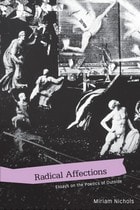
Radical Affections
Essays on the Poetics of OutsideMiriam Nichols
University of Alabama Press, 2011
In 1950 the poet Charles Olson published his influential essay “Projective Verse” in which he proposed a poetry of “open field” composition—to replace traditional closed poetic forms with improvised forms that would reflect exactly the content of the poem.
The poets and poetry that have followed in the wake of the “projectivist” movement—the Black Mountain group, the New York School, the San Francisco Renaissance, and the Language poets—have since been studied at length. But more often than not they have been studied through the lens of continental theory with the effect that these highly propositional, pragmatic, and adaptable forms of verse were interpreted in very cramped, polemical ways.
Miriam Nichols highlights many of the impulses original to the thinking and methods of each poet: appeals to perceptual experience, spontaneity, renewed relationships with nature, engaging the felt world—what Nichols terms a “poetics of outside”—focusing squarely on experiences beyond the self-regarding self. As Nichols states, these poets may well “represent the last moment in recent cultural history when a serious poet could write from perception or pursue a visionary poetics without irony or quotation marks and expect serious intellectual attention.”
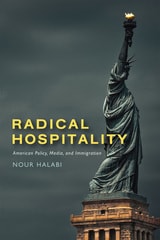
Radical Hospitality
American Policy, Media, and ImmigrationNour Halabi
Rutgers University Press, 2022
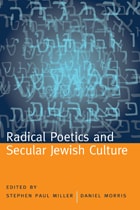
Radical Poetics and Secular Jewish Culture
Edited by Stephen Paul Miller and Daniel Morris
University of Alabama Press, 2009
--Franz Kafka
Kafka's quip--paradoxical, self-questioning, ironic--highlights vividly some of the key issues of identity and self-representation for Jewish writers in the 20th century. No group of writers better represents the problems of Jewish identity than Jewish poets writing in the American modernist tradition--specifically secular Jews: those disdainful or suspicious of organized religion, yet forever shaped by those traditions.
This collection of essays is the first to address this often obscured dimension of modern and contemporary poetry: the secular Jewish dimension. Editors Daniel Morris and Stephen Paul Miller asked their contributors to address what constitutes radical poetry written by Jews defined as "secular," and whether or not there is a Jewish component or dimension to radical and modernist poetic practice in general. These poets and critics address these questions by exploring the legacy of those poets who preceded and influenced them--Stein, Zukofsky, Reznikoff, Oppen, and Ginsberg, among others.
While there is no easy answer for these writers about what it means to be a Jew, in their responses there is a rich sense of how being Jewish reflects on their aesthetics and practices as poets, and how the tradition of the avant-garde informs their identities as Jews. Fragmented identities, irony, skepticism, a sense of self as "other" or "outsider," distrust of the literal, and belief in a tradition that questions rather than answers--these are some of the qualities these poets see as common to themselves, the poetry they make, and the tradition they work within.
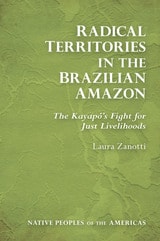
Radical Territories in the Brazilian Amazon
The Kayapó’s Fight for Just LivelihoodsLaura Zanotti
University of Arizona Press, 2016
Radical Territories in the Brazilian Amazon sheds light on the creative and groundbreaking efforts Kayapó peoples deploy to protect their lands and livelihoods. Now at the front lines of cultivating diversified strategies for resistance, the Kayapó are creating a powerful activist base, experimenting with nontimber forest projects, and forging strong community conservation partnerships. Tracing the complex politics of the Kayapó’s homeland, Laura Zanotti advances approaches to understanding how indigenous peoples cultivate self-determination strategies in conflict-ridden landscapes.
Kayapó peoples are providing a countervision of what Amazonia can look like in the twenty-first century, dominated neither by agro-industrial interests nor by uninhabited protected landscapes. Instead, Kayapó peoples see their homeland as a living landscape where indigenous vision engages with broader claims for conservation and development in the region.
Weaving together anthropological and ethnographic research with personal interactions with the Kayapó, Zanotti tells the story of activism and justice in the Brazilian Amazon, and how Kayapó communities are using diverse pathways to make a sustainable future for their peoples and lands. The author interweaves Kayapó perspectives with a political ecology framework to show how working with indigenous peoples is vital to addressing national and global challenges in the present time, when many environmentally significant conditions and processes are profoundly altered by human activities.

Raising Your Kids Right
Children's Literature and American Political ConservatismAbate, Michelle Ann
Rutgers University Press, 2011
Highlighting the works of William Bennett, Lynne Cheney, Bill O'Reilly, and others, Michelle Ann Abate brings together such diverse fields as cultural studies, literary criticism, political science, childhood studies, brand marketing, and the cult of celebrity. Raising Your Kids Right dispels lingering societal attitudes that narratives for young readers are unworthy of serious political study by examining a variety of texts that offer information, ideology, and even instructions on how to raise kids right, not just figuratively but politically.
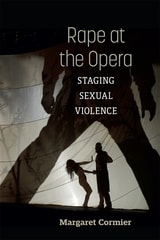
Rape at the Opera
Staging Sexual ViolenceMargaret Cormier
University of Michigan Press, 2024
Drawing on archival footage as well as attendance at live events, Cormier analyzes productions of canonic operas from German, Italian, and French traditions from the eighteenth to the early twentieth century, including Die Entführung aus dem Serail, Don Giovanni, La forza del destino, Un ballo in maschera, Salome, and Turandot. In doing so, Cormier highlights the dynamism of twenty-first-century opera performance practice with regard to sexual violence, establishes methods to evaluate representations of sexual violence on the opera stage, and reframes the primary responsibility of opera critics and creators as being not to opera composers and librettists but to the public.
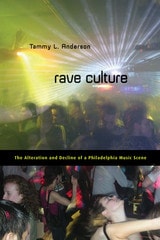
Rave Culture
The Alteration and Decline of a Philadelphia Music SceneTammy L. Anderson
Temple University Press, 2009
It used to be that raves were grassroots organized, anti-establishment, unlicensed all-night drug-fueled dance parties held in abandoned warehouses or an open field. These days, you pay $40 for a branded party at popular riverfront nightclubs where age and status, rather than DJ expertise and dancing, shape your experience.
In Rave Culture, sociologist Tammy Anderson explores the dance music, drug use and social deviance that are part of the pulsing dynamics of this collective. Her ethnographic study compares the Philadelphia rave scene with other rave scenes in London and Ibiza. She chronicles how generational change, commercialization, law enforcement, hedonism, and genre fragmentation fundamentally altered electronic dance music parties. Her analysis calls attention to issues of personal and collective identity in helping to explain such social change and what the decline of the rave scene means for the future of youth culture and electronic dance music.
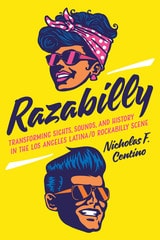
Razabilly
Transforming Sights, Sounds, and History in the Los Angeles Latina/o Rockabilly SceneBy Nicholas F. Centino
University of Texas Press, 2021
Vocals tinged with pain and desperation. The deep thuds of an upright bass. Women with short bangs and men in cuffed jeans. These elements and others are the unmistakable signatures of rockabilly, a musical genre normally associated with white male musicians of the 1950s. But in Los Angeles today, rockabilly's primary producers and consumers are Latinos and Latinas. Why are these "Razabillies" partaking in a visibly "un-Latino" subculture that's thought of as a white person's fixation everywhere else?
As a Los Angeles Rockabilly insider, Nicholas F. Centino is the right person to answer this question. Pairing a decade of participant observation with interviews and historical research, Centino explores the reasons behind a Rockabilly renaissance in 1990s Los Angeles and demonstrates how, as a form of working-class leisure, this scene provides Razabillies with spaces of respite and conviviality within the alienating landscape of the urban metropolis. A nuanced account revealing how and why Los Angeles Latinas/os have turned to and transformed the music and aesthetic style of 1950s rockabilly, Razabilly offers rare insight into this musical subculture, its place in rock and roll history, and its passionate practitioners.
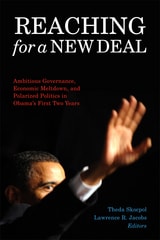
Reaching for a New Deal
Ambitious Governance, Economic Meltdown, and Polarized Politics in Obama's First Two YearsTheda Skocpol
Russell Sage Foundation, 2011
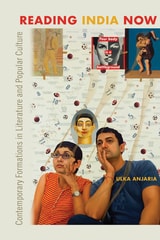
Reading India Now
Contemporary Formations in Literature and Popular CultureUlka Anjaria
Temple University Press, 2019
In an age of social media and reality television, reading and consumption habits in India now demand homegrown pulp fictions. Ulka Anjaria categorizes post-2000 Indian literature and popular culture as constituting “the contemporary,” a movement defined by new and experimental forms—where high- and low-brow meet, and genres break down.
Reading India Now studies the implications of this developing trend as both the right-wing resurges and marginalized voices find expression. Anjaria explores the fiction of Chetan Bhagat and Anuja Chauhan as well as Aamir Khan’s television talk show, Satyamev Jayate, plus the work of documentarian Paromita Vohra, to argue how different kinds of texts are involved in imagining new political futures for an India in transition. Contemporary literature and popular culture in India might seem artless and capitalistic, but it is precisely its openness to the world outside that allows these new works to offer significant insight into the experiences and sensibilities of contemporary India.
Reading Relations
How Authors Enter Our LivesDixon, Dan
University of Iowa Press, 2026
Drawing on the ordinary language philosophy of Toril Moi and Stanley Cavell, Dan Dixon argues that the act of reading shares emotional ground with our social lives. It prompts us to attend to the kinds of affective attachments that frequently resist description, as well as the attachments that encourage debate among scholars of literature.
Dixon posits that the interpretation of a text is significantly shaped by our impression of the writer. Through the lens of persona, this book examines the work of influential and iconic post-1945 American essayists, such as Joan Didion, Maggie Nelson, James Baldwin, Janet Malcolm, Teju Cole, David Foster Wallace, and Ben Lerner. The attachments we form might facilitate insight, consolation, distrust, or vanity. But whatever their effects, they can’t be ignored.
Reading for the Planet
Toward a GeomethodologyChristian Moraru
University of Michigan Press, 2015
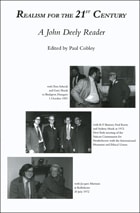
Realism for the 21st Century
A John Deely ReaderJohn Deely
University of Scranton Press, 2009
Realism for the 21st Century is a collection of thirty essays from John Deely—a major figure in contemporary semiotics and an authority on scholastic realism and the works of Charles Sanders Peirce. The volume tracks Deely’s development as a pragmatic realist, featuring his early essays on our relation to the world after Darwinism; crucial articles on logic, semiotics, and objectivity; overviews of philosophy after modernity; and a new essay on “purely objective reality.”
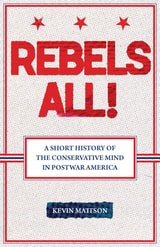
Rebels All!
Rebels All! A Short History of the Conservative Mind in Postwar AmericaMattson, Kevin
Rutgers University Press, 2008
Outstanding Academic Title of 2008
Do you ever wonder why conservative pundits drop the word “faggot” or talk about killing and then Christianizing Muslims abroad? Do you wonder why the right’s spokespeople seem so confrontational, rude, and over-the-top recently? Does it seem strange that conservative books have such apocalyptic titles? Do you marvel at why conservative writers trumpeted the “rebel” qualities of George W. Bush just a few years back?
There is no doubt that the style of the political right today is tough, brash, and by many accounts, not very conservative sounding. After all, isn’t conservatism supposed to be about maintaining standards, upholding civility, and frowning upon rebellion? Historian Kevin Mattson explains the apparent contradictions of the party in this fresh examination of the postwar conservative mind. Examining a big cast of characters that includes William F. Buckley, Whittaker Chambers, Norman Podhoretz, Irving Kristol, Kevin Phillips, David Brooks, and others, Mattson shows how right-wing intellectuals have always, but in different ways, played to the populist and rowdy tendencies in America’s political culture. He boldly compares the conservative intellectual movement to the radical utopians among the New Left of the 1960s and he explains how conservatism has ingested central features of American culture, including a distrust of sophistication and intellectualism and a love of popular culture, sensation, shock, and celebrity.
Both a work of history and political criticism, Rebels All! shows how the conservative mind made itself appealing, but also points to its endemic problems. Mattson’s conclusion outlines how a recast liberalism should respond to the conservative ascendancy that has marked our politics for the last thirty years.

Rebels and Outliers
Real Stories of the American WestJohn M Glionna
University of Nevada Press, 2025
This vibrant collection invites readers to journey through the rugged landscapes and tight-knit communities that define the American West. Along the way, you’ll meet individuals whose grit, resilience, and pioneering spirit embody the heart of this region’s legacy.
A captivating follow-up to Glionna’s 2022 book, Outback Nevada: Real Stories of the Silver State, Rebels and Outliers is a testament to the untamed, enduring character of the people who call the West home.
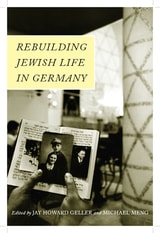
Rebuilding Jewish Life in Germany
Jay Howard Geller
Rutgers University Press, 2020
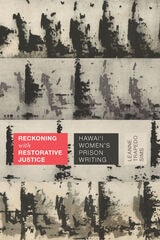
Reckoning with Restorative Justice
Hawai'i Women's Prison WritingLeanne Trapedo Sims
Duke University Press, 2023
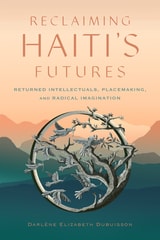
Reclaiming Haiti's Futures
Returned Intellectuals, Placemaking, and Radical ImaginationDarlène Elizabeth Dubuisson
Rutgers University Press, 2025
Winner of the 2024 Annual Book Award from the Society for Latin American and Caribbean Anthropology (SLACA)
Co-winner of the Isis Duarte Book Prize from the Latin American Studies Association
Haiti was once a beacon of Black liberatory futures, but now it is often depicted as a place with no future where emigration is the only way out for most of its population. But Reclaiming Haiti's Futures tells a different story. It is a story about two generations of Haitian scholars who returned home after particular crises to partake in social change. The first generation, called jenerasyon 86, were intellectuals who fled Haiti during the Duvalier dictatorship (1957–1986). They returned after the regime fell to participate in the democratic transition through their political leadership and activism. The younger generation, dubbed the jenn doktè, returned after the 2010 earthquake to partake in national reconstruction through public higher education reform. An ethnography of the future, the book explores how these returned scholars resisted coloniality's fractures and displacements by working toward and creating inhabitability or future-oriented places of belonging through improvisation, rasanblaj (assembly), and radical imagination. By centering on Haiti and the Caribbean, the book offers insights not just into the Haitian experience but also into how fractures have come to typify more aspects of life globally and what we might do about it.
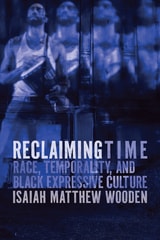
Reclaiming Time
Race, Temporality, and Black Expressive CultureIsaiah Matthew Wooden
Northwestern University Press, 2025
Showing how twenty-first-century Black theater and media arts challenge dominant conceptualizations of time
Reclaiming Time: Race, Temporality, and Black Expressive Culture examines works by contemporary Black artists in multiple media—drama, film, performance art, and photography—that trouble dominant conceptualizations and normative configurations of time in relation to race in the twenty-first century. Isaiah Matthew Wooden explores the ways in which an intentional and sometimes ludic engagement with time and temporality has enabled these artists to probe urgent questions and themes concerning the conditions of contemporary Black life.
Wooden surveys a diverse array of performance-based and visual texts to explore the rich practices of contemporary Black expressive culture: dramatic works by playwrights Eisa Davis, Tarell Alvin McCraney, and Robert O’Hara; performance art and photography by visual artists Jefferson Pinder and LaToya Ruby Frazier; and feature-length cinema by director-producer Tanya Hamilton. These works expose normative time as specious and evidence the transformative potential in honing practices of Black temporal experimentation and intervention. By putting this cross-disciplinary set of texts in conversation with each other, Wooden sheds new light on the shrewd ways that they each reflect an investment in unbinding time from the exigencies of normativity and teleology, as well as on their shared commitments to reclaiming time to reimagine and represent Blackness in all its multiplicities.
Reconsidering Parties and Partisanship
Edited by Christopher F. Karpowitz and Jeremy C. Pope
University of Michigan Press, 2026
The scholars here approach parties from the standpoint of partisan and social identities, polarization, the prevalence of independents (and pseudo-independents), political campaigns, and more. In linking the different faces or levels—party-in-the-electorate, party-in-government, and party-as-an-organization—the chapters provide a wide-ranging set of theories and ideas to consider. Through this exploration, Reconsidering Parties and Partisanship provides a valuable road map for partisanship in our current era.
Readers will learn
- How conditional party government seems to work in this highly partisan era
- How donors and pressure groups have taken ownership over campaigns
- How independents are often undercover partisans, but who also feel repelled by the existing parties—even the one they typically support
- How various identities converge to produce partisan affection (when that exists)
- How partisanship relates to ideology.
Records of Reward
Essays on Literature and ValueFrances Ferguson
University of Chicago Press, 2026
A selection of essays revealing the singular brilliance of Ferguson’s critical writing over four decades.
Ranging across literature, philosophy, and social thought, Frances Ferguson asks how forms—whether aesthetic, legal, or bureaucratic—help to assign value and thereby organize our relations as well as our personal identities. Ferguson is a literary critic who takes her lead, unexpectedly, from Jeremy Bentham, showing how modernity tracks and makes perceptible the values of a host of human activities—the knowledge that comes from early learning exercises, the specialized knowledge that funds particular professions, and the exacting if unspecialized knowledge of the social world of courtship or hanging out.
Gathering Ferguson’s most influential and still timely essays, Records of Reward includes, among others, “The Nuclear Sublime,” in which Ferguson turns to Mary Shelley’s Frankenstein to examine how the aesthetic logic of the sublime obscures the claims of domesticity and the beautiful; “Rape and the Rise of the Novel,” which examines the history of rape law to highlight the importance of Samuel Richardson’s foregrounding of consent in Clarissa; “Pornography, the Theory,” where she explores the threshold between speech and action to identify environments—such as schools and workplaces—in which pornographic expression can be harmfully potentiated; and “Jane Austen, Emma, and the Impact of Form,” in which she analyzes Austen’s use of free indirect style to depict both her protagonist and her reader engaged in acts of “over-knowing” others in everyday life. Most unexpectedly, perhaps, the collection also includes an essay analyzing Bitcoin as a small language model that exerts enormous affective pressure on its partisans.
A vivid demonstration of the enduring rewards of theory and close reading alike, Records of Reward will be essential reading across the fields of literary studies, cultural studies, and political thought.
Red Chamber, World Dream
Actors, Audience, and Agendas in Chinese Foreign Policy and BeyondJing Sun
University of Michigan Press, 2021
Chinese president Xi Jinping is most famously associated with his “Chinese Dream” campaign, envisioning a great rejuvenation of the nation. Many observers, though, view China’s pursuit of this dream as alarming. They see a global power ready to abandon its low-profile diplomacy and eager to throw its weight around.
Red Chamber, World Dream represents an interdisciplinary effort of deciphering the Chinese Dream and its global impact. Jing Sun employs methods from political science and journalism and concepts from literature, sociology, psychology and drama studies, to offer a multilevel analysis of various actors’ roles in Chinese foreign policy making: the leaders, the bureaucrats, and its increasingly diversified public. This book rejects a simple dichotomy of an omnipotent, authoritarian state versus a suppressed society. Instead, it examines how Chinese foreign policy is constantly being forged and contested by interactions among its leaders, bureaucrats, and people. The competition for shaping China’s foreign policy also happens on multiple arenas: intraparty fighting, inter-ministerial feuding, social media, TV dramas and movies, among others. This book presents vast amounts of historical detail, many unearthed the first time in the English language. Meanwhile, it also examines China’s diplomatic responses to ongoing issues like the Covid-19 crisis. The result is a study multidisciplinary in nature, rich in historical nuance, and timely in contemporary significance.
Redoubted
Poems byR. Vincent Moniz Jr.
Michigan State University Press, 2018
Reflections on the Pandemic
COVID and Social Crises in the Year Everything ChangedTeresa Politano
Rutgers University Press, 2024
Contributors include: Patricia Akhimie, Marc Aronson, Ulla D. Berg, Stephanie Bonne, Stephanie Boyer, Kimberly Camp, Jordan Casteel, Kelly-Jane Cotter, Mark Doty, David Dreyfus, Adrienne E. Eaton, Katherine C. Epstein, Leah Falk, Paul G. Falkowski, Rigoberto González, James Goodman, David Greenberg, Angelique Haugerud, Grace Lynne Haynes, Leslieann Hobayan, Jonathan Holloway, James W. Hughes, Naomi Jackson, Amy Jordan, Vikki Katz, Mackenzie Kean, Robert E. Kopp, Christian Lighty, Stephen Masaryk, Louis P. Masur, Revathi V. Machan, Yalidy Matos, Belinda McKeon, Susan L. Miller, Yehoshua November, Joyce Carol Oates, Mary E. O’Dowd, Katherine Ognyanova, David Orr, Gregory Pardlo, Steve Pikiell, Teresa Politano, en Purkert, Nick Romanenko, Evie Shockley, Caridad Svich, and Didier William.
Refuge in the Lord
Lawrence J. McAndrews
Catholic University of America Press, 2015
Refugees in America
Stories of Courage, Resilience, and Hope in Their Own WordsLee T Bycel
Rutgers University Press, 2019
Each chapter of Refugees in America focuses on an individual from a different country, from a 93-year-old Polish grandmother who came to the United States after surviving the horrors of Auschwitz to a young undocumented immigrant from El Salvador who became an American college graduate, despite being born impoverished and blind. Some have found it easy to reinvent themselves in the United States, while others have struggled to adjust to America, with its new culture, language, prejudices, and norms.
Each of them speaks candidly about their experiences to author Lee T. Bycel, who provides illuminating background information on the refugee crises in their native countries. Their stories help reveal the real people at the center of political debates about US immigration.
Giving a voice to refugees from such far-flung locations as South Sudan, Guatemala, Syria, and Vietnam, this book weaves together a rich tapestry of human resilience, suffering, and determination.
Profits from the sale of this book will be donated to two organizations that are doing excellent refugee resettlement work and offer many opportunities to support refugees: HIAS (founded as the Hebrew Immigrant Aid Society) hias.org International Rescue Committee (IRC) rescue.org
Reimagining A Raisin in the Sun
Four New PlaysRebecca Ann Rugg
Northwestern University Press, 2012
Winner, 2011 Pulitzer Prize for Drama
Winner, 2012 Tony Award for Best Play
Winner, 1974 National Book Award for Philosophy and Religion
In 1959, Lorraine Hansberry’s A Raisin in the Sun energized the conversation about how Americans live together across lines of race and difference. In Reimagining “A Raisin in the Sun,” Rebecca Ann Rugg and Harvey Young bring together four contemporary plays—including 2011 Pulitzer Prize for Drama winner Clybourne Park—that, in their engagement with Hansberry’s play, illuminate the tensions and anxieties that still surround neighborhood integration.
Although the plays—Robert O’Hara’s Etiquette of Vigilance, Gloria Bond Clunie’s Living Green, Branden Jacobs-Jenkins’s Neighbors, and Bruce Norris’s Clybourne Park—are distinct from one another in terms of style and perspective on their predecessor, they commonly feature characters who are forced to closely examine, and sometimes revise or abandon, their ideas concerning race and their notions of social and economic justice. Above all, the plays use the lenses of neighborliness, privacy, and community to engage the large question of America’s common purpose. Each play is accompanied by an interview with the playwright about the influence of Hansberry’s landmark work. The afterword includes an interview with George C. Wolfe, whose play The Colored Museum laid the groundwork for the titles in this collection.
The conversation around A Raisin in the Sun has continued unabated since its premiere fifty years ago. Rugg and Young’s book will serve as a valuable resource to fans, scholars, and students alike.
Reimagining Nabokov
Pedagogies for the 21st CenturyJosé Vergara
Amherst College Press, 2022
“It is both timely and refreshing to have an influx of teacher-scholars who engage Nabokov from a variety of perspectives… this volume does justice to the breadth of Nabokov’s literary achievements, and it does so with both pedagogical creativity and scholarly integrity."—Dana Dragunoiu, Carleton University
"[A] valuable study for any reader, teacher, scholar, or student of Nabokov. Amongst specific and urgent insights on the potential for digital methods, the relevance of Nabokov for students today, and how to reconcile issues of identity with an author who disavowed history and politics, are much wider and timeless questions of authorial control and the ability to access reality."—Anoushka Alexander-Rose, Nabokov Online Journal
Contributions by Galya Diment, Tim Harte, Robyn Jensen, Sara Karpukhin, Yuri Leving, Roman Utkin, José Vergara, Meghan Vicks, Olga Voronina, Lisa Ryoko Wakamiya, and Matthew Walker.
Reimagining National Belonging
Post-Civil War El Salvador in a Global ContextRobin Maria DeLugan
University of Arizona Press, 2012
Examining events that unfolded between 1992 and 2011, DeLugan both illustrates the idiosyncrasies of state and society in El Salvador and opens a larger portal into conditions of constructing a state in the present day around the globe—particularly the process of democratization in an age of neoliberalism. She demonstrates how academics, culture experts, popular media, and the United Nations and other international agencies have all helped shape ideas about national belonging in El Salvador. She also reveals the efforts that have been made to include populations that might have been overlooked, including indigenous people and faraway citizens not living inside the country’s borders. And she describes how history and memory projects have begun to recall the nation’s violent past with the goal of creating a more just and equitable nation.
This illuminating case study fills a gap in the scholarship about culture and society in contemporary El Salvador, while offering an “ethnography of the state” that situates El Salvador in a global context.
Reinventing Cinema
Movies in the Age of Media ConvergenceTryon, Chuck
Rutgers University Press, 2009
Reinventing Cinema examines film culture at the turn of this century, at the precise moment when digital media are altering our historical relationship with the movies. Spanning multiple disciplines, Chuck Tryon addresses the interaction between production, distribution, and reception of films, television, and other new and emerging media.Through close readings of trade publications, DVD extras, public lectures by new media leaders, movie blogs, and YouTube videos, Tryon navigates the shift to digital cinema and examines how it is altering film and popular culture.
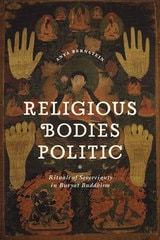
Religious Bodies Politic
Rituals of Sovereignty in Buryat BuddhismAnya Bernstein
University of Chicago Press, 2013
Religious Freedom after the Sexual Revolution
A Catholic GuideHelen Alvare
Catholic University of America Press, 2022
Remake, Remodel
Women's Magazines in the Digital AgeBrooke Erin Duffy
University of Illinois Press, 2013
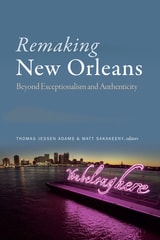
Remaking New Orleans
Beyond Exceptionalism and AuthenticityThomas J. Adams and Matt Sakakeeny, editors
Duke University Press, 2019
Contributors. Thomas Jessen Adams, Vincanne Adams, Vern Baxter, Maria Celeste Casati Allegretti, Shannon Lee Dawdy, Rien Fertel, Megan French-Marcelin, Cedric G. Johnson, Alecia P. Long, Vicki Mayer, Toby Miller, Sue Mobley, Marguerite Nguyen, Aaron Nyerges, Adolph Reed Jr., Helen A. Regis, Matt Sakakeeny, Heidi Schmalbach, Felipe Smith, Bryan Wagner
Remaking the Citizen for New Times
History, Pedagogy and the Amar Chitra KathaDeepa Sreenivas
Seagull Books, 2024
How does orthodoxy maintain its power over culture? In Remaking the Citizen for New Times, Deepa Sreenivas explores how the Amar Chitra Katha, a widely read comic series started in 1967 in India, influenced the historical and national consciousness of young readers in a conservative direction. Tacitly blaming Nehruvian welfarism of the time for the moral decline of the nation, the Amar Chitra Katha emerged as a literary articulation of the Indian right’s Hindu-nationalist ideology in a modern, bourgeois guise. To renew Hindutva hegemony, the comic series gave orthodox ideas a new sheen, both in its form and content, merging Western comic styles with Indian visual storytelling traditions on the one hand, and combining mythological characters with political figureheads into harmonious narratives on the other—making it difficult to sift history from myths and legends. Sreenivas deftly argues that these mythological-political tales emphasized the instructive rather than the informative potential of history, encouraging neoliberal values such as merit and hard work while ignoring caste or class as systemic issues.
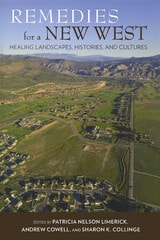
Remedies for a New West
Healing Landscapes, Histories, and CulturesEdited by Patricia Nelson Limerick, Andrew Cowell, and Sharon K. Collinge
University of Arizona Press, 2009
The signs of illness and trauma can seem omnipresent in today’s West: land and soil disrupted from mining, overgrazing, logging, and farming; wildlife habitat reduced and fragmented; native societies disturbed and threatened; open space diminished by cities and suburbs; wilderness destroyed by roads and recreation-seekers. But as these essays suggest, the “treatment program” for healing the West has many healthful side effects. Engaging in the kinds of projects suggested by contributors is therapeutic not only for the environment but for participants as well. Restoration, repair, and recovery can counter symptoms of despair with concentrated doses of promise and possibility.
The more “lesions” the West has, this book suggests, the more opportunities there are for westerners to revive and ultimately cure the ailing patient they have helped to create. The very idea of restoring the West to health, contributors and editors contend, unleashes our imaginations, sharpens our minds, and gives meaning to the ways we choose to live our lives. At the same time, acknowledging the profound difficulties of the work that lies ahead immunizes us against our own arrogance as we set about the task of healing the West.
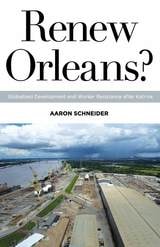
Renew Orleans?
Globalized Development and Worker Resistance after KatrinaAaron Schneider
University of Minnesota Press, 2018
Urban development after disaster, the fading of black political clout, and the onset of gentrification
Like no other American city, New Orleans since Hurricane Katrina offers powerful insight into issues of political economy in urban development and, in particular, how a city’s character changes after a disaster that spurs economic and political transition. In New Orleans, the hurricane upset an existing stalemate among rival factions of economic and political elites, and its aftermath facilitated the rise of a globally oriented faction of local capital.
In Renew Orleans? Aaron Schneider shows how some city leaders were able to access fragmented local institutions and capture areas of public policy vital to their development agenda. Through interviews and surveys with workers and advocates in construction, restaurants, shipyards, and hotel and casino cleaning, Schneider contrasts sectors prioritized during post-Katrina recovery with neglected sectors. The result is a fine-grained view of the way labor markets are structured to the advantage of elites, emphasizing how dual development produces wealth for the few while distributing poverty and exclusion to the many on the basis of race, gender, and ethnicity.
Schneider shows the way exploitation operates both in the workplace and the community, tracing working-class resistance that joins struggles for dignity at home and work. In the process, working classes and popular sectors put forth their own alternative forms of development.
Repealed
Ireland’s Unfinished Fight for Reproductive RightsCamilla Fitzsimons
Pluto Press, 2021
*Winner of the James S. Donnelly, Sr. Prize 2022*
In Ireland, 2018, a constitutional ban that equated the life of a woman to the life of a fertilized embryo was overturned and abortion was finally legalized. This victory for the Irish feminist movement set the country alight with euphoria. But the celebrations were short-lived - the new legislation turned out to be one of the most conservative in Europe. This book tells the story of the ‘Repeal’ campaign through the lens of the activists.
The authors trace the shocking history of the origins of the eighth amendment, which was drawn up in fear of a tide of liberal reforms across Europe. They draw out the lessons learned through the decades and from the groundbreaking campaign in 2018, which was an inspiring example of modern grassroots activism. They also recount the tensions between a medicalized approach and reproductive justice approach to abortion, as well as the harsh effect of the campaign on the health of activists.
Grounded in a radical feminist politics, this book is an honest and inspirational account of a movement that is only just beginning.
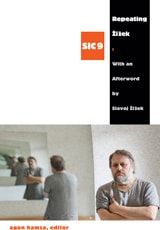
Repeating Žižek
Agon Hamza, ed.
Duke University Press, 2015
Contributors. Henrik Jøker Bjerre, Bruno Bosteels, Agon Hamza, Brian Benjamin Hansen, Adrian Johnston, Katja Kolšek, Adam Kotsko, Catherine Malabou, Benjamin Noys, Geoff Pfeifer, Frank Ruda, Oxana Timofeeva, Samo Tomšic, Gabriel Tupinambá, Fabio Vighi, Gavin Walker, Sead Zimeri, Slavoj Žižek

Replacing Home
From Primordial Hut to Digital Network in Contemporary ArtJennifer Johung
University of Minnesota Press, 2011
From property deeds to shipping containers to wearable shelters to virtual spaces: what does it mean to draw a spatial boundary? To be at home? In a world in which notions of place are constantly changing, Jennifer Johung looks at new constructions of staying in place—in contemporary site-specific art, digital media, portable architecture, and various other imaginable shelters and sites.
Replacing Home suggests that while “place” may no longer be a sustainable category, being in place and belonging at home are nonetheless possible. By emphasizing reusability rather than fixed constructions, art and architecture together propose various systems of replacing home in which sites can be revisited, material structures can be renewed, and dwellers can come back into contact over time. Bringing together a range of objects and events, Johung considers the structural replacements of home as evident in artistic analogies of the prehistoric hut, modular homes, transformable garments, and digitally networked sites.
In charting these intersections between contemporary art and architecture, Replacing Home introduces a new framework for reconceptualizing spatial situation; at the same time, it presents a new way to experience being and belonging within our globally expanded environments.
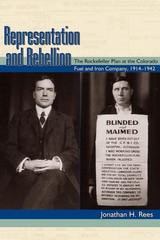
Representation and Rebellion
The Rockefeller Plan at the Colorado Fuel and Iron Company, 1914-1942Jonathan H. Rees
University Press of Colorado, 2010
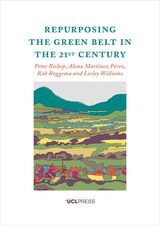
Repurposing the Green Belt in the 21st Century
Peter Bishop, Alona Martinez, Rob Roggema, and Lesley Williams
University College London, 2020
Through an examination of practice in the UK, the Netherlands, Spain, and Germany, Repurposing the Green Belt in the 21st Century proposes a framework for a reconsideration of the critical relationship between the city and its hinterlands. It will be useful for undergraduate and postgraduate students of planning, landscape architecture, urban design, architecture, and land economics, as well as practitioners in design, planning, and real estate.
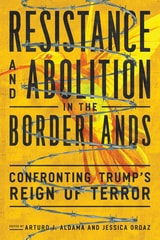
Resistance and Abolition in the Borderlands
Confronting Trump's Reign of TerrorEdited by Arturo J. Aldama and Jessica Ordaz; Foreword by Leo R. Chavez; Afterword by Karma R. Chávez
University of Arizona Press, 2024
This volume provides a well-argued look at the Trump era. Insightful contributions delve into the impact of Donald Trump’s rhetoric and policies on migrants detained and returned, immigrant children separated from their parents and placed in detention centers, and migrant women subjected to sexual and reproductive abuses, among other timely topics. The chapter authors document a long list in what the book calls “Trump’s Reign of Terror.”
Organized thematically, the book has four sections: The first gathers histories about the Trump years’ roots in a longer history of anti-migration; the second includes essays on artistic and activist responses on the border during the Trump years; the third critiques the normalization of Trump’s rhetoric and actions in popular media and culture; and the fourth envisions the future.
Resistance and Abolition in the Borderlands is an essential reader for those wishing to understand the extent of the damage caused by the Trump era and its impact on Latinx people.
Contributors
Arturo J. Aldama
Rebecca Avalos
Cynthia Bejarano
Tria Blu Wakpa
Renata Carvalho Barreto
Karma R. Chávez
Leo R. Chavez
Jennifer Cullison
Jasmin Lilian Diab
Allison Glover
Jamila Hammami
Alexandria Herrera
Diana J. Lopez
Sergio A. Macías
Cinthya Martinez
Alexis N. Meza
Roberto A. Mónico
José Enrique Navarro
Jessica Ordaz
Eliseo Ortiz
Kiara Padilla
Leslie Quintanilla
J-M Rivera
Heidy Sarabia
Tina Shull
Nishant Upadhyay
Maria Vargas
Antonio Vásquez
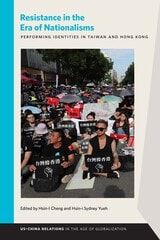
Resistance in the Era of Nationalisms
Performing Identities in Taiwan and Hong KongHsin-I Cheng
Michigan State University Press, 2023
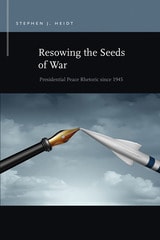
Resowing the Seeds of War
Presidential Peace Rhetoric since 1945Stephen J. Heidt
Michigan State University Press, 2021