Results by title
240 books match the query 'Agriculture & Food' and 9 start with r

Race and Repast
Foodscapes in Twentieth-Century Southern LiteratureUrszula Niewiadomska-Flis
University of Arkansas Press, 2022
Reimagining Marginalized Foods
Global Processes, Local PlacesEdited by Elizabeth Finnis
University of Arizona Press, 2012
With globalization has come an increased focus on food—where it comes from, how it is transported, who eats it, and what cultural significance it has. This volume brings together ethnographically based anthropological analyses of shifting meanings and representations associated with the foods, ingredients, and cooking practices of marginalized and/or indigenous cultures. Contributors are particularly interested in how these foods intersect with politics, nationhood and governance, identity, authenticity, and conservation.
The chapters cover diverse locales, issues, and foods: the cultural meanings of sinonggi, a thick sago porridge from Sulawesi, Indonesia; the significance of pom, a Surinam dish popular in the Netherlands; the transformation of alpaca meat in Peru; the impact of culinary tourism on indigenous cuisine in Mexico; the re-presenting of minor millets in South India; and the development of cheeses in the Italian Alps. A conceptual essay on food and social boundaries rounds out the collection.
Throughout, the contributors address important questions, including: How are traditional foods “repackaged” in the process of mainstreaming access? What does this repackaging mean for the ways local or indigenous peoples view their traditional food practices? How are local cuisines mobilized in movements to create national images and identities? What tensions emerge between new representations of foods and local cultural meanings?
Together the contributors provide a thoughtful inquiry into what happens when food and culinary practices are moved from the cultural or physical margins, and how such movements can be shaped by—and employed in the pursuit of—political, social, and cultural goals.
Republic of Barbecue
Stories Beyond the BrisketBy Elizabeth S. D. Engelhardt
University of Texas Press, 2009
Winner, Barbara Sudler Award, Colorado Historical Society, 2010
It's no overstatement to say that the state of Texas is a republic of barbecue. Whether it's brisket, sausage, ribs, or chicken, barbecue feeds friends while they catch up, soothes tensions at political events, fuels community festivals, sustains workers of all classes, celebrates brides and grooms, and even supports churches. Recognizing just how central barbecue is to Texas's cultural life, Elizabeth Engelhardt and a team of eleven graduate students from the University of Texas at Austin set out to discover and describe what barbecue has meant to Texans ever since they first smoked a beef brisket.
Republic of Barbecue presents a fascinating, multifaceted portrait of the world of barbecue in Central Texas. The authors look at everything from legendary barbecue joints in places such as Taylor and Lockhart to feedlots, ultra-modern sausage factories, and sustainable forests growing hardwoods for barbecue pits. They talk to pit masters and proprietors, who share the secrets of barbecue in their own words. Like side dishes to the first-person stories, short essays by the authors explore a myriad of barbecue's themes—food history, manliness and meat, technology, nostalgia, civil rights, small-town Texas identity, barbecue's connection to music, favorite drinks such as Big Red, Dr. Pepper, Shiner Bock, and Lone Star beer—to mention only a few. An ode to Texas barbecue in films, a celebration of sports and barbecue, and a pie chart of the desserts that accompany brisket all find homes in the sidebars of the book, while photographic portraits of people and places bring readers face-to-face with the culture of barbecue.
Ridge Stories
Herding Hens, Powdering Pigs, and Other Recollections from a Boyhood in the DriftlessGary Jones
Wisconsin Historical Society Press, 2019
Raised on a small dairy farm in the Driftless Area in the mid-twentieth century, Gary Jones gets real about his rural roots. In this collection of interrelated stories, Jones writes with plainspoken warmth and irreverence about farm, family, and folks on the ridge. Readers will meet Gramp Jones, whose oversized overalls saved him from losing a chunk of flesh to an irate sow; the young one-room-school teacher who helped the kids make sled jumps at recess; Charlotte, the lawn-mowing sheep who once ended up in the living room; Victor the pig-cutter, who learned his trade from folk tradition rather than vet school; and other colorful characters of the ridge. Often humorous and occasionally touching, Jones’s essays paint a vivid picture that will entertain city and country folk alike.
Risqué Business
Breastaurants in American CultureTy Matejowsky
University of Alabama Press, 2025
Risqué Business serves up the breastaurant industry, where food service, sex appeal, identity, and gender politics mix.
Risqué Business explores the rise and ongoing cultural reckoning of “breastaurants”: sports bar–style restaurants like Hooters and Twin Peaks, which have long relied on the sexualized presentation of female servers to attract a mostly straight, male clientele. Ty Matejowsky, professor of anthropology at the University of Central Florida, is uniquely positioned in America’s foundational, breastaurant-saturated landscape. From this vantage, he offers a well-balanced account that draws on pop culture, media analysis, and contemporary gender politics. He delivers a smart, layered analysis of how breastaurants commodify youth and femininity, uphold retrograde masculinity, and serve as symbolic battlegrounds in today's highly charged political environments including America's deeply polarized Red State/Blue State divide.
With case studies, cultural critique, and a critical lens on labor and sexuality, Matejowsky reveals how these restaurants are more than just risqué marketing gimmicks. They reflect deeper anxieties about gender, identity, and the uneasy fusion of sex and service in American consumer culture. Risqué Business is a high-spirited study of an industry that thrives at the intersection of appetite and identity.
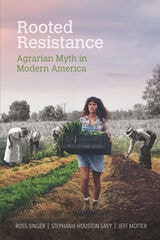
Rooted Resistance
Agrarian Myth in Modern AmericaNorie R. Singer
University of Arkansas Press, 2020
Through a careful examination of several case studies, Rooted Resistance traverses the ground of agrarian myth in modern America. The authors investigate key figures and movements in the history of modern agrarianism, including the World War I victory garden efforts, the postwar Country Life movement for the vindication of farmers’ rights, the Southern Agrarian critique of industrialism, and the practical and spiritual prophecy of organic farming put forth by J. I. Rodale. This critical history is then brought up to date with recent examples such as the contested South Central Farm in urban Los Angeles and the spectacular rise and fall of the Chipotle “Food with Integrity” branding campaign.
By examining a range of case studies, Singer, Grey, and Motter aim for a deeper critical understanding of the many applications of agrarian myth and reveal why it can help provide a pathway for positive systemic change in the food system.
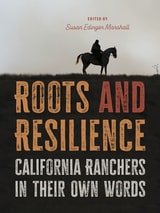
Roots and Resilience
California Ranchers in Their Own WordsSusan Edinger Marshall
University of Nevada Press, 2024
The editors have drawn together these stories, poems, and musings from ranchers across the state, calling upon real people to share their experiences, and beckoning readers to find a shared understanding concerning often divisive land-use topics. Many perspectives are considered, including those of transplanted suburbanites to seventh-generation heirs. Notably, many women’s writings are including in the book, offering unique and valuable perspectives on ranching culture.
Roots and Resilience gives voice to California’s Indigenous, Mexican American, Basque and other European American ranchers, asking the reader to find common ground in the name of land stewardship and conservation.
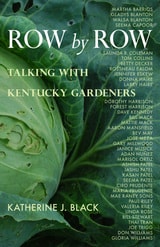
Row by Row
Talking with Kentucky GardenersKatherine J. Black
Ohio University Press, 2015
For two and a half years, Katherine J. Black crisscrossed Kentucky, interviewing home vegetable gardeners from a rich variety of backgrounds. Row by Row: Talking with Kentucky Gardeners is the result, a powerful compilation of testimonies on the connections between land, people, culture, and home.
The people profiled here share a Kentucky backdrop, but their life stories, as well as their gardens, have as many colors, shapes, and tastes as heirloom tomatoes do. Black interviewed those who grow in city backyards, who carve out gardens from farmland, and who have sprawling plots in creek bottoms and former pastures. Many of the gardeners in Row by Row speak eloquently about our industrialized food system’s injuries to the land, water, and health of people. But more often they talk about what they are doing in their gardens to reverse this course.
Row by Row is as sure to appeal to historians, food studies scholars, and sustainability advocates as it is to gardeners and local food enthusiasts. These eloquent portraits, drawn from oral histories and supplemented by Deirdre Scaggs’ color photographs, form a meditation on how gardeners make sense of their lives through what they grow and how they grow it.
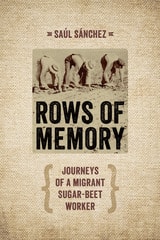
Rows of Memory
Journeys of a Migrant Sugar-Beet WorkerSaul Sanchez
University of Iowa Press, 2014
Rows of Memory tells his story and the story of his family and other migrant farm laborers like them, people who endured dangerous, dirty conditions and low pay, surviving because they took care of each other. Facing racism both on the road and at home, they lived a largely segregated life only occasionally breached by friendly employers.
Despite starting school late and leaving early every year and having to learn English on the fly, young Saúl succeeded academically. At the same time that Mexican Americans in South Texas upended the Anglo-dominated social order by voting their own leaders into local government, he upended his family’s order by deciding to go to college. Like many migrant children, he knew that his decision to pursue an education meant he would no longer be able to help feed and clothe the rest of his family. Nevertheless, with his parents’ support, he went to college, graduating in 1967 and, after a final display of his skill with a short hoe for his new friends, abandoned migrant labor for teaching.
In looking back at his youth, Sánchez invites us to appreciate the largely unrecognized and poorly rewarded strength and skill of the laborers who harvest the fruits and vegetables we eat. A first-person portrait of life on the bottom rung of the food system, this coming-of-age tale illuminates both the history of Latinos in the United States and the human consequences of industrial agriculture.