Results by title
64 books match the query 'American prose literature' and 5 start with r
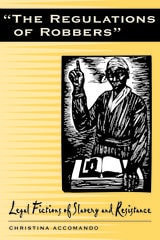
REGULATIONS OF ROBBERS
LEGAL FICTIONS OF SLAVERY AND RESISTANCEChristina Accomando
The Ohio State University Press, 2001
[more]
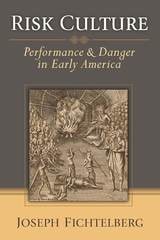
Risk Culture
Performance and Danger in Early AmericaJoseph Fichtelberg
University of Michigan Press, 2010
"As a number of recent studies have shown, the north European commercial world made the precise calculation of risk a central concern of the intellectual project of exploration, trade, and colonization. The great merit of Fichtelberg's book is systematizing the imaged world of dangers, and charting the various kinds of ritual and discursive performances marshaled to deal with the pressure of the unspeakable in early America from the 17th into the early 19th century. The readings of texts are invariably careful, and the points made, persuasive."
---David Shields, University of South Carolina
---David Shields, University of South Carolina
Risk Culture is the first scholarly book to explore how strategies of performance shaped American responses to modernity. By examining a variety of early American authors and cultural figures, from John Smith and the Salem witches to Phillis Wheatley, Susanna Rowson, and Aaron Burr, Joseph Fichtelberg shows how early Americans created and resisted a dangerously liberating new world. The texts surveyed confront change through a variety of performances designed both to imagine and deter menaces ranging from Smith's hostile Indians, to Wheatley's experience of slavery, to Rowson's fear of exposure in the public sphere. Fichtelberg combines a variety of scholarly approaches, including anthropology, history, cultural studies, and literary criticism, to offer a unique synthesis of literary close reading and sociological theory in the service of cultural analysis.
Joseph Fichtelberg is Professor of English and Chair of the English Department at Hofstra University.
[more]

Road-Book America
Contemporary Culture and the New PicaresqueRowland A. Sherrill
University of Illinois Press, 2000
In this wide-ranging and sophisticated study, Rowland Sherrill explores the resurgence and transformation of an old literary form--the picaresque narrative--into a new form that he shows to be both responsive and instructive to late twentieth-century American life.
Road-Book America discloses how the old picaresque tradition, embodied in such novels as Henry Fielding's Tom Jones and Daniel Defoe's Moll Flanders, opens to include a number of new American texts, both fiction and nonfiction, that decisively share the characterizing form. Sherrill's discussion encompasses hundreds of American narratives published in the past four decades, including such examples of the genre as William Least Heat-Moon's Blue Highways, John Steinbeck's Travels with Charley, James Leo Herlihy's Midnight Cowboy, Bill Moyers's Listening to America, and E. L. Doctorow's Billy Bathgate.
Sketching the socially marginal, ingenuous, traveling characters common to both old and new versions, Sherrill shows how the "new American picaresque" transforms the satirical aims of the original into an effort to map and catalog the immensity and variety of America.
Open, resilient, perennially hopeful, and endowed with a protean adaptability, the protagonist of the new American picaresque follows a therapeutic path for the alienated modern self. Mining the relevance of the reformulated picaresque for American life, Road-Book America shows how this old form, adaptable as the picaro himself, lays the groundwork for spiritual renewal and a restoration of cultural confidence in some old ways of being American.
[more]
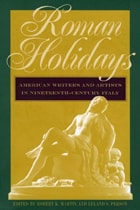
Roman Holidays
American Writers and Artists in Nineteenth-Century ItalyRobert K. Martin
University of Iowa Press, 2001
Featuring essays by twelve prominent American literature scholars, Roman Holidaysexplores the tradition of American travel to Italy and makes a significant contribution to the understanding of nineteenth-century American encounters with Italian culture and, more specifically, with Rome.
The increase in American travel to Italy during the nineteenth century was partly a product of improved conditions of travel. As suggested in the title, Italy served nineteenth-century writers and artists as a kind of laboratory site for encountering Others and “other” kinds of experience. No doubt Italy offered a place of holiday—a momentary escape from the familiar—but the journey to Rome, a place urging upon the visitor a new and more complex sense of history, also forced a reexamination of oneself and one's identity. Writers and artists found their religious, political, and sexual assumptions challenged.
Nathaniel Hawthorne's The Marble Faun has a prominent place in this collection: as Henry James commented in his study of Hawthorne, the book was “part of the intellectual equipment of the Anglo-Saxon visitor to Rome.” The essayists also examine works by James, Fuller, Melville, Douglass, Howells, and other writers as well as such sculptors as Hiram Powers, William Wetmore Story, and Harriet Hosmer.
Bringing contemporary concerns about gender, race, and class to bear upon nineteenth-century texts, Roman Holidays is an especially timely contribution to nineteenth-century American studies.
[more]
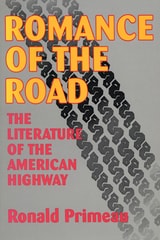
Romance Of The Road
Literature Of The American HighwayRonald Primeau
University of Wisconsin Press, 1996
For four decades, the American road narrative has been a significant and popular literary genre for expressing journeys of self discovery. These works have been used as springboards for authors to define our national identity, to explore opportunities to escape from the daily routine, and to express social protest. This comprehensive study of an important American art form examines how road narratives create dialogues between travelers, authors, and readers about who we are, what we value, and where we hope to be going.
Writers examined include Jack Kerouac, Jim Dodge, Ralph Waldo Emerson, William Least Heat Moon, Robert M. Pirsig, Henry Miller, Joan Didion, Mona Simpson, and Walt Whitman.
Writers examined include Jack Kerouac, Jim Dodge, Ralph Waldo Emerson, William Least Heat Moon, Robert M. Pirsig, Henry Miller, Joan Didion, Mona Simpson, and Walt Whitman.
[more]