Results by title
59 books match the query 'Antiques & Collectibles' and 3 start with r

Railroad Postcards In Age Steam
H. Roger Grant
University of Iowa Press, 1994
Out of the tradition of those long-gone days of great, heaving steam locomotives and endless rail lines comes this remarkable selection of vintage cards, a treasure trove selected from John Vander Maas' consummate collection at the University of Iowa Libraries.
This lavish volume is the first general book-length work devoted to the once-ubiquitous railroad picture postcard. It comprises an introductory essay and an album of cards. The former fully examines the nature of the postcard craze, which reached its zenith about 1910, and discusses why images of American railroads played such an important part in the card phenomenon. The album divides an engaging assortment of more than 150 representative views into five sections: “Trains and Rolling Stock,” “Depots and Railway Structures,” “The Railroad Corridor,” “People and Railroads,” and “The Lighter Side of Railroading.”
Railroad historians, train enthusiasts, postcard collectors, and all other readers will find much to interest them in this selection of images. Not only are the cards themselves visually striking, but they convey a sense of how important railroads once were to the nation's citizenry. The sight of steaming locomotives and the hustle and bustle associated with “train time” caused hearts to quicken. These feelings made views of railroad scenes popular with buyers of postcards and now with latter-day railroad fans and card collectors.

Rare and Used
Adventures of a Book Scout's ApprenticeDaniel Dietz
Oregon State University Press, 2026
Coming home to Oregon to reconnect with his aging parents, Daniel Dietz discovers the rhythms and relationships of a changing book world. As the internet pushes bibliophiles away from used bookstores and toward digital commerce, Dietz’s stepfather Michael, now nearing eighty, clings to the precarious trade of scouring thrift stores and library sales for rare books to sell. He explores the stacks, from garage sales in Eugene’s Whiteaker neighborhood to Portland’s Powell’s City of Books, for overlooked first editions and valuable rare books from the past.
With humor and tenderness, Rare and Used introduces us to Michael and to a dedicated and zealous community of book people, each with a grail book that they seek above all others. For Dietz, it’s Beat poet Diane di Prima’s debut collection This Kind of Bird Flies Backward—a book once owned by his stepfather. In his quest for the book, Dietz grapples with larger questions about possession, inheritance, and what we can hold onto. A tribute to books and booksellers as well as to family and place, Rare and Used explores what it means to return home to a community that shaped you.
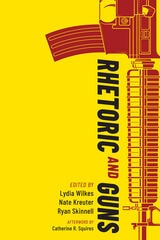
Rhetoric and Guns
Lydia Wilkes
Utah State University Press, 2021
Guns hold a complex place in American culture. Over 30,000 Americans die each year from gun violence, and guns are intimately connected to issues of public health, as is evident whenever a mass shooting occurs. But guns also play an important role in many Americans’ lives that is not reducible to violence and death—as tools, sporting equipment, and identity markers. They are also central to debates about constitutional rights, as seen in ongoing discussions about the Second Amendment, and they are a continuous source of legislative concern, as apparent in annual ratings of gun-supporting legislators.
Even as guns are wrapped up with other crucial areas of concern, they are also fundamentally a rhetorical concern. Guns and gun violence occupy a unique rhetorical space in the United States, one characterized by silent majorities, like most gun owners; vocal minorities, like the firearm industry and gun lobby; and a stalemate that fails to stem the flood of the dead. How Americans talk, deliberate, and fight about guns is vital to how guns are marketed, used, and regulated. A better understanding of the rhetorics of guns and gun violence can help Americans make better arguments about them in the world. However, where guns are concerned, rhetorical studies is not terribly different from American culture more generally. Guns are ever-present and exercise powerful effects, but they are commonly talked about in oblique, unsystematic ways.
Rhetoric and Guns advances more direct, systematic engagement in the field and beyond by analyzing rhetoric about guns, guns in rhetoric, and guns as rhetoric, particularly as they relate to specific instances of guns in culture. The authors attempt to understand rhetoric’s relationship to guns by analyzing rhetoric about guns and how they function in and as rhetoric related to specific instances—in media coverage, political speech, marketing, and advertising. Original chapters from scholars in rhetorical studies, communication, education, and related fields elucidate how rhetoric is used to maintain and challenge the deadly status quo of gun violence in the United States and extend rhetoricians’ sustained interest in the fields’ relationships to violence, brutality, and atrocity.
Contributors: Ira J. Allen, Brian Ballentine, Matthew Boedy, Peter Buck, Lisa Corrigan, Rosa Eberly, Kendall Gerdes, Ian E. J. Hill, Nathalie Kuriowa-Lewis, Patricia Roberts-Miller, Craig Rood, Bradley Serber, Catherine R. Squires, Scott Gage