Results by title
64 books match the query 'Architecture and society' and 4 start with r

Reconstructing Architecture
Critical Discourses and Social PracticesThomas A. Dutton and Lian Hurst Mann, Editors
University of Minnesota Press, 1996
Reconstructing Architecture was first published in 1996. Minnesota Archive Editions uses digital technology to make long-unavailable books once again accessible, and are published unaltered from the original University of Minnesota Press editions.
To create architecture is an inherently political act, yet its nature as a social practice is often obscured beneath layers of wealth and privilege. The contributors to this volume question architecture's complicity with the status quo, moving beyond critique to outline the part architects are playing in building radical social movements and challenging dominant forms of power.
The making of architecture is instrumental in the construction of our identities, our differences, the world around us-much of what we know of institutions, the distribution of power, social relations, and cultural values is mediated by the built environment. Historically, architecture has constructed the environments that house the dominant culture. Yet, as the essays in Reconstructing Architecture demonstrate, there exists a strong tradition of critical practice in the field, one that attempts to alter existing social power relations. Engaging the gap between modernism and postmodernism, each chapter addresses an oppositional discourse that has developed within the field and then reconstructs it in terms of a new social project: feminism, social theory, environmentalism, cultural studies, race and ethnic studies, and critical theory.
The activists and scholars writing here provide a clarion call to architects and other producers of culture, challenging them to renegotiate their political allegiances and to help reconstruct a viable democratic life in the face of inexorable forces driving economic growth, destroying global ecology, homogenizing culture, and privatizing the public realm. Reconstructing Architecture reformulates the role of architecture in society as well as its capacity to further a progressive social transformation.
Contributors: Sherry Ahrentzen, U of Wisconsin, Milwaukee; Bradford C. Grant, California Polytechnic State U, San Luis Obispo; Richard Ingersoll, Rice U; Margaret Soltan, George Washington U; Anthony Ward, U of Auckland, New Zealand.
Thomas A. Dutton is an architect and professor of architecture at Miami University, Ohio. He is editor of Voices in Architectural Education (1991) and is associate editor of the Journal of Architectural Education.
Lian Hurst Mann is an architect and editor of Architecture California. A founding member of the Labor/Community Strategy Center in Los Angeles, she is editor of its bilingual quarterly Ahora Now and a coauthor of Reconstructing Los Angeles from the Bottom Up (1993).
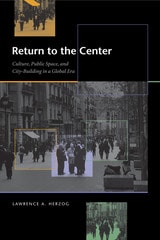
Return to the Center
Culture, Public Space, and City Building in a Global EraBy Lawrence A. Herzog
University of Texas Press, 2006
The redesign and revitalization of traditional urban centers is the cutting edge of contemporary urban planning, as evidenced by the intense public and professional attention to the rebuilding of city cores from Berlin to New York City's "Ground Zero." Spanish and Latin American cities have never received the recognition they deserve in the urban revitalization debate, yet they offer a very relevant model for this "return to the center." These cultures have consistently embraced the notion of a city whose identity is grounded in its organic public spaces: plazas, promenades, commercial streets, and parks that invite pedestrian traffic and support a rich civic life. This groundbreaking book explores Spanish, Mexican, and Mexican-American border cities to learn what these urban areas can teach us about effectively using central public spaces to foster civic interaction, neighborhood identity, and a sense of place.
Herzog weaves the book around case studies of Madrid and Barcelona, Spain; Mexico City and Querétaro, Mexico; and the Tijuana-San Diego border metropolis. He examines how each of these urban areas was formed and grew through time, with attention to the design lessons of key public spaces. The book offers original and incisive discussions that challenge current urban thinking about politics and public space, globalization, and the future of privatized communities, from gated suburbs to cyberspace. Herzog argues that well-designed, human-scaled city centers are still vitally necessary for maintaining community and civic life. Applicable to urban renewal projects around the globe, Herzog's book will be important reading for planners, architects, designers, and all citizens interested in creating more livable cities.
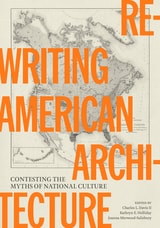
Rewriting American Architecture
Contesting the Myths of National CultureEdited by Charles L. Davis II, Kathryn E. Holliday, and Joanna Merwood-Salisbury
University of Texas Press, 2026
A critical reassessment of nineteenth‑century American architecture that uncovers how race, settler colonialism, and contested national identities shaped the built environment and its historiography.
Rewriting American Architecture offers a revisionist riposte to the canonical story of nineteenth-century American architecture. Drawing on new archival research and revisionist historiography, the essays in this volume reveal how American architecture was shaped not by inevitable progress toward a unified national culture but by the turbulent realities of race, labor, settler colonialism, and territorial expansion. Rather than treating architecture as an apolitical aesthetic expression, the contributors expose it as an active arena in which the meanings of nationhood were constructed, contested, and often violently enforced. From Indigenous spatial practices and Black institutional building to transnational exchanges and the racial politics embedded in professionalization, this collection reframes the built environment as central to the competing cultural, political, and geographic claims that defined the United States during this period.

Robert de Cotte and the Perfection of Architecture in Eighteenth-Century France
Robert Neuman
University of Chicago Press, 1994
After describing de Cotte's training and the professional context in which he worked, Neuman offers a thorough survey of de Cotte's output. For each commission, he recreates the actual design process, showing how de Cotte manipulated an accepted vocabulary of architectural forms to meet the patron's specific requirements. De Cotte's own drawings, many reproduced here for the first time, and quotations from a wide variety of contemporary writings vividly supplement the case histories. Beautifully illustrated, Neuman's much-needed book reveals de Cotte as an innovative and strikingly modern architect.