Results by title
71 books match the query 'Aristotle' and 3 start with r
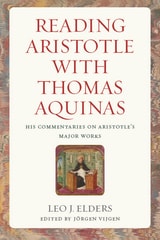
Reading Aristotle with Thomas Aquinas
His Commentaries on Aristotle's Major WorksLeo J. Elders
Catholic University of America Press, 2022
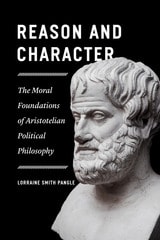
Reason and Character
The Moral Foundations of Aristotelian Political PhilosophyLorraine Smith Pangle
University of Chicago Press, 2020
A close and selective commentary on Aristotle’s Nicomachean Ethics, offering a novel interpretation of Aristotle’s teachings on the relation between reason and moral virtue.
What does it mean to live a good life or a happy life, and what part does reason play in the quest for fulfillment? Lorraine Smith Pangle shows how Aristotle’s arguments for virtue as the core of happiness and for reason as the guide to virtue emerge in response to Socrates’s paradoxical claim that virtue is knowledge and vice is ignorance.
Against Socrates, Aristotle does justice to the effectual truth of moral responsibility—that our characters do indeed depend on our own voluntary actions. But he also incorporates Socratic insights into the close interconnection of passion and judgment and the way passions and bad habits work not to overcome knowledge that remains intact but to corrupt the knowledge one thinks one has. Reason and Character presents fresh interpretations of Aristotle’s teaching on the character of moral judgment and moral choice, on the way reason finds the mean—especially in justice—and on the relation between practical and theoretical wisdom.
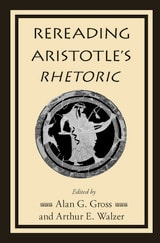
Rereading Aristotle's Rhetoric
Edited by Alan G. Gross and Arthur E. Walzer
Southern Illinois University Press, 2000
In this collection edited by Alan G. Gross and Arthur E. Walzer, scholars in communication, rhetoric and composition, and philosophy seek to “reread” Aristotle’s Rhetoric from a purely rhetorical perspective. So important do these contributors find the Rhetoric, in fact, that a core tenet in this book is that “all subsequent rhetorical theory is but a series of responses to issues raised by the central work.”
The essays reflect on questions basic to rhetoric as a humanistic discipline. Some explore the ways in which the Rhetoric explicates the nature of the art of rhetoric, noting that on this issue, the tensions within the Rhetoric often provide a direct passageway into our own conflicts.