Results by title
167 books match the query 'Artists, Architects, Photographers' and 4 start with r
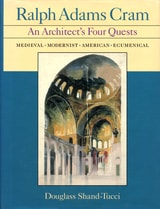
Ralph Adams Cram
An Architect's Four QuestsDouglass Shand-Tucci
University of Massachusetts Press, 2005
With his partner Bertram Goodhue, Cram won a number of important commissions, beginning with the West Point competition in 1903. Although an increasingly bitter rivalry with Goodhue would lead to the dissolution of their partnership in 1912, Cram had already begun to strike out on his own. Supervising architect at Princeton, consulting architect at Wellesley, and head of the MIT School of Architecture, he would also design most of New York's Cathedral of St. John the Divine and the campus of Rice University, as well as important church and collegiate structures throughout the country. By the 1920s Cram had become a household name, even appearing on the cover of Time magazine.
A complex man, Cram was a leading figure in what Shand-Tucci calls "a full-fledged homosexual monastery" in England, while at the same time married to Elizabeth Read. Their relationship was a complicated one, the effect of which on his children and his career is explored fully in this book. So too is his work as a religious leader and social theorist.
Shand-Tucci traces the influence on Cram of such disparate figures as Franklin Delano Roosevelt, Phillips Brooks, Henry Adams, and Ayn Rand. He divides Cram's career into four lifelong "quests": medieval, modernist, American, and ecumenical. Some quests may have failed, but in each he left a considerable legacy, ultimately transforming the visual image of American Christianity in the twentieth century.
Handsomely illustrated with over 130 photographs and drawings and eight pages of color plates, Ralph Adams Cram can be read on its own or in conjunction with Boston Bohemia, 1881–1900. Together, the two volumes complete what the Christian Century has described as a "superbly researched and captivating biography."
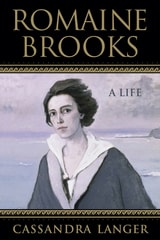
Romaine Brooks
A LifeCassandra Langer
University of Wisconsin Press, 2015
Romaine Brooks: A Life introduces much fresh information from Langer's decades of research on Brooks and establishes this groundbreaking artist's centrality to feminism and contemporary sexual politics as well as to visual culture.
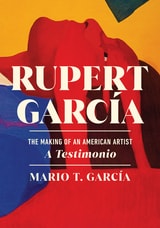
Rupert García
The Making of an American Artist, a TestimonioMario T. García
Rutgers University Press, 2026
This is the first biography of the renowned American Chicano visual artist and activist Rupert García, drawing on fifty hours of interviews conducted over thirty years and accompanied by eighty images. This in-depth oral history gives an unparalleled look at García’s life and work, tracing his evolution as an artist and the political upheavals that shaped his life and worldview.
Mario T. García’s testimonio places Rupert García’s art in historical perspective, from his beginnings as a working-class Mexican American from California’s Central Valley, his coming of age in the U.S. Air Force during the Vietnam War, his involvement in the antiwar movement during the San Francisco State student strike in 1968-69, and his participation in the Chicano Movement and beyond. Influenced by history and politics, García’s vital works of art represent a changing world through the eyes of an artist, speaking to issues of poverty, racism, capitalism, war, and the role of the artist in society.
His art—from revolutionary silkscreen posters to monumental pastels to portraits of political icons like Frida Kahlo, Che Guevara, and Dolores Huerta—serves to critique history and reassess it. It is work that will endure for generations to come.
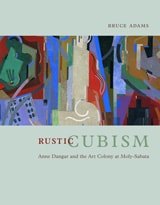
Rustic Cubism
Anne Dangar and the Art Colony at Moly-SabataBruce Adams
University of Chicago Press, 2004
In part a gripping biography of this Australian expatriate, Rustic Cubism chronicles Dangar's personal battles and the tumult of the World War II era during her tempestuous tenure at Moly-Sabata. Dangar dedicated herself to the colony's aims by working in the region's village potteries, combining their vernacular elements with Gleizes' design methods to arrive at a type of rustic Cubism. Her work there would ultimately be rewarded; her pieces can today be found in the Musée des Arts Décoratifs in Paris, the Musée d'Art Moderne de la Ville de Paris, the Museo Internazionale delle Ceramiche in Faenza, the National Gallery of Australia, Canberra, and many other museums.
Rustic Cubism places Dangar at the heart of Moly-Sabata's alternative art movement—one that, in its nostalgic present, attempted to construct a culture based on the distant past. Generously illustrated with photographs of the art and social milieu of the period, this captivating and original narrative makes a considerable contribution to our understanding of French modernism and early twentieth-century cultural politics as well as of the life of a most talented and intriguing female artist.