200 books match the query 'Asian American & Pacific Islander' and 7 start with r
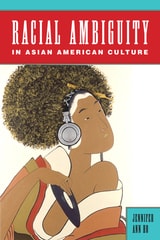
cover of Racial Ambiguity in Asian American Culture

Racial Ambiguity in Asian American Culture

Ho, Jennifer Ann

Rutgers University Press, 2015
The sheer diversity of the Asian American populace makes them an ambiguous racial category. Indeed, the 2010 U.S. Census lists twenty-four Asian-ethnic groups, lumping together under one heading people with dramatically different historical backgrounds and cultures. In Racial Ambiguity in Asian American Culture, Jennifer Ann Ho shines a light on the hybrid and indeterminate aspects of race, revealing ambiguity to be paramount to a more nuanced understanding both of race and of what it means to be Asian American. 
 
Exploring a variety of subjects and cultural artifacts, Ho reveals how Asian American subjects evince a deep racial ambiguity that unmoors the concept of race from any fixed or finite understanding. For example, the book examines the racial ambiguity of Japanese American nisei Yoshiko Nakamura deLeon, who during World War II underwent an abrupt transition from being an enemy alien to an assimilating American, via the Mixed Marriage Policy of 1942. It looks at the blogs of Korean, Taiwanese, and Vietnamese Americans who were adopted as children by white American families and have conflicted feelings about their “honorary white” status. And it discusses Tiger Woods, the most famous mixed-race Asian American, whose description of himself as “Cablinasian”—reflecting his background as Black, Asian, Caucasian, and Native American—perfectly captures the ambiguity of racial classifications.   
 
Race is an abstraction that we treat as concrete, a construct that reflects only our desires, fears, and anxieties. Jennifer Ho demonstrates in Racial Ambiguity in Asian American Culture that seeing race as ambiguous puts us one step closer to a potential antidote to racism. 
 
[more]
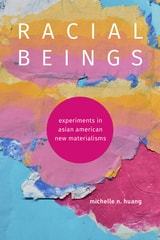
cover of Racial Beings: Experiments in Asian American New Materialisms

Racial Beings

Experiments in Asian American New Materialisms

Michelle N. Huang

Duke University Press, 2026
In Racial Beings, Michelle N. Huang brings a feminist new materialist lens to bear on contemporary Asian American literature’s innovative play with discourses of science and technology. She argues that emerging from these works is a “molecular aesthetics”—formal experimentation that diminishes the boundaries of the human—which challenge the perception of racial identity as a trait of an individual human. Instead, molecular aesthetics reveals how race permeates the matter of the world. Reading works by authors such as Ruth Ozeki, Larissa Lai, Mei-mei Berssenbrugge, and Julie Otsuka through the language of scientific discourses like quantum physics, genetic engineering, and elemental chemistry, Huang develops a synthetic reading practice which shows both that the nexus of race and science is not reducible to scientific racism and that science can provide an unlikely creative reservoir for Asian American writers and artists which allows us to imagine alternative ways of understanding racial being beyond the limits of the human individual.
[more]
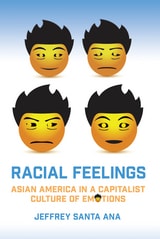
cover of Racial Feelings: Asian America in a Capitalist Culture of Emotion

Racial Feelings

Asian America in a Capitalist Culture of Emotion

Jeffrey Santa Ana

Temple University Press, 2015

In Racial Feelings, Jeffrey Santa Ana examines how Asian American narratives communicate and critique—to varying degrees—the emotions that power the perception of Asians as racially different.
 
Santa Ana explores various forms of Asian American cultural production, ranging from literature and graphic narratives to film and advertising, to illuminate the connections between global economic relations and the emotions that shape aspirations for the good life. He illustrates his argument with examples including the destitute Filipino immigrant William Paulinha, in Han Ong’s Fixer Chao, who targets his anger on the capitalist forces of objectification that racially exploit him, and Nan and Pingpin in Ha Jin’s A Free Life, who seek happiness and belonging in America. 
 
Racial Feelings addresses how Asian Americans both resist and rely on stereotypes in their writing and art work. In addition, Santa Ana investigates how capitalism shapes and structures an emotional discourse that represents Asians as both economic exemplars and threats.  
[more]
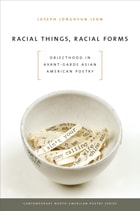
cover of Racial Things, Racial Forms: Objecthood in Avant-Garde Asian American Poetry

Racial Things, Racial Forms

Objecthood in Avant-Garde Asian American Poetry

Joseph Jonghyun Jeon

University of Iowa Press, 2012
In Racial Things, Racial Forms, Joseph Jonghyun Jeon focuses on a coterie of underexamined contemporary Asian American poets—Theresa Hak Kyung Cha, Myung Mi Kim, Mei-mei Berssenbrugge, and John Yau—who reject many of the characteristics of traditional minority writing, in particular the language of identity politics, which tends to challenge political marginalization without contesting more fundamental assumptions about the construction of racial form. In the poets’ various treatments of things (that is, objects of art), one witnesses a confluence of heretofore discrete factors: the avant-garde interest in objecthood and the racial question of objectification.
 
By refashioning avant-garde investigations of things into questions about how American discourse visualizes race in and on the body, these poets implicitly critique dominant modes of racial visibility, seeking alternatives to the unreflective stances that identity politics often unwittingly reproduces. At the heart of Jeon’s project is the assumption thatracial form is continually recalibrated to elide ideological ambiguities and ambivalences in contemporary culture. Thus, rather than focusing exclusively on the subject—on interiority and individual experience—Racial Things, Racial Forms also uses the calculated strangeness of the avant-garde art object as an occasion to emphasize the physical and visual oddness of racial constructs, as a series of everchanging, contemporary phenomena that are in conversation with, but not entirely determined by, their historical legacy.
 
In this critical study, Jeon argues that by invoking the foreignness of an avant-garde art object as a way to understand racial otherness, these writers model the possibility of a post-identity, racial politics that challenges how race is fundamentally visualized. In addition to appealing to those interested in Asian American studies and race in American literature, Racial Things, Racial Forms addresses readers interested in contemporary poetry, art, and visual culture, paying particular attention to the intersections between literary and visual art.
[more]
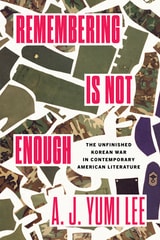
cover of Remembering Is Not Enough: The Unfinished Korean War in Contemporary American Literature

Remembering Is Not Enough

The Unfinished Korean War in Contemporary American Literature

A. J. Yumi Lee

Temple University Press, 2027

Remembering Is Not Enough traces the emergence of a critical consciousness of the Korean War in American literature and culture over the past seventy-five years. A. J. Yumi Lee provides close readings of key texts from the post-Cold War era that remember and represent the “forgotten” Korean War, including Sook Nyul Choi’s Year of Impossible Goodbyes, Toni Morrison’s Home, Marie Myung-ok Lee’s The Evening Hero, and Paul Yoon’s Snow Hunters. She argues that rather than simply revisiting a known and settled history, contemporary Korean War literature is actively processing an unresolved conflict that is both past and not past.

Lee shows how literary works have challenged common understandings of the war as an American victory for freedom, from soldiering narratives that address the violence of U.S. imperialism to Korean diasporic novels that depict the surfacing of memory across generations. These examples ask readers to process, analyze, and critique as they remember, and Lee emphasizes that how and why we remember matters as much as what is being recalled.

Reflecting on the Korean War in new and often unexpected ways, Remembering Is Not Enough prompts us to reorient our memories, our storytelling, and our actions toward a more just and peaceful future.

[more]
cover of Repair Attempts: Poems

Repair Attempts

Poems

Cameron Quan

Northwestern University Press, 2027

A poetic reckoning with personal, political, and historical wounds

The titular “repair attempts” describes the words and actions people use to heal broken connections and de-escalate conflict. In his debut collection, Cameron Quan transforms this concept into a powerful lens for examining moral responsibility in contemporary America. Quan’s Repair Attempts navigates Asian American identity, American exceptionalism, patriarchal violence, grief, and the nature of apologies. The speakers grapple with transgression and healing from unexpected angles, asking what kind of repair is possible in a world marred by atrocities. These poems dance across landscapes—from an imagined American holiday of atonement to the pope’s apology to Indigenous peoples, from a mother preparing to flee domestic violence to an unsettling childhood game boys play with butterflies. A chorus of repair attempts that toggle between the personal and political, this collection invites us into difficult territory where failure, wrongdoing, and shame require a collective reckoning and a collective effort to be better.

[more]
cover of Replica

Replica

Lisa Low

University of Wisconsin Press, 2026

Stand-up comedy, a celebrity non-apology, observations of racism, and the slipperiness of nostalgia underpin Replica. In poignant, witty poems, Lisa Low navigates the tensions of solidarity and hostility in white spaces as she sets out to write differently about race.

“The problem of being with a white man is also a problem of writing,” Low says in a prose poem that turns writing about identity on its head. She peers in from outside the poem, as if through an open ceiling. The poem itself becomes a site of investigation—a counterpoint to constricting narratives about Asian American identity—reimagined as a dollhouse, a stage with props, an image the speaker wears like a bodysuit. Replica asks what it means to represent yourself and your experiences in a world where you are indistinguishable from others.

[more]