Results by title
208 books match the query 'Autobiography' and 7 start with r
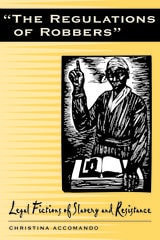
REGULATIONS OF ROBBERS
LEGAL FICTIONS OF SLAVERY AND RESISTANCEChristina Accomando
The Ohio State University Press, 2001
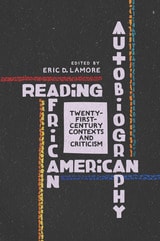
Reading African American Autobiography
Twenty-First-Century Contexts and CriticismEdited by Eric D. Lamore
University of Wisconsin Press, 2016
The life narratives studied range from an eighteenth-century criminal narrative, a 1918 autobiography, and the works of Richard Wright to new media, graphic novels, and a celebrity memoir from Pam Grier.
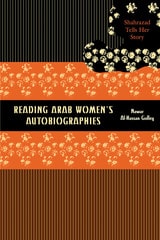
Reading Arab Women's Autobiographies
Shahrazad Tells Her StoryBy Nawar Al-Hassan Golley
University of Texas Press, 2003
Authors of autobiographies are always engaged in creating a "self" to present to their readers. This process of self-creation raises a number of intriguing questions: why and how does anyone choose to present herself or himself in an autobiography? Do women and men represent themselves in different ways and, if so, why? How do differences in culture affect the writing of autobiography in various parts of the world?
This book tackles these questions through a close examination of Arab women's autobiographical writings. Nawar Al-Hassan Golley applies a variety of western critical theories, including Marxism, colonial discourse, feminism, and narrative theory, to the autobiographies of Huda Shaarawi, Fadwa Tuqan, Nawal el-Saadawi, and others to demonstrate what these critical methodologies can reveal about Arab women's writing. At the same time, she also interrogates these theories against the chosen texts to see how adequate or appropriate these models are for analyzing texts from other cultures. This two-fold investigation sheds important new light on how the writers or editors of Arab women's autobiographies have written, documented, presented, and organized their texts.
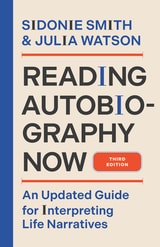
Reading Autobiography Now
An Updated Guide for Interpreting Life Narratives, Third EditionSidonie Smith
University of Minnesota Press, 2024
A user-friendly guide to reading, writing, and theorizing autobiographical texts and practices for students, scholars, and practitioners of life narrative
The boom in autobiographical narratives continues apace. It now encompasses a global spectrum of texts and practices in such media as graphic memoir, auto-photography, performance and plastic arts, film and video, and online platforms. Reading Autobiography Now offers both a critical engagement with life narrative in historical perspective and a theoretical framework for interpreting texts and practices in this wide-ranging field. Hailed upon its initial publication as “the Whole Earth Catalog of autobiography studies,” this essential book has been updated, reorganized, and expanded in scope to serve as an accessible and contemporary guide for scholars, students, and practitioners.
Sidonie Smith and Julia Watson explore definitions of life narrative, probe issues of subjectivity, and outline salient features of autobiographical acts and practices. In this updated edition, they address emergent topics such as autotheory, autofiction, and autoethnography; expand the discussions of identity, relationality, and agency; and introduce new material on autobiographical archives and the profusion of “I”s in contemporary works. Smith and Watson also provide a helpful toolkit of strategies for reading life narrative and an extensive glossary of mini-essays analyzing key theoretical concepts and dozens of autobiographical genres.
An indispensable exploration of this expansive, transnational, multimedia field, Reading Autobiography Now meticulously unpacks the heterogeneous modes of life narratives through which people tell their stories, from traditional memoirs and trauma narratives to collaborative life narrative and autobiographical comics.
Reading Autobiography
A Guide for Interpreting Life NarrativesSidonie Smith
University of Minnesota Press, 2002
Recovering Bodies
Illness, Disability, and Life WritingG. Thomas Couser
University of Wisconsin Press, 1997
Responding to the recent growth of illness and disability narratives in the United States—such works as Juliet Wittman’s Breast Cancer Journal, John Hockenberry’s Moving Violations, Paul Monette’s Borrowed Time: An AIDS Memoir, and Lou Ann Walker’s A Loss for Words: The Story of Deafness in a Family—Couser addresses questions of both poetics and politics. He examines why and under what circumstances individuals choose to write about illness or disability; what role plot plays in such narratives; how and whether closure is achieved; who assumes the prerogative of narration; which conditions are most often represented; and which literary conventions lend themselves to representing particular conditions. By tracing the development of new subgenres of personal narrative in our time, this book explores how explicit consideration of illness and disability has enriched the repertoire of life writing. In addition, Couser’s discussion of medical discourse joins the current debate about whether the biomedical model is entirely conducive to humane care for ill and disabled people.
With its sympathetic critique of the testimony of those most affected by these conditions, Recovering Bodies contributes to an understanding of the relations among bodily dysfunction, cultural conventions, and identity in contemporary America.
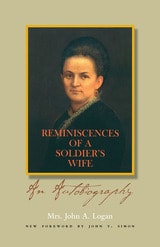
Reminiscences of a Soldier's Wife
An AutobiographyMrs. John A. Logan. Foreword by John Y. Simon
Southern Illinois University Press, 1997
"To tell my own story is to tell that of my famous husband, General John A. Logan," explains Mary S. Logan in the preface to her autobiography.
Married to John A. Logan for thirty-one years, Mary Logan shared in her distinguished husband’s career as a prosecutor in southern Illinois, as a Civil War general, and as a senator from Illinois. She observed firsthand the extraordinary events before, during, and after the Civil War, and she knew personally those world leaders who held the power to shape history. After the death of her husband, she maintained her influence in Washington, D.C. "Under the brightest and darkest skies," she explains, "I have passed than a half-century at the national capital."
Born in 1838, Logan writes of her early days growing up in southern Illinois through 1913, when this book was first published. A skillful observer, she recounts events that are personal, regional, and national in scope. In charming detail, she shares her courtship and subsequent marriage to a young prosecutor from Jackson County and the births of their children. She writes proudly of the Lincoln-Douglas debates in 1858 and her husband’s election to the Thirty-seventh Congress that same year. Logan tells of the coming of the Civil War and of her husband—formerly a Democrat and an enemy of Lincoln—casting his fate with the Union and raising a regiment in southern Illinois. She poignantly describes her brother’s defection to the Confederate Army, her life in war-torn Cairo, Illinois, and her horror at her husband’s severe war wounds. She recounts the battles, the political campaigns, and Lincoln’s reelection and subsequent assassination from her point of view—and, as the wife of a politician and general, hers is a decidedly privileged perspective.
In a position to observe and to participate in events ranging from momentous to minute throughout the latter half of the nineteenth and early twentieth centuries, she reports the essential episodes of history with the flair of journalism, a career she in fact embraced after the death of her husband. She writes movingly of a wounded captain on the road to recovery who suddenly died when the minié shifted next to his lung, amusingly of the excuses soldiers invented to wrangle a pass to town, and elegantly of her trips to Europe and of the pomp and circumstance of the parties attended by the great men and women of the time. Drawing on events grand and small, she re-creates history as only a skillful writer who was in the right place at the right time could.