Results by title
277 books match the query 'Biology' and 5 start with r
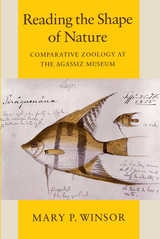
Reading the Shape of Nature
Comparative Zoology at the Agassiz MuseumMary P. Winsor
University of Chicago Press, 1991
In 1859, Louis Agassiz established the Museum of Comparative Zoology to house research on the ideal types that he believed were embodied in all living forms. Agassiz's vision arose from his insistence that the order inherent in the diversity of life reflected divine creation, not organic evolution. But the mortar of the new museum had scarcely dried when Darwin's Origin was published. By Louis Agassiz's death in 1873, even his former students, including his son Alexander, had defected to the evolutionist camp. Alexander, a self-made millionaire, succeeded his father as director and introduced a significantly different agenda for the museum.
To trace Louis and Alexander's arguments and the style of science they established at the museum, Winsor uses many fascinating examples that even zoologists may find unfamiliar. The locus of all this activity, the museum building itself, tells its own story through a wonderful series of archival photographs.
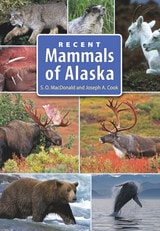
Recent Mammals of Alaska
Stephen O. MacDonald and Joseph A. Cook
University of Alaska Press, 2009
From the polar bear and the gray wolf to the walrus and river otter, there are 115 species of mammals in Alaska that have never been fully catalogued until now. Biologists Joseph A. Cook and Stephen O. MacDonald have compiled here the first comprehensive guide to all of Alaska’s mammals, big and small, endearing and ferocious.
Through extensive fieldwork and research the authors have produced a unique and authoritative reference. Detailed entries for each species include distribution and taxonomic information, status, habitat, and fossil history. Appendices include quick reference listings of mammal distribution by region, specimen locations, conservation status, and the incidence of Pleistocene mammals. The guide is generously illustrated with line drawings by Alaskan artist W. D. Berry and includes several maps indicating populations and locations of species.
Mammals of Alaska will be an accessible, easy to use source for scholars and hobbyists alike.
Regenerating Japan
Organicism, Modernism and National Destiny in Oka Asajiro's Evolution and Human LifeGregory Sullivan
Central European University Press, 2018
As the first step toward a comprehensive reinterpretation of the role of evolutionary science and biomedicine in pre-1945 Japan, this book addresses the early writings of that era’s most influential exponent of shinkaron (evolutionism), the German-educated research zoologist and popularizer of biomedicine, Oka Asajirō (1868–1944). Concentrating on essays that Oka published in the years during and after the Russo-Japanese War (1904–5), the author describes the process by which Oka came to articulate a programmatic modernist vision of national regeneration that would prove integral to the ideological climate in Japan during the first half of the twentieth century. In contrast to other scholars who insist that Oka was merely a rationalist enlightener bent on undermining state Shinto orthodoxy, Gregory Sullivan maintains that Oka used notions from evolutionary biology of organic individuality—especially that of the nation as a super-organism—to underwrite the social and geopolitical aims of the Meiji state.
The author suggests that this generative scientism gained wide currency among early twentieth-century political and intellectual elites, including Emperor Hirohito himself, who had personal connections to Oka. The wartime ideology may represent an unfinished attempt to synthesize Shinto fundamentalism and the eugenically-oriented modernism that Oka was among the first to articulate.
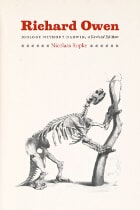
Richard Owen
Biology without DarwinNicolaas A. Rupke
University of Chicago Press, 2009
In the mid-1850s, no scientist in the British Empire was more visible than Richard Owen. Mentioned in the same breath as Isaac Newton and championed as Britain’s answer to France’s Georges Cuvier and Germany’s Alexander von Humboldt, Owen was, as the Times declared in 1856, the most “distinguished man of science in the country.” But, a century and a half later, Owen remains largely obscured by the shadow of the most famous Victorian naturalist of all, Charles Darwin. Publicly marginalized by his contemporaries for his critique of natural selection, Owen suffered personal attacks that undermined his credibility long after his name faded from history.
With this innovative biography, Nicolaas A. Rupke resuscitates Owen’s reputation. Arguing that Owen should no longer be judged by the evolution dispute that figured in only a minor part of his work, Rupke stresses context, emphasizing the importance of places and practices in the production and reception of scientific knowledge. Dovetailing with the recent resurgence of interest in Owen’s life and work, Rupke’s book brings the forgotten naturalist back into the canon of the history of science and demonstrates how much biology existed with, and without, Darwin
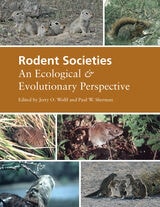
Rodent Societies
An Ecological and Evolutionary PerspectiveEdited by Jerry O. Wolff and Paul W. Sherman
University of Chicago Press, 2007
Rodent Societies synthesizes and integrates the current state of knowledge about the social behavior of rodents, providing ecological and evolutionary contexts for understanding their societies and highlighting emerging conservation and management strategies to preserve them. It begins with a summary of the evolution, phylogeny, and biogeography of social and nonsocial rodents, providing a historical basis for comparative analyses. Subsequent sections focus on group-living rodents and characterize their reproductive behaviors, life histories and population ecology, genetics, neuroendocrine mechanisms, behavioral development, cognitive processes, communication mechanisms, cooperative and uncooperative behaviors, antipredator strategies, comparative socioecology, diseases, and conservation. Using the highly diverse and well-studied Rodentia as model systems to integrate a variety of research approaches and evolutionary theory into a unifying framework, Rodent Societies will appeal to a wide range of disciplines, both as a compendium of current research and as a stimulus for future collaborative and interdisciplinary investigations.