Results by title
85 books match the query 'Black' and 5 start with r

Red and Black
A Chronicle of 1830Raymond N. Stendhal
University of Minnesota Press, 2022
A masterpiece of nineteenth-century literature in a fresh translation that fully captures the language, psychology, and social reach of Stendhal’s original
Fueled with a combustible mix of ambition, naivete, and Napoleonic ideals, Julien Sorel sets his sights on the heights of French society. But for the son of a provincial carpenter in post-Napoleonic France, the prospects for advancement are vanishingly narrow, the chances for glory rarer yet. After securing a toehold as a tutor to a wealthy family, Julien proceeds through a series of misadventures, illicit affairs, and lucky reversals to breach the ranks of French aristocracy—only to be undone by treasonous schemes, cynical romantic calculations, and an unexpectedly genuine and ultimately disastrous passion.
Shocking at the time of its original publication, startling in its relevance today, Stendhal’s masterpiece is a scorching social satire, a remarkably detailed portrait of a fraught moment in history and, as perhaps the first psychological novel, a brilliant precursor to modern literature at once comical and tragic, cerebral and passionate. This new translation faithfully reproduces the nimble wit, emotional depth, and social acuity of Stendhal’s text. Distinguished translator Raymond N. MacKenzie includes an extensive introduction to Stendhal’s world and time, as well as copious annotations that explain allusions and terms for the modern reader.

Red, Black, and Jew
New Frontiers in Hebrew LiteratureBy Stephen Katz
University of Texas Press, 2009
Between 1890 and 1924, more than two million Jewish immigrants landed on America's shores. The story of their integration into American society, as they traversed the difficult path between assimilation and retention of a unique cultural identity, is recorded in many works by American Hebrew writers. Red, Black, and Jew illuminates a unique and often overlooked aspect of these literary achievements, charting the ways in which the Native American and African American creative cultures served as a model for works produced within the minority Jewish community.
Exploring the paradox of Hebrew literature in the United States, in which separateness, and engagement and acculturation, are equally strong impulses, Stephen Katz presents voluminous examples of a process that could ultimately be considered Americanization. Key components of this process, Katz argues, were poems and works of prose fiction written in a way that evoked Native American forms or African American folk songs and hymns. Such Hebrew writings presented America as a unified society that could assimilate all foreign cultures. At no other time in the history of Jews in diaspora have Hebrew writers considered the fate of other minorities to such a degree. Katz also explores the impact of the creation of the state of Israel on this process, a transformation that led to ambivalence in American Hebrew literature as writers were given a choice between two worlds.
Reexamining long-neglected writers across a wide spectrum, Red, Black, and Jew celebrates an important chapter in the history of Hebrew belles lettres.
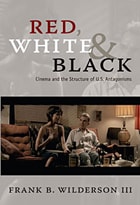
Red, White & Black
Cinema and the Structure of U.S. AntagonismsFrank B. Wilderson III
Duke University Press, 2010
Wilderson provides detailed readings of two films by Black directors, Antwone Fisher (Denzel Washington) and Bush Mama (Haile Gerima); one by an Indian director, Skins (Chris Eyre); and one by a White director, Monster’s Ball (Marc Foster). These films present Red and Black people beleaguered by problems such as homelessness and the repercussions of incarceration. They portray social turmoil in terms of conflict, as problems that can be solved (at least theoretically, if not in the given narratives). Wilderson maintains that at the narrative level, they fail to recognize that the turmoil is based not in conflict, but in fundamentally irreconcilable racial antagonisms. Yet, as he explains, those antagonisms are unintentionally disclosed in the films’ non-narrative strategies, in decisions regarding matters such as lighting, camera angles, and sound.

Reimaging Britain
500 Years of Black and Asian HistoryRon Ramdin
Pluto Press, 1999
Blacks and Asians have a long history in the British Isles. Ramdin illustrates this by covering a 500-year period, from 1500 to the present day. He recounts the major historical episodes and covers all the major figures, including Ottobah Cugoano, William Cuffay, William Davidson, George Padmore, Mary Seacole, C.L.R. James, V.S. Naipaul, Sam Selvon, Walter Tull, Shirley Bassey, Bill Morris, Salman Rushdie, Hanif Kureshi and Bernie Grant.
In bringing the largely hidden histories of these immigrant communities to the fore, Ron Ramdin’s wide-ranging study challenges conventional histories of the British Isles. Reimaging Britain will lead to a reappraisal of how ‘British’ history is written in the future.
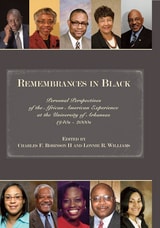
Remembrances in Black
Personal Perspectives of the African American Experience at the University of Arkansas, 1940s–2000sCharles F. Robinson II
University of Arkansas Press, 2015