Results by title
178 books match the query 'Book' and 3 start with r
Reading Randomised Controlled Trials
Opening the BookRobert Savage, Amy Fox, Anneka Dawson, Helen Gray, and Clare Huxley
University College London, 2025
A behind-the-scenes look at a large-scale reading intervention trial, exposing the human decisions and real-world challenges that shape educational research.
Reading Randomised Controlled Trials presents an illuminating exploration of how large-scale educational trials unfold in real-world settings, displaying the often-overlooked human decisions that shape their outcomes. Using the Flexible Phonics trial—an ambitious study involving nearly 3,000 children in 118 schools across England—as a case study, the authors examine the practical and ethical problems with conducting randomized controlled trials (RCTs) in education. Unlike pharmaceutical trials, educational RCTs operate in dynamic environments where factors such as teacher decision-making and school culture play a crucial role.
This book depicts the inner workings of education research and also underlines its broader significance, particularly in the wake of school closures during the COVID-19 pandemic. By focusing on early childhood literacy and the long-term impact of evidence-based interventions, Reading Randomised Controlled Trials provides important insights for educators and researchers seeking to bridge the gap between rigorous research and meaningful classroom practice. A must-read for those invested in improving educational outcomes, this book contests assumptions about what works in education—and why.
[more]
Reading the Book of Nature
How Eight Best Sellers Reconnected Christianity and the Sciences on the Eve of the Victorian AgeJonathan R. Topham
University of Chicago Press, 2022
A powerful reimagining of the world in which a young Charles Darwin developed his theory of evolution.
When Charles Darwin returned to Britain from the Beagle voyage in 1836, the most talked-about scientific books of the day were the Bridgewater Treatises. This series of eight works was funded by a bequest of the last Earl of Bridgewater and written by leading men of science appointed by the president of the Royal Society to explore "the Power, Wisdom, and Goodness of God, as manifested in the Creation." Securing public attention beyond all expectations, the series offered Darwin’s generation a range of approaches to one of the great questions of the age: how to incorporate the newly emerging disciplinary sciences into Britain’s overwhelmingly Christian culture.
Drawing on a wealth of archival and published sources, including many unexplored by historians, Jonathan R. Topham examines how and to what extent the series contributed to a sense of congruence between Christianity and the sciences in the generation before the fabled Victorian conflict between science and religion. Building on the distinctive insights of book history and paying close attention to the production, circulation, and use of the books, Topham offers new perspectives on early Victorian science and the subject of science and religion as a whole.
[more]
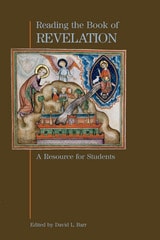
Reading the Book of Revelation
A Resource for StudentsDavid L. Barr
SBL Press, 2003
The Apocalypse lends itself to multivalent readings, and this volume fills a gap for students and scholars by discussing how different methods apply to readings. Using historical, literary, and social analysis in combination with strategies such as social-conflict theory, philosophy, women’s studies, ethics, history of religions, postcolonial studies, and popular culture, the essays in this volume focus on specific texts and show not only how each helps interpret the text but also how diverse methods produce divergent readings of a text. Developed as a classroom resource for undergraduates, this work will also prove useful to graduate students, religious leaders, and others who wish to explore how methods shape our understandings of various texts, including Revelation.
[more]