Results by title
81 books match the query 'Boston' and 4 start with r
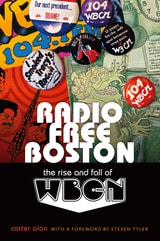
Radio Free Boston
The Rise and Fall of WBCNCarter Alan
University Press of New England, 2013
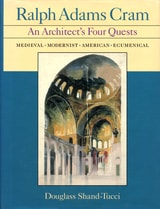
Ralph Adams Cram
An Architect's Four QuestsDouglass Shand-Tucci
University of Massachusetts Press, 2005
With his partner Bertram Goodhue, Cram won a number of important commissions, beginning with the West Point competition in 1903. Although an increasingly bitter rivalry with Goodhue would lead to the dissolution of their partnership in 1912, Cram had already begun to strike out on his own. Supervising architect at Princeton, consulting architect at Wellesley, and head of the MIT School of Architecture, he would also design most of New York's Cathedral of St. John the Divine and the campus of Rice University, as well as important church and collegiate structures throughout the country. By the 1920s Cram had become a household name, even appearing on the cover of Time magazine.
A complex man, Cram was a leading figure in what Shand-Tucci calls "a full-fledged homosexual monastery" in England, while at the same time married to Elizabeth Read. Their relationship was a complicated one, the effect of which on his children and his career is explored fully in this book. So too is his work as a religious leader and social theorist.
Shand-Tucci traces the influence on Cram of such disparate figures as Franklin Delano Roosevelt, Phillips Brooks, Henry Adams, and Ayn Rand. He divides Cram's career into four lifelong "quests": medieval, modernist, American, and ecumenical. Some quests may have failed, but in each he left a considerable legacy, ultimately transforming the visual image of American Christianity in the twentieth century.
Handsomely illustrated with over 130 photographs and drawings and eight pages of color plates, Ralph Adams Cram can be read on its own or in conjunction with Boston Bohemia, 1881–1900. Together, the two volumes complete what the Christian Century has described as a "superbly researched and captivating biography."
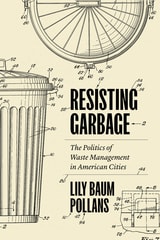
Resisting Garbage
The Politics of Waste Management in American CitiesLily Baum Pollans
University of Texas Press, 2021
Resisting Garbage presents a new approach to understanding practices of waste removal and recycling in American cities, one that is grounded in the close observation of case studies while being broadly applicable to many American cities today.
Most current waste practices in the United States, Lily Baum Pollans argues, prioritize sanitation and efficiency while allowing limited post-consumer recycling as a way to quell consumers’ environmental anxiety. After setting out the contours of this “weak recycling waste regime,” Pollans zooms in on the very different waste management stories of Seattle and Boston over the last forty years. While Boston’s local politics resulted in a waste-export program with minimal recycling, Seattle created new frameworks for thinking about consumption, disposal, and the roles that local governments and ordinary people can play as partners in a project of resource stewardship. By exploring how these two approaches have played out at the national level, Resisting Garbage provides new avenues for evaluating municipal action and fostering practices that will create environmentally meaningful change.
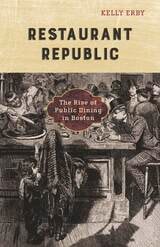
Restaurant Republic
The Rise of Public Dining in BostonKelly Erby
University of Minnesota Press, 2016
Before the 1820s, the vast majority of Americans ate only at home. As the nation began to urbanize and industrialize, home and work became increasingly divided, resulting in new forms of commercial dining.
In this fascinating book, Kelly Erby explores the evolution of such eating alternatives in Boston during the nineteenth century. Why Boston? Its more modest assortment of restaurants, its less impressive—but still significant—expansion in commerce and population, and its growing diversity made it more typical of the nation’s other urban centers than New York. Restaurants, clearly segmented along class, gender, race, ethnic, and other lines, helped Bostonians become more comfortable with deepening social stratification in their city and young republic even as the experience of eating out contributed to an emerging public consumer culture.
Restaurant Republic sheds light on how commercial dining both reflected and helped shape growing fragmentation along lines of race, class, and gender—from the elite Tremont House, which served fashionable French cuisine, to such plebeian and ethnic venues as oyster saloons and Chinese chop suey houses. The epilogue takes us to the opening, in 1929 near Boston, of the nation’s first Howard Johnson’s and that restaurant’s establishment as a franchise in the next decade. The result is a compelling story that continues to shape America.