Results by title
379 books match the query 'Botany' and 7 start with r
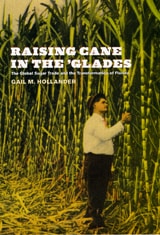
Raising Cane in the 'Glades
The Global Sugar Trade and the Transformation of FloridaGail M. Hollander
University of Chicago Press, 2008
Using, among other sources, interviews, government and corporate documents, and recently declassified U.S. State Department memoranda, Gail M. Hollander demonstrates that the development of Florida’s sugar region was the outcome of pitched battles reaching the highest political offices in the U.S. and in countries around the world, especially Cuba—which emerges in her narrative as a model, a competitor, and the regional “other” to Florida’s “self.” Spanning the period from the age of empire to the era of globalization, the book shows how the “sugar question”—a label nineteenth-century economists coined for intense international debates on sugar production and trade—emerges repeatedly in new guises. Hollander uses the sugar question as a thread to stitch together past and present, local and global, in explaining Everglades transformation.
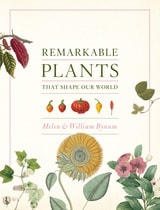
Remarkable Plants That Shape Our World
Helen Bynum and William Bynum
University of Chicago Press, 2014
Remarkable Plants celebrates the wonder and utility of the green kingdom, taking a detailed look at how plants have shaped our world. It focuses on eighty key species and richly explores their history, highlighting their importance and bringing to light surprising stories. Organized thematically into eight sections, the book starts with “Transformers” (including rice, beans, olives) and moves through sections such as “Heal and Harm” (poppy, aloe, strychnos) and “Revered and Adored” (lotus, frankincense, rose). Each species is introduced with its common and scientific names and followed by an exploration of its cultural, historical, botanical, and symbolic associations. Hundreds of botanical illustrations show full plants as well as highlight distinctive leaves, blooms, and fruits.
Rooted in one of the world’s most important and renowned temples of greenery, the Royal Botanic Gardens, Kew, Remarkable Plants is a symbiotic balance of science and art that will open readers’ eyes to the deep influence of the natural world on our modern one.

Remarkable Trees
Christina Harrison and Tony Kirkham
University of Chicago Press, 2019
Remarkable Trees tells the unique story of more than sixty species, each selected for its resonance and connection with people. In portraits that combine vivid cultural and historical narrative with a firm scientific grounding, Christina Harrison and Tony Kirkham reveal fascinating details of trees from the world’s major environmental zones and habitats. Some are obvious superstars such as oaks, redwoods and coconut, while others are more surprising: we learn of the monkey puzzle, a tree native to Chile that “can grow for 1,000 years,” and of the manchineel, a tree that contains sap so toxic to human skin that it’s a risk to stand beneath it on a rainy day. In these pages are trees that are healers and killers, trees that serve as foundations of great buildings and grand feasts, and trees that leave us with a sense of wonder and of worry for their survival.
In a tribute to the artists and botanists who have been inspired by trees for centuries, this book is filled with 240 delightful illustrations. The varied and beautiful images come from the unrivalled archive at the Royal Botanic Gardens, Kew, and they bring this enlightening and enchanting volume to life.
While trees have supported us for millennia, we have recently lost that direct, deep connection with them. Harrison and Kirkham remind us that we do not have to look far to reestablish that relationship and that we can still cherish the splendor and significance of these quiet giants.
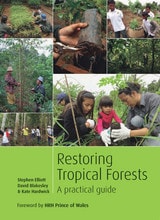
Restoring Tropical Forests
A Practical GuideStephen Elliott, David Blakesley, and Kate Hardwick
Royal Botanic Gardens, Kew, 2013
The book is based on the innovative techniques developed at Chiang Mai University’s Forest Restoration Research Unit, Thailand. It takes a threepart approach, first looking at effective general concepts of tropical forest dynamics and regeneration, then at specific proven restoration techniques, and finally at how to use research methods to refine and adapt the techniques to local ecological and socioeconomic conditions. In addition, illustrations and case studies of successful applications help to make this a global, user-friendly guide. Whether for developing new techniques or improving old ones, Restoring Tropical Forests is a valuable tool for effective, ecologically sound change.
Restoring Tropical Forests
A Practical Guide (French Edition)Stephen Elliott, David Blakesley, and Kate Hardwick
Royal Botanic Gardens, Kew, 2014
The book is based on the innovative techniques developed at Chiang Mai University’s Forest Restoration Research Unit, Thailand. It takes a threepart approach, first looking at effective general concepts of tropical forest dynamics and regeneration, then at specific proven restoration techniques, and finally at how to use research methods to refine and adapt the techniques to local ecological and socioeconomic conditions. In addition, illustrations and case studies of successful applications help to make this a global, user-friendly guide. Whether for developing new techniques or improving old ones, Restoring Tropical Forests is a valuable tool for effective, ecologically sound change.
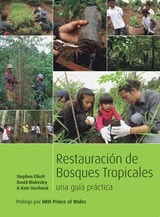
Restoring Tropical Forests
A Practical Guide (Spanish Edition)Stephen Elliott, David Blakesley, and Kate Hardwick
Royal Botanic Gardens, Kew, 2014
The book is based on the innovative techniques developed at Chiang Mai University’s Forest Restoration Research Unit, Thailand. It takes a threepart approach, first looking at effective general concepts of tropical forest dynamics and regeneration, then at specific proven restoration techniques, and finally at how to use research methods to refine and adapt the techniques to local ecological and socioeconomic conditions. In addition, illustrations and case studies of successful applications help to make this a global, user-friendly guide. Whether for developing new techniques or improving old ones, Restoring Tropical Forests is a valuable tool for effective, ecologically sound change.
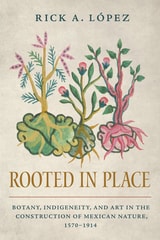
Rooted in Place
Botany, Indigeneity, and Art in the Construction of Mexican Nature, 1570–1914Rick A. López
University of Arizona Press, 2025
Prize for Best Book in Environmental Studies, Latin American Studies Association
Honorable mention for Best Book Prize in Visual Culture, Latin American Studies Association
Honorable mention for Best Book on Mexico, Latin American Studies Association
Since the first moment of conquest, colonizers and the colonized alike in Mexico confronted questions about what it meant to be from this place, what natural resources it offered, and who had the right to control those resources and on what basis.
Focusing on the ways people, environment, and policies have been affected by political boundaries, historian Rick A. López explores the historical connections between political identities and the natural world. López analyzes how scientific intellectuals laid claim to nature within Mexico, first on behalf of the Spanish Empire and then in the name of the republic, during three transformative moments: the Hernández expedition of the late sixteenth century; the Royal Botanical Expedition of the late eighteenth century; and the heyday of scientific societies such as the Sociedad Mexicana de Historia Natural of the late nineteenth century.
This work traces how scientific intellectuals studied and debated what it meant to know and claim the flora that sprang from Mexican soil—ranging from individual plants to forests and vegetated landscapes—and the importance they placed on indigeneity. It also points to the short- and long-term consequences of these efforts. López draws on archival and published sources produced from the sixteenth century through the start of the twentieth century and gives special attention to the use of visual images such as scientific illustrations and landscape art. López employs the term “visualization” in recognition of the degree to which officials, botanists, and draftsmen produced imagery and also how they and others viewed nature.
Rooted in Place reveals how scientific endeavors were not just about cataloging flora but were deeply intertwined with the construction of identity and the political landscape at three pivotal moments in Mexican history.