Results by title
60 books match the query 'Britain' and 4 start with r
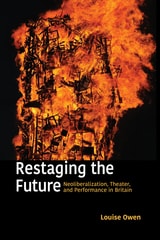
Restaging the Future
Neoliberalization, Theater, and Performance in BritainLouise Owen
Northwestern University Press, 2023
Post-Thatcher, British cultural politics were shaped by the government’s use of the arts in service of its own social and economic agenda. Restaging the Future: Neoliberalization, Theater, and Performance in Britain interrogates how arts practices and cultural institutions were enmeshed with the particular processes of neoliberalization mobilized at the end of the twentieth century and into the twenty-first.
Louise Owen traces the uneasy entanglement of performance with neoliberalism's marketization of social life. Focusing on this political moment, Owen guides readers through a wide range of performance works crossing multiple forms, genres, and spaces—from European dance tours, to Brazilian favelas, to the streets of Liverpool—attending to their distinct implications for the reenvisioned future in whose wake we now live.
Analyzing this array of participatory dance, film, music, public art, and theater projects, Owen uncovers unexpected affinities between community-based, experimental, and avant-garde movements. Restaging the Future provides key historical context for these performances, their negotiations of their political moment, and their themes of insecurity, identity, and inequality, created in a period of profound ideological and socioeconomic change.

Rheumatic Fever in America and Britain
A Biological, Epidemiological, and Medical HistoryPeter C. English
Rutgers University Press, 1999
Rheumatic Fever in America and Britain is the first book to examine comprehensively a disease that has been a moving target for physicians and health care workers. A disease of skin, brain, heart, connective tissue, blood, tonsils, and joints bound to a member of the streptococcus family of bacteria, this illness has practically disappeared from the present-day scene. Yet in 1940 more than one million Americans suffered from the heart disease that followed the ravages of rheumatic fever. It struck nearly 2 percent of all school-aged children, filling hospitals, convalescent homes, and special schools.
Rheumatic fever rose in prevalence throughout the nineteenth century, reaching its peak in that century's last decades, and then steadily declined-both in occurrence and severity-throughout the twentieth century. In the nineteenth century, acute rheumatic fever was largely a disease of children and young adults. Another remarkable epidemiological change occurred during the twentieth century; rheumatic fever shifted its character, became milder, and in doing so allowed its victims to live longer, if disabled lives. As this disease so altered, adults increasingly became its victims.
Dr. Peter C. English explores both the shifting biological nature of this disease and the experiences of physicians and patients who fought its ravages. Using insights from biology, epidemiology, and social history, Dr. English-both a physician and medical historian-is uniquely suited to unravel this disease's epidemiological and cultural complexities.

Roads to Rome
A Guide to Notable Converts from Britain and Ireland from the Reformation to theJohn Beaumont
St. Augustine's Press, 2010
To be a Christian is to be a convert. The word “convert” applies in a real sense both to cradle-born Catholics and to those, traditionally regarded as converts, who become Catholics as adults. The Catholic Church is the divinely established framework of the program of a conversion, which Christ presented as a thorough change of mind and heart (metanoia). While for a cradle-born Catholic the implementation of that program is usually a gradual process, for converts it contains a momentous act as they vote, so to speak, with their feet, on behalf of Truth, by joining the Church as the One True Fold, the Sole Ark of Salvation, to recall hallowed phrases dear to John Henry Newman, easily the greatest convert during the nineteenth century.
The aim of this book is to summarize the lives of notable converts from Britain and Ireland and explain (by reference to quotations from their writings) why they entered the Catholic Church. These reasons were many. Some looked chiefly at history and saw the apostolic Church in their day to be residing in the Catholic communion. Others, though appreciating the fact of the gift of faith, saw reason as the chief support of the step they were taking. To yet others it was the endurance of both the Church and that remarkable office of the papacy that proved the necessary stimulus. Many were inspired by the witness of some unsung saint in their neighbourhood. Some were eminent even before their “move to Rome,” others almost completely unknown. Some found fame on their conversion, others suffered greatly for their zeal for the one true fold of Christ. Some came into the Church relatively early in life, others entered at the final hour, even while on their death bed.
Taken altogether these accounts provide a profound and moving witness to the operation of divine grace in human souls.

Roy Pascal and Georg Lukács
Towards a Re-Evaluation of the History of Marxist Literary Criticism in Britain?Helmut Peitsch
University of London Press, 2018