Results by title
61 books match the query 'Business Development' and 4 start with r
R&D and Productivity
The Econometric EvidenceZvi Griliches
University of Chicago Press, 1998
Zvi Griliches, a world-renowned pioneer in the field of productivity growth, has compiled in a single volume his pathbreaking research on R&D and productivity. Griliches addresses the relationship between research and development (R&D) and productivity, one of the most complex yet vital issues in today's business world. Using econometric techniques, he establishes this connection and measures its magnitude for firm-, industry-, and economy-level data.
Griliches began his studies of productivity growth during the 1950s, adding a variable of "knowledge stock" to traditional production function models, and his work has served as the point of departure for much of the research into R&D and productivity. This collection of essays documents both Griliches's distinguished career as well as the history of this line of thought.
As inputs into production increasingly taking the form of "intellectual capital" and new technologies that are not as easily measured as traditional labor and capital, the methods Griliches has refined and applied to R&D become crucial to understanding today's economy.
[more]
R&D, Patents and Productivity
Edited by Zvi Griliches
University of Chicago Press, 1984
Zvi Griliches, a world-renowned pioneer in the field of productivity growth, has compiled in a single volume his pathbreaking research on R&D and productivity. Griliches addresses the relationship between research and development (R&D) and productivity, one of the most complex yet vital issues in today's business world. Using econometric techniques, he establishes this connection and measures its magnitude for firm-, industry-, and economy-level data.
[more]
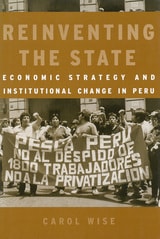
Reinventing the State
Economic Strategy and Institutional Change in PeruCarol Wise
University of Michigan Press, 2003
The political economic history of Latin America in the post-World War II era has largely been one of underachievement and opportunities lost. This all changed with the wave of market reforms that were implemented in the 1990s. However, the precise role of these reforms as an agent of change is still hotly debated. This in-depth analysis of the Peruvian case argues for an explanation that treats institutional innovation and state reconstruction as necessary conditions for the apparent success of the market in Latin America.
Exploring how state intervention has been both the cause of Latin America's economic downfall in the 1980s and the solution to its recovery, Reinventing the State analyzes three main phases of state intervention: the developmentalism that lasted until 1982, the state in retreat of the 1980s, and the streamlined state of the 1990s. Through a comprehensive examination of the Peruvian experience, the book explains the country's impressive turnaround from the standpoint of institutional modernization and internal state reform.
Written for a broad academic audience, the public-policy community, and the private sector, this book is also meant as a quick primer for any journalist, consultant, or private-sector analyst in need of an overview of the region's market-reform effort and how it has played out in Peru.
Carol Wise is Associate Professor, School of International Relations, University of Southern California.
[more]
Rethinking Sustainability
Power, Knowledge, and InstitutionsJonathan Harris, Editor
University of Michigan Press, 2003
Bringing together the thoughts of economists, political scientists, anthropologists, philosophers, and agricultural policy professionals, this volume focuses on the issues of sustainability in development. Examining such topics as international trade, political power, gender roles, legal institutions, and agricultural research, the contributors focus on the missing links in theory and practice that have been barriers to the achievement of truly sustainable development.
Any theory of sustainable development must take into account economic, social, and environmental dimensions. Until recently, the question "What is development?" was often answered predominantly from the economist's perspective, with high priority being assigned to expansion of economic output. Social, political, institutional, and ethical aspects have often been neglected. But now that sustainable development has become a broadly accepted concept, it is impossible to maintain a narrowly economistic view of development. For this reason, the varied perspectives offered by the contributors to this volume are crucial to understanding the process of development as it relates to environmental sustainability and human well-being.
The selection of articles is meant to be stimulating and provocative rather than comp-rehensive. They are roughly divided between those dealing with broad theoretical issues concerning the economic, political, and social aspects of development (Part I) and those presenting more applied analysis (Part II). The common thread is a concern for examining which factors contribute to making development socially just and environmentally sound.
Rethinking Sustainability will be of interest to economists and social scientists, development professionals, and instructors seeking to offer their students a broad perspective on development issues.
Jonathan Harris is Senior Research Associate, Global Development and Environment Institute at Tufts University, as well as Adjunct Associate Professor of International Economics at Tufts University Fletcher School of Law.
[more]