Results by title
80 books match the query 'Catalogs' and 7 start with r
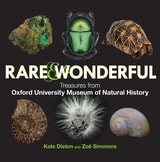
Rare and Wonderful
Treasures from the Oxford University Museum of Natural HistoryKate Diston and Zoë Simmons
Bodleian Library Publishing, 2018
This lavishly illustrated book features highlights from the collections, ranging from David Livingstone’s tsetse fly specimens to Mary Anning’s ichthyosaur, and from crabs collected by Darwin during his voyage on the Beagle to the iconic Dodo, the only soft tissue specimen of the species in existence. Also featured are the first described dinosaur bones, found in a small Oxfordshire village, the Red Lady of Paviland (who was in fact a man who lived 29,000 years ago), and a meteorite from the planet Mars.
Each item tells a unique story about natural history, the history of science, collecting, or the museum itself. Rare & Wonderful offers unique insight into the extraordinary wealth of information and fascinating tales that can be gleaned from these collections.

Rijksmuseum
The Building, the Collection and the Outdoor GalleryEdited by Cees W. de Jong and Patrick Spijkerman
Amsterdam University Press, 2015
The museum recently reopened after a ten-year renovation that cost more than $400 million, and the result is stunning: never before has the Rijksmuseum’s collection been displayed so well. This book offers a lavishly illustrated chronicle of both the collection and the building that houses it. Though nothing can replace an actual trip to the Rijksmuseum—as the more than two million annual visitors can attest—this book comes as close as possible, taking art lovers on a virtual tour of the greatest masterworks of Western art in a building that is brilliantly designed to show them at their best.

Robert Kipniss
Paintings and Poetry, 1950–1964Robert Kipniss
The Artist Book Foundation, 2013
A comprehensive look at a memorable period in the celebrated painter and printmaker's life and career, Robert Kipniss: Paintings and Poetry, 1950–1964 is the result of his many arduous months revisiting his more-than-half-a-century-ago writings and peoms that were stashed away and essentially forgotten. "Some of the poems are straightforward, some are infused with surreal irony, and some are angry," says Kipniss in his candid and honest preface. Thoughtful and articulate from conception to completion, his never-before-published poems are choreographed with his early paintings in this monograph's contemplation of these influential and foundational fourteen years. "When I stopped writing [in 1961] my vision was no longer divided between word-thinking and picture-thinking: these approaches had merged and in expressing myself I was more whole," reflects Kipniss in his retrospective musings.
This written and visual account of previously unpublished poems and critically acclaimed early paintings includes two astute and illustrative essays that further engage the reader in the evolution of the artist's prolific oeuvre. His prints, drawings, and paintings are remarkable for their eloquence and refinement, earning him international recognition for his expansive landscapes and small town vistas, as well as quiet interors and intimate still lifes.
Readers of this seminal volume are all the richer for catching a glimpse of an intensely personal segment of this accomplished artist's private history. In an unambiguous assessment, Kipniss elaborates, "The most significant insight that arose in this undertaking...came when I began to collate reproductions of my paintings of the 1950s. I could clearly see that my work in the two mediums were from very differing parts of my psyche, and that while they were both in themselves completely engaged, they were not in any way together."
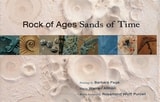
Rock of Ages, Sands of Time
Paintings by Barbara Page, Text by Warren AllmonBarbara Page and Warren D. Allmon
University of Chicago Press, 2001
These are just a few scenes from the magnificent drama that unfolds in glorious full color and three-dimensional texture in Rock of Ages, Sands of Time. Each of Barbara Page's 544 contiguous painted panels represents a million years of the history of life on earth, with fossil plants and animals depicted at the same scale and in association with each other just as they might be found by a paleontologist in the field. A muted rainbow of background colors evoke the rocks in which the fossils were found—the Texas Red Beds, for instance, or the yellow Solnhofen limestone—and keystone events are shown metaphorically, with fat rolls of paint marking major extinctions or continental drift.
To fully experience the awesome impact of an eon's worth of time spread across 500 feet of bas-relief panels, you'd have to visit the Museum of the Earth in Ithaca, New York, where Page's specially commissioned work will be installed when the museum opens in 2002. But this book is the next best thing. Not only does it contain crisp color reproductions of each painting, but it also includes an accessible essay from paleontologist Warren Allmon giving the scientific context behind the art.
For fossil lovers of all ages, and anyone interested in the merging of art and science, Rock of Ages, Sands of Time will be the find of a lifetime.
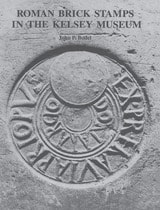
Roman Brick Stamps in the Kelsey Museum
John P. Bodel
University of Michigan Press, 1983
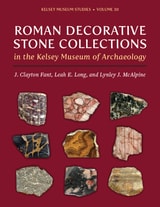
Roman Decorative Stone Collections in the Kelsey Museum of Archaeology
J. Clayton Fant, Leah E. Long, and Lynley J. McAlpine
University of Michigan Press, 2024
In keeping with the nature of the collection, Roman Decorative Stone Collections focuses on archaeological contexts and object biographies, from the stones’ first use to their eventual display in the Kelsey Museum. Entries are accompanied by rich photographs detailing the stones’ appearances, environmental factors, and their collectors. The fully illustrated catalog includes essays deriving from Kelsey’s original notes on sources, buildings, sites, and dealers. As the first formal catalog of these items, Roman Decorative Stone Collections is an accessible resource of Roman archaeology, antiquities, and the decorative arts.
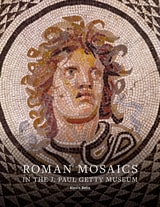
Roman Mosaics in the J. Paul Getty Museum
Alexis Belis
J. Paul Getty Trust, The, 2016
The mosaics in the collection of the J. Paul Getty Museum span the second through the sixth centuries AD and reveal the diversity of compositions found throughout the Roman Empire during this period. Elaborate floors of stone and glass tesserae transformed private dwellings and public buildings alike into spectacular settings of vibrant color, figural imagery, and geometric design. Scenes from mythology, nature, daily life, and spectacles in the arena enlivened interior spaces and reflected the cultural ambitions of wealthy patrons. This online catalogue documents all of the mosaics in the Getty Museum’s collection, presenting their artistry in new color photography as well as the contexts of their discovery and excavation across Rome's expanding empire—from its center in Italy to provinces in southern Gaul, North Africa, and ancient Syria.
Reflecting the Getty's commitment to open content, Roman Mosaics in the J. Paul Getty Museum is available online at www.getty.edu/publications/romanmosaics and may be downloaded free of charge in multiple formats. For readers who wish to have a bound reference copy, a paperback edition has been made available for sale.
The publication of this online catalogue is issued on the occasion of the exhibition, Roman Mosaics across the Empire, on view at the Getty Villa from March 30 through September 12, 2016.