501 books match the query 'Catholic Church' and 25 start with r
cover of Reading Patristic Texts on Social Ethics: Issues and Challenges for the Twenty-First Century

Reading Patristic Texts on Social Ethics

Issues and Challenges for the Twenty-First Century

Johan Leemans

Catholic University of America Press, 2011
Can writings of the church fathers related to the field of social ethics be of value to contemporary discussions on the topic? In addressing this question, the authors of this book discuss the exciting challenges that scholars of both early Christianity and contemporary Catholic social thought face regarding the interaction of historical sources and present issues.
[more]
cover of Rebuilding Trust: Clergy Morale in the Wake of the Abuse Crisis

Rebuilding Trust

Clergy Morale in the Wake of the Abuse Crisis

Brandon Vaidyanathan

Catholic University of America Press, 2025
While much attention has rightly been given to abuse survivors and institu­tional accountability, less has been said about how the sexual abuse crisis has shaped the experience of clergy themselves. Drawing on findings from the National Study of Catholic Priests (NSCP)—the most comprehensive survey of American priests in over 50 years—Rebuilding Trust explores how the abuse crisis and the Church’s institutional response have affected priestly well-be­ing and morale, perceptions of episcopal leadership, and the culture of the presbyterate more broadly. The study reveals a striking breakdown in trust between priests and their bishops, exacerbated by concerns over due process in the wake of an abuse allegation, inconsistent application of abuse preven­tion policies, and a widening ideological divide between younger and older clergy. The book combines sociological analysis with theological, psycholog­ical, historical, canonical, and pastoral perspectives to contextualize these findings. Contributors from various fields examine shifts in the priesthood over the past few decades, assess the implementation of the 2002 Charter for the Protection of Children and Young People (the “Dallas Charter”) and explore practical strategies for strengthening clergy formation, fostering fra­ternity, and improving bishop-priest relationships. By integrating empirical research with theological reflection, this volume offers a timely and neces­sary addition to the discussion of how the Church can rebuild trust, support priests, and cultivate a healthier presbyterate. It will be essential reading for Church leaders, seminary formators, scholars of Catholicism, and anyone concerned with the future of the priesthood in the United States.
[more]
cover of Recovering Origins: A Unique Healing Program for Adult Children of Divorce

Recovering Origins

A Unique Healing Program for Adult Children of Divorce

Margaret Harper McCarthy

Catholic University of America Press, 2021
Recovering Origins is a healing program offered to adult children of divorced parents who now, with a certain distance from the practical difficulties that burden younger children, wrestle with the core problem at the heart of those difficulties. Having lost the community that brought them into the world, they have suffered a “primal loss.” Children are the literal embodiment of that community. When it is voluntarily dismantled, and worse–wished never to have been–the effect is not negligible. Children of divorce, by their own description, are now “pulled apart” as if “between two worlds.” They are “torn asunder.” Paradoxically the idea for Recovering Origins was occasioned by this straight talk about divorce. For, by going to the depths of the loss of one’s primal community one can be opened up to the Community that stands at the root of it. “Deep calls unto deep,” as the Psalmist says. In short, Recovering Origins invites participants to move through the broken image of love that they see in their parents, to the loving Origin which is more fundamental than any human reflection of it, broken or not. Recovering Origins begins with an invitation to look honestly at the actual experience of divorce, beyond all the “happy talk” about the “good divorce.” Participants are then invited to follow the path of the Lord’s Prayer, to recover what is at once challenging and precious to those whose very identities are on uncertain ground: the memory of God the Father, the goodness of their lives, and the real possibility of a good future. In this way, the program offers adult children of divorce a path to healing in the deepest sense. Recovering Origins offers an occasion to encounter the Christian Faith more deeply, especially where it bears on fundamental question faced by children of divorce in a particularly dramatic way. Recovering Origins addresses adult children of divorce, then, not only as individuals in need of pastoral care, but as potential witnesses to something they can, perhaps, see more clearly: the goodness and fidelity of the One on whom their lives ultimately depend and the possibility (and need) that that be reflected in an irrevocable and fruitful love between the creatures made in his image.
[more]
cover of Recovering Self-Evident Truths: Catholic Perspectives on American Law

Recovering Self-Evident Truths

Catholic Perspectives on American Law

Michael A. Scaperlanda

Catholic University of America Press, 2007
This book presents an engaging collection of essays exploring "catholic" and "Catholic" perspectives on American law--catholic in their claims of universal truths, and Catholic in their grounding in the teachings of the Roman Catholic Church
[more]
cover of Religion and Spanish Film: Luis Buñuel, the Franco Era, and Contemporary Directors

Religion and Spanish Film

Luis Buñuel, the Franco Era, and Contemporary Directors

Elizabeth Scarlett

University of Michigan Press, 2014
Treatments of religion found in Spanish cinema range from the pious to the anticlerical and atheistic, and every position in between. In a nation with a strong Catholic tradition, resistance to and rebellion against religious norms go back almost as far as the notion of “Sacred Spain.” Religion and Spanish Film provides a sustained study of the religious film genre in Spain practiced by mainstream Francoist film makers, the evolving iconoclasm, parody, and reinvention of the Catholic by internationally renowned Surrealist Luis Buñuel, and the ongoing battle of the secular versus the religious manifested in critically and popularly acclaimed directors Pedro Almodóvar, Julio Medem, Alejandro Amenábar, and many others. The conflicted Catholicism that emerges from examining religious themes in Spanish film history shows no sign of ending, as unresolved issues from the Civil War and Franco dictatorship, as well as the unsettled relationship between Church and State, continue into the present.
  
[more]
cover of Religion and State Formation in Postrevolutionary Mexico

Religion and State Formation in Postrevolutionary Mexico

Ben Fallaw

Duke University Press, 2012

The religion question—the place of the Church in a Catholic country after an anticlerical revolution—profoundly shaped the process of state formation in Mexico. From the end of the Cristero War in 1929 until Manuel Ávila Camacho assumed the presidency in late 1940 and declared his faith, Mexico's unresolved religious conflict roiled regional politics, impeded federal schooling, undermined agrarian reform, and flared into sporadic violence, ultimately frustrating the secular vision shared by Plutarco Elías Calles and Lázaro Cárdenas.

Ben Fallaw argues that previous scholarship has not appreciated the pervasive influence of Catholics and Catholicism on postrevolutionary state formation. By delving into the history of four understudied Mexican states, he is able to show that religion swayed regional politics not just in states such as Guanajuato, in Mexico's central-west "Rosary Belt," but even in those considered much less observant, including Campeche, Guerrero, and Hidalgo. Religion and State Formation in Postrevolutionary Mexico reshapes our understanding of agrarian reform, federal schooling, revolutionary anticlericalism, elections, the Segunda (a second Cristero War in the 1930s), and indigenism, the Revolution's valorization of the Mesoamerican past as the font of national identity.
[more]
cover of Religious Crisis and Civic Transformation: How Conflicts over Gender and Sexuality Changed the West German Catholic Church

Religious Crisis and Civic Transformation

How Conflicts over Gender and Sexuality Changed the West German Catholic Church

Kimba Allie Tichenor

Brandeis University Press, 2016
This book offers a fresh interpretation of the connection between the West German Catholic Church and post-1950s political debates on women’s reproductive rights and the protection of life in West Germany. According to Tichenor, Catholic women in West Germany, influenced by the culture of consumption, the sexual revolution, Vatican II reforms, and feminism, sought to renegotiate their relationship with the Church. They demanded a more active role in Church ministries and challenged the Church’s hierarchical and gendered view of marriage and condemnation of artificial contraception. When the Church refused to compromise, women left en masse. In response, the Church slowly stitched together a new identity for a postsecular age, employing an elaborate nuptial symbolism to justify its stance on celibacy, women’s ordination, artificial contraception, abortion, and reproductive technologies. Additionally, the Church returned to a radical interventionist agenda that embraced issue-specific alliances with political parties other than the Christian parties. In her conclusion, Tichenor notes more recent setbacks to the German Catholic Church, including disappointment with the reactionary German Pope Benedict XVI and his failure in 2010 to address over 250 allegations of sexual abuse at twenty-two of Germany’s twenty-seven dioceses. How the Church will renew itself in the twenty-first century remains unclear. This closely observed case study, which bridges religious, political, legal, and women’s history, will interest scholars and students of twentieth-century European religious history, modern Germany, and the intersection of Catholic Church practice and women’s issues.
[more]
cover of Religious Freedom after the Sexual Revolution: A Catholic Guide

Religious Freedom after the Sexual Revolution

A Catholic Guide

Helen Alvare

Catholic University of America Press, 2022
Laws mandating cooperation with the state’s new sexual orthodoxy are among the leading contemporary threats to the religious freedom of Catholic institutions in the United States. These demand that Catholic schools, health-care providers, or social services cooperate with contraception, cohabitation, abortion, same-sex marriage, or transgender identity and surgeries. But Catholic institutions’ responses seem thin and uninspiring to many. They are criticized as legalistic, authoritarian, bureaucratic, retrograde and hurtful to women and to persons who identify as LGBTQ. They are even called “un-Christian.” They invite disrespect both for Catholic sexual responsibility norms and for religious freedom generally, not only among lawmakers and judges, but also in the court of public opinion, which includes skeptical Catholics. The U.S. Constitution protects Catholic institutions’ “autonomy” – their authority over faith and doctrine, internal operations, and the personnel involved in personifying and transmitting the faith. Other constitutional and statutory provisions also safeguard religious freedom, if not always perfectly. Catholic institutions could take far better advantage of all of these existing protections if they communicated, first, how they differ from secular institutions: how their missions emerge from their faith in Jesus Christ, and their efforts both to make his presence felt in the world today, and to display the inbreaking of the Kingdom of God. Second, they need to draw out the link between their teachings on sexual responsibility and love of God and neighbor. Drawing upon Scripture, tradition, history, theology and empirical evidence, Helen Alvaré frames a more complete, inspiring and appealing response to current laws’ attempts to impose a new sexual orthodoxy upon Catholic institutions. It clarifies the “ecclesial” nature of Catholic schools, hospitals and social services. It summarizes the empirical evidence supporting the link between personnel decisions and mission, and between Catholic sexual responsibility norms and human flourishing. It grounds Catholic sexual responsibility teachings in the same love of God and neighbor that animate the existence, operations, and services of Catholic institutions.
[more]
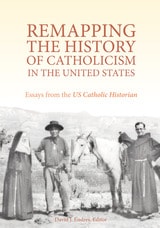
cover of Remapping the History of Catholicism in the United States

Remapping the History of Catholicism in the United States

David J. Endres

Catholic University of America Press, 2017

For more than thirty years, the U.S. Catholic Historian has mapped the diverse terrain of American Catholicism. This collection of recent essays tells the story of Catholics previously underappreciated by historians: women, African Americans, Latinos, Asian Americans, and those on the frontier and borderlands.

Timothy Matovina’s opening essay sets the theme for the volume, encouraging a remapping of U.S. Catholic history to more widely encompass its various localities and peoples, especially the significance of non-European ethnic groups and the role of Catholics in the American Southwest. Jeanne Petit explores Catholic womanhood’s strength and organizational zeal in the post-World War I era, noting the obstacles and successes of women’s attempts to be recognized fully as American citizens and members of the Church. Anne Klejment weaves together the lives of Dorothy Day and Cesar Chavez to illustrate their use of nonviolence and “weapons of the spirit” to respond to societal injustice. Amanda Bresie provides a window into the life of Mother Katharine Drexel, noting the generosity of the millionaire heiress, but also her meticulous record keeping and close supervision of her funding of educational and evangelization e­orts among Native and African Americans. Kristine Ashton Gunnell analyzes the ways in which the Daughters of Charity crossed cultural boundaries to off­er charitable assistance to Mexican and Japanese communities in Los Angeles. Matthew Cressler explores the intersection of Black Power and distinctive African American-inspired liturgies, arguing that the liturgy became a site of struggle as black self-determination and nationalism impacted worship and black Catholic identity. Finally, Joseph Chinnici off­ers an important essay on re-envisioning post-conciliar U.S. Catholicism in its global context, off­ering a new approach to how we consider the American Catholic narrative and write its history.

Together these path-breaking studies serve as a model for historians seeking to engage in the cartographic task of remapping the U.S. Catholic experience.
[more]
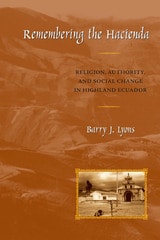
cover of Remembering the Hacienda: Religion, Authority, and Social Change in Highland Ecuador

Remembering the Hacienda

Religion, Authority, and Social Change in Highland Ecuador

By Barry J. Lyons

University of Texas Press, 2006

From the colonial period through the mid-twentieth century, haciendas dominated the Latin American countryside. In the Ecuadorian Andes, Runa—Quichua-speaking indigenous people—worked on these large agrarian estates as virtual serfs. In Remembering the Hacienda: Religion, Authority, and Social Change in Highland Ecuador, Barry Lyons probes the workings of power on haciendas and explores the hacienda's contemporary legacy.

Lyons lived for three years in a Runa village and conducted in-depth interviews with elderly former hacienda laborers. He combines their wrenching accounts with archival evidence to paint an astonishing portrait of daily life on haciendas. Lyons also develops an innovative analysis of hacienda discipline and authority relations. Remembering the Hacienda explains the role of religion as well as the reshaping of Runa culture and identity under the impact of land reform and liberation theology.

This beautifully written book is a major contribution to the understanding of social control and domination. It will be valuable reading for a broad audience in anthropology, history, Latin American studies, and religious studies.
[more]
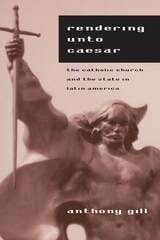
cover of Rendering unto Caesar: The Catholic Church and the State in Latin America

Rendering unto Caesar

The Catholic Church and the State in Latin America

Anthony Gill

University of Chicago Press, 1997
Nowhere has the relationship between state and church been more volatile in recent decades than in Latin America. Anthony Gill's controversial book not only explains why Catholic leaders in some countries came to oppose dictatorial rule but, equally important, why many did not. Using historical and statistical evidence from twelve countries, Gill for the first time uncovers the causal connection between religious competition and the rise of progressive Catholicism. In places where evangelical Protestantism and "spiritist" sects made inroads among poor Catholics, Church leaders championed the rights of the poor and turned against authoritarian regimes to retain parishioners. Where competition was minimal, bishops maintained good relations with military rulers. Applying economic reasoning to an entirely new setting, Rendering unto Caesar offers a new theory of religious competition that dramatically revises our understanding of church-state relations.
[more]
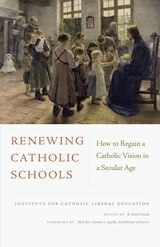
cover of Renewing Catholic Schools: How to Regain a Catholic Vision for a Secular Age

Renewing Catholic Schools

How to Regain a Catholic Vision for a Secular Age

R. Jared Staudt

Catholic University of America Press, 2020
Catholic education remains one of the most compelling expressions of the Church’s mission to form disciples. Despite decades of decline in the number of schools and students, many Catholic schools have been experiencing renewal by returning to the great legacy of the Catholic tradition. Renewing Catholic Schools offers an overview of the reasons behind this renewal and practical suggestions for administrators, clergy, teachers, and parents on how to begin the process of reinvigoration. The book begins by situating Catholic education within the Church’s mission. Fidelity to Catholic mission and identity, including a commitment to the fulness of truth, provides the fundamental mark for the true success of Catholic education. The Catholic intellectual tradition, in particular, established by figures such as Augustine, Boethius, and Aquinas, can continue to direct Catholic schools, providing a depth of vision to overcome today’s educational crisis. To transcend the now dominate secular model of education, Catholic schools can align their curriculum more closely to the Catholic tradition. One touchpoint comes from Archbishop Michael Miller’s The Holy See’s Teaching on Catholic Schools, which the book explores as a source for practical guidance. It also offers a Catholic vision for curriculum, examining the full range of subjects from gymnasium, the fine arts, the liberal arts, literature, history, and catechesis, all of which lead to a well-formed graduate, inspired by beauty, attune to truth, and ordered toward the good. Finally, the book provides a practical vision for renewing the school through the formation of teachers, creation of a school community, and by offering suggestions for implementation of a stronger Catholic mission and philosophy of education. The teacher, ultimately, should strive to teach like Jesus, while the community should joyfully embody the school’s mission, making it a lived reality. The book concludes with examples of Catholic schools that have successfully undergone renewal.
[more]
cover of Renewing Our Hope: Essays for the New Evangelization

Renewing Our Hope

Essays for the New Evangelization

Robert Barron

Catholic University of America Press, 2020
In a time of discouragement, how can the Church renew itself and its outreach to all people? Bishop Robert Barron, Auxiliary Bishop of the Archdiocese of Los Angeles, insists that a "dumbed down" Catholicism cannot succeed in today's highly educated society--instead, the Church needs to draw upon its great theological heritage in order to renew its hope in Christ. With Renewing Our Hope: Essays for the New Evangelization, Bishop Barron traces this renewal through four stages. "Renewing Our Mission" lays out the challenges that call for Catholics to become more aware of their own intellectual resources in encountering the "Nones." "Renewing Our Minds" showcases the importance of theological reflection as a font of wisdom and sanity in the Church, touching on Thomas Aquinas, Hans Urs von Balthasar, the recently canonized John Henry Newman, and Pope Francis. In "Renewing the Church," he proceeds to look at how Scripture, the family, the seminary, and Catholic college graduates can each contribute to this renewal. Finally, in "Renewing Our Culture," he returns to the judgments Catholics must make in assessing contemporary culture, specifically, family life, liberalism, relativism, and (surprisingly) the beauty of cinema. Bishop Barron, known as the host of the Catholicism PBS video series, was previously rector and professor of systematic theology at Mundelein Seminary outside Chicago, Illinois. He demonstrates again in Renewing Our Hope his ability to make the fruits of his wide reading accessible to a broad audience, while still giving his academic colleagues much to consider.
[more]
cover of Renewing the Mind

Renewing the Mind

Ryan N.S. Topping

Catholic University of America Press, 2015
Renewing the Mind includes an introductory essay on the history and renewal of Catholic education, followed by 38 selections each with an introduction, biography, and study questions; adorning the text throughout are illustrations from the National Gallery of Art. Educators of children and college students will find this an essential guide to the best of what has been said about what it means to be conformed to the mind of Christ.
[more]
cover of Respectably Catholic and Scientific: Evolution and Birth Control Between the World Wars

Respectably Catholic and Scientific

Evolution and Birth Control Between the World Wars

Alexander Pavuk

Catholic University of America Press, 2021
Respectfully Catholic and Scientific traces the unexpected manner in which several influential liberal-progressive Catholics tried to shape how evolution and birth control were framed and debated in the public square in the era between the World Wars-- and the unintended consequences of their efforts. A small but influential cadre of Catholic priests professionally trained in social sciences, Frs. John Montgomery Cooper, John A. Ryan, and John A. O’Brien, gained a hearing from mainline public intellectuals largely by engaging in dialogue on these topics using the lingua franca of the age, science, to the near exclusion of religious argumentation. The Catholics’ approach was more than just tactical. It also derived from the subtle influence of Catholic theological Modernism, with its strong enthusiasm for science, and from an inclination toward scientism inherited from the Progressive Era’s social science milieu. All three shared a fervent desire to translate the Catholic ethos, as they understood it, into the vocabulary of the modern age while circumventing anti-Catholic attitudes in the process. However, their method resulted in a series of unintended consequences whereby their arguments were not infrequently co-opted and used against both them and the institutional church they served. Alexander Pavuk considers the complex role of both liberal religious figures and scientific elites in evolution and birth control discourse, and how each contributed in unexpected ways to the reconstruction of those topics in public culture. The reconstruction saw the topics themselves shift from matters considered largely within moral frameworks into bodies of kno
[more]
cover of Ressourcement Thomism: Sacred Doctrine, the Sacraments, and the Moral Life

Ressourcement Thomism

Sacred Doctrine, the Sacraments, and the Moral Life

Reinhard Hütter

Catholic University of America Press, 2010
The essays in this volume explore three areas in which St. Thomas Aquinas's voice has never fallen silent: sacred doctrine, the relationship of sacraments and metaphysics, and the central role of virtue in moral theology.
[more]
cover of Revelation and Convergence

Revelation and Convergence

Mark Bosco

Catholic University of America Press, 2017
Revelation & Convergence brings together professors of literature, theology, and history to help both critics and readers better understand Flannery O’Connor’s religious imagination.
[more]
cover of Revelations of Humanity: Anthropological Dimensions of Theological Controversies

Revelations of Humanity

Anthropological Dimensions of Theological Controversies

Richard Schenk, OP

Catholic University of America Press, 2022
Revelations of Humanity brings together essays into the history and actuality of how our searches for God and for our own humanity are interwoven. They argue that the revelation of God is possible only when accompanied by a revelation of what it means to be a human being. Revelation implies that the truth is not fully evident in either case. This quest is aided in many of the essays by a recollection of the thought of Thomas Aquinas. As opposed to simple memory, recollection implies that memory has been lost or become clouded, here by the misrepresentation of Thomas’ view of humanity’s relation to God as harmonistic, at best semi-Pelagian, often even naturalistic. This difficult recovery is made possible by historical research that alone can escape the easy systematic alienation that supporters and critics of Thomas have often brought to their interpretation of his works. Thomas’s sense of a real but finite capacity of human beings for God, his grace and revelation, anticipates in more ways than is commonly known much of contemporary suspicion about human capacities, but in ways that are open to God. That programmatic insight into the historical Thomas, keenly aware of human entanglements, limits and hopes, offers on many contemporary issues a ressourcement of systematic thought. Revelations of Humanity revolves around three clusters of issues. The first asks about the reality and limits of the human capacity for truth: in metaphysical, moral and political matters and in relation to the disputed issues of analogous reason and faith. The second cluster is structured around the four involvements that the Second Vatican Council identified as the human face of genuine Christian existence: participation in the legitimate joys, hopes, sorrows and fears of the contemporary world. These are refracted in the broken light of the human proprium of risibility, the abiding uncertainty addressed by hope, the disputed question of a suffering God and the recollection of Christ’s anxiety in the face of death. The final cluster brings together anthropological dimensions of current ecumenical and interreligious disputes: the need to complement affirmation with admonition in ecumenical conversation, exemplified by the ambivalence towards sacrifice in a genuinely Catholic theology and the need to avoid the excesses of univocity, equivocity or an all too facile analogy in the determination of interreligious relationalities.
[more]
cover of Revisiting the Idea of Vocation: Theological Explorations

Revisiting the Idea of Vocation

Theological Explorations

John C. Haughey, S.J.

Catholic University of America Press, 2004
Until recently theologians have been in a deep slumber about the subject of vocations. This volume represents one of the first awakenings in the theological community to this subject. The ten contributors, all theologians at Loyola University Chicago, present original essays that explore vocations, or callings.
[more]
cover of Revolutions in Mexican Catholicism: Reform and Revelation in Oaxaca, 1887–1934

Revolutions in Mexican Catholicism

Reform and Revelation in Oaxaca, 1887–1934

Edward Wright-Rios

Duke University Press, 2009

In Revolutions in Mexican Catholicism, Edward Wright-Rios investigates how Catholicism was lived and experienced in the Archdiocese of Oaxaca, a region known for its distinct indigenous cultures and vibrant religious life, during the turbulent period of modernization in Mexico that extended from the late nineteenth century through the early twentieth. Wright-Rios centers his analysis on three “visions” of Catholicism: an enterprising archbishop’s ambitious religious reform project, an elderly indigenous woman’s remarkable career as a seer and faith healer, and an apparition movement that coalesced around a visionary Indian girl. Deftly integrating documentary evidence with oral histories, Wright-Rios provides a rich, textured portrait of Catholicism during the decades leading up to the Mexican Revolution of 1910 and throughout the tempestuous 1920s.

Wright-Rios demonstrates that pastors, peasants, and laywomen sought to enliven and shape popular religion in Oaxaca. The clergy tried to adapt the Vatican’s blueprint for Catholic revival to Oaxaca through institutional reforms and attempts to alter the nature and feel of lay religious practice in what amounted to a religious modernization program. Yet some devout women had their own plans. They proclaimed their personal experiences of miraculous revelation, pressured priests to recognize those experiences, marshaled their supporters, and even created new local institutions to advance their causes and sustain the new practices they created. By describing female-led visionary movements and the ideas, traditions, and startling innovations that emerged from Oaxaca’s indigenous laity, Wright-Rios adds a rarely documented perspective to Mexican cultural history. He reveals a remarkable dynamic of interaction and negotiation in which priests and parishioners as well as prelates and local seers sometimes clashed and sometimes cooperated but remained engaged with one another in the process of making their faith meaningful in tumultuous times.
[more]
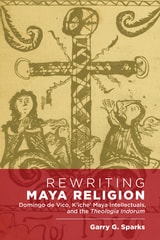
cover of Rewriting Maya Religion: Domingo de Vico, K’iche’ Maya Intellectuals, and the Theologia Indorum

Rewriting Maya Religion

Domingo de Vico, K’iche’ Maya Intellectuals, and the Theologia Indorum

Garry G. Sparks

University Press of Colorado, 2019

In Rewriting Maya Religion Garry Sparks examines the earliest religious documents composed by missionaries and native authors in the Americas, including a reconstruction of the first original, explicit Christian theology written in the Americas—the nearly 900-page Theologia Indorum (Theology for [or of] the Indians), initially written in Mayan languages by Friar Domingo de Vico by 1554. Sparks traces how the first Dominican missionaries to the Maya repurposed native religious ideas, myths, and rhetoric in their efforts to translate a Christianity and how, in this wake, K’iche’ Maya elites began to write their own religious texts, like the Popol Vuh. This ethnohistory of religion critically reexamines the role and value of indigenous authority during the early decades of first contact between a Native American people and Christian missionaries.
 
Centered on the specific work of Dominicans among the Highland Maya of Guatemala in the decades prior to the arrival of the Catholic Reformation in the late sixteenth century, the book focuses on the various understandings of religious analyses—Hispano-Catholic and Maya—and their strategic exchanges, reconfigurations, and resistance through competing efforts of religious translation. Sparks historically contextualizes Vico’s theological treatise within both the wider set of early literature in K’iche’an languages and the intellectual shifts between late medieval thought and early modernity, especially the competing theories of language, ethnography, and semiotics in the humanism of Spain and Mesoamerica at the time.
 
Thorough and original, Rewriting Maya Religion serves as an ethnohistorical frame for continued studies on Highland Maya religious symbols, discourse, practices, and logic dating back to the earliest documented evidence. It will be of great significance to scholars of religion, ethnohistory, linguistics, anthropology, and Latin American history.
 
[more]
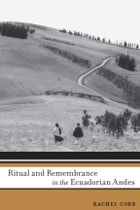
cover of Ritual and Remembrance in the Ecuadorian Andes

Ritual and Remembrance in the Ecuadorian Andes

Rachel Corr

University of Arizona Press, 2010

Not every world culture that has battled colonization has suffered or died. In the Ecuadorian Andean parish of Salasaca, the indigenous culture has stayed true to itself and its surroundings for centuries while adapting to each new situation. Today, indigenous Salascans continue to devote a large part of their lives to their distinctive practices—both community rituals and individual behaviors—while living side by side with white-mestizo culture.

In this book Rachel Corr provides a knowledgeable account of the Salasacan religion and rituals and their respective histories. Based on eighteen years of fieldwork in Salasaca, as well as extensive research in Church archives—including never-before-published documents—Corr’s book illuminates how Salasacan culture adapted to Catholic traditions and recentered, reinterpreted, and even reshaped them to serve similarly motivated Salasacan practices, demonstrating the link between formal and folk Catholicism and pre-Columbian beliefs and practices. Corr also explores the intense connection between the local Salasacan rituals and the mountain landscapes around them, from peak to valley.

Ritual and Remembrance in the Ecuadorian Andes is, in its portrayal of Salasacan religious culture, both thorough and all-encompassing. Sections of the book cover everything from the performance of death rituals to stories about Amazonia as Salasacans interacted with outsiders—conquistadors and camera-toting tourists alike. Corr also investigates the role of shamanism in modern Salasacan culture, including shamanic powers and mountain spirits, and the use of reshaped, Andeanized Catholicism to sustain collective memory. Through its unique insider’s perspective of Salasacan spirituality, Ritual and Remembrance in the Ecuadorian Andes is a valuable anthropological work that honestly represents this people’s great ability to adapt.
[more]
cover of Robert of Arbrissel: A Medieval Religious Life

Robert of Arbrissel

A Medieval Religious Life

Bruce L. Venarde

Catholic University of America Press, 2003
[more]
cover of Robert of Arbrissel: Sex, Sin, and Salvation in the Middle Ages

Robert of Arbrissel

Sex, Sin, and Salvation in the Middle Ages

Jacques Dalarun

Catholic University of America Press, 2006
This book tells the fascinating story of Robert of Arbrissel (ca. 1045-1116). Robert was a parish priest, longtime student, reformer, hermit, wandering preacher, and, most famously, founder of the abbey of Fontevraud
[more]
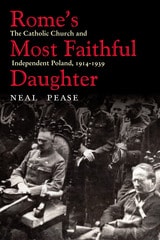
cover of Rome’s Most Faithful Daughter: The Catholic Church and Independent Poland, 1914–1939

Rome’s Most Faithful Daughter

The Catholic Church and Independent Poland, 1914–1939

Neal Pease

Ohio University Press, 2009

When an independent Poland reappeared on the map of Europe after World War I, it was widely regarded as the most Catholic country on the continent, as “Rome’s Most Faithful Daughter.” All the same, the relations of the Second Polish Republic with the Church—both its representatives inside the country and the Holy See itself—proved far more difficult than expected.

Based on original research in the libraries and depositories of four countries, including recently opened collections in the Vatican Secret Archives, Rome’s Most Faithful Daughter: The Catholic Church and Independent Poland, 1914–1939 presents the first scholarly history of the close but complex political relationship of Poland with the Catholic Church during the interwar period. Neal Pease addresses, for example, the centrality of Poland in the Vatican’s plans to convert the Soviet Union to Catholicism and the curious reluctance of each successive Polish government to play the role assigned to it. He also reveals the complicated story of the relations of Polish Catholicism with Jews, Freemasons, and other minorities within the country and what the response of Pope Pius XII to the Nazi German invasion of Poland in 1939 can tell us about his controversial policies during World War II.

Both authoritative and lively, Rome’s Most Faithful Daughter shows that the tensions generated by the interplay of church and state in Polish public life exerted great influence not only on the history of Poland but also on the wider Catholic world in the era between the wars.

[more]