66 books match the query 'Central' and 5 start with r
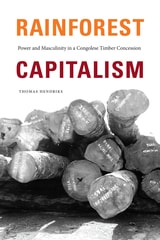
cover of Rainforest Capitalism: Power and Masculinity in a Congolese Timber Concession

Rainforest Capitalism

Power and Masculinity in a Congolese Timber Concession

Thomas Hendriks

Duke University Press, 2022
Congolese logging camps are places where mud, rain, fuel smugglers, and village roadblocks slow down multinational timber firms; where workers wage wars against trees while evading company surveillance deep in the forest; where labor compounds trigger disturbing colonial memories; and where blunt racism, logger machismo, and homoerotic desires reproduce violence. In Rainforest Capitalism Thomas Hendriks examines the rowdy world of industrial timber production in the Democratic Republic of the Congo to theorize racialized and gendered power dynamics in capitalist extraction. Drawing on ethnographic fieldwork among Congolese workers and European company managers as well as traders, farmers, smugglers, and barkeepers, Hendriks shows how logging is deeply tied to feelings of existential vulnerability in the face of larger forces, structures, and histories. These feelings, Hendriks contends, reveal a precarious side of power in an environment where companies, workers, and local residents frequently find themselves out of control. An ethnography of complicity, ecstasis, and paranoia, Rainforest Capitalism queers assumptions of corporate strength and opens up new ways to understand the complexities and contradictions of capitalist extraction.
[more]
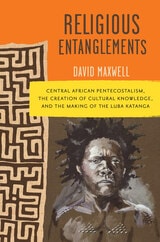
cover of Religious Entanglements: Central African Pentecostalism, the Creation of Cultural Knowledge, and the Making of the Luba Katanga

Religious Entanglements

Central African Pentecostalism, the Creation of Cultural Knowledge, and the Making of the Luba Katanga

David Maxwell

University of Wisconsin Press, 2023

Under the leadership of William F. P. Burton and James Salter, the Congo Evangelistic Mission (CEM) grew from a simple faith movement founded in 1915 into one of the most successful classical Pentecostal missions in Africa, today boasting more than one million members in the Democratic Republic of the Congo. Drawing on artifacts, images, documents, and interviews, David Maxwell examines the roles of missionaries and their African collaborators—the Luba-speaking peoples of southeast Katanga—in producing knowledge about Africa.
 
Through the careful reconstruction of knowledge pathways, Maxwell brings into focus the role of Africans in shaping texts, collections, and images as well as in challenging and adapting Western-imported presuppositions and prejudices. Ultimately, Maxwell illustrates the mutually constitutive nature of discourses of identity in colonial Africa and reveals not only how the Luba shaped missionary research but also how these coproducers of knowledge constructed and critiqued custom and convened new ethnic communities.

Making a significant intervention in the study of both the history of African Christianity and the cultural transformations effected by missionary encounters across the globe, Religious Entanglements excavates the subculture of African Pentecostalism, revealing its potentiality for radical sociocultural change.
[more]
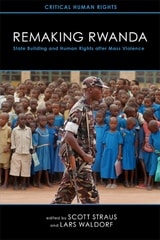
cover of Remaking Rwanda: State Building and Human Rights after Mass Violence

Remaking Rwanda

State Building and Human Rights after Mass Violence

Scott Straus

University of Wisconsin Press, 2011
In the mid-1990s, civil war and genocide ravaged Rwanda. Since then, the country’s new leadership has undertaken a highly ambitious effort to refashion Rwanda’s politics, economy, and society, and the country’s accomplishments have garnered widespread praise. Remaking Rwanda is the first book to examine Rwanda’s remarkable post-genocide recovery in a comprehensive and critical fashion. By paying close attention to memory politics, human rights, justice, foreign relations, land use, education, and other key social institutions and practices, this volume raises serious concerns about the depth and durability of the country’s reconstruction.
            Edited by Scott Straus and Lars Waldorf, Remaking Rwanda brings together experienced scholars and human rights professionals to offer a nuanced, historically informed picture of post-genocide Rwanda—one that reveals powerful continuities with the nation’s past and raises profound questions about its future.
 
 
Best Special Interest Books, selected by the American Association of School Librarians
 
Best Special Interest Books, selected by the Public Library Reviewers
[more]
cover of Retuning Culture: Musical Changes in Central and Eastern Europe

Retuning Culture

Musical Changes in Central and Eastern Europe

Mark Slobin

Duke University Press, 1996

As a measure of individual and collective identity, music offers both striking metaphors and tangible data for understanding societies in transition—and nowhere is this clearer than in the recent case of the Eastern Bloc. Retuning Culture presents an extraordinary picture of this phenomenon. This pioneering set of studies traces the tumultuous and momentous shifts in the music cultures of Central and Eastern Europe from the first harbingers of change in the 1970s through the revolutionary period of 1989–90 to more recent developments.
During the period of state socialism, both the reinterpretation of the folk music heritage and the domestication of Western forms of music offered ways to resist and redefine imposed identities. With the removal of state control and support, music was free to channel and to shape emerging forms of cultural identity. Stressing both continuity and disjuncture in a period of enormous social and cultural change, this volume focuses on the importance and evolution of traditional and popular musics in peasant communities and urban environments in Hungary, Poland, Romania, Russia, the Czech Republic, Ukraine, the former Yugoslavia, Macedonia, and Bulgaria. Written by longtime specialists in the region and considering both religious and secular trends, these essays examine music as a means of expressing diverse aesthetics and ideologies, participating in the formation of national identities, and strengthening ethnic affiliation.
Retuning Culture provides a rich understanding of music’s role at a particular cultural and historical moment. Its broad range of perspectives will attract readers with interests in cultural studies, music, and Central and Eastern Europe.

Contributors. Michael Beckerman, Donna Buchanan, Anna Czekanowska, Judit Frigyesi, Barbara Rose Lange, Mirjana Lausevic, Theodore Levin, Margarita Mazo, Steluta Popa, Ljerka Vidic Rasmussen, Timothy Rice, Carol Silverman, Catherine Wanner
[more]
cover of Rumba Rules: The Politics of Dance Music in Mobutu’s Zaire

Rumba Rules

The Politics of Dance Music in Mobutu’s Zaire

Bob W. White

Duke University Press, 2008

Mobutu Sese Seko, who ruled Zaire (now the Democratic Republic of Congo) from 1965 until 1997, was fond of saying “happy are those who sing and dance,” and his regime energetically promoted the notion of culture as a national resource. During this period Zairian popular dance music (often referred to as la rumba zaïroise) became a sort of musica franca in many parts of sub-Saharan Africa. But how did this privileged form of cultural expression, one primarily known for a sound of sweetness and joy, flourish under one of the continent’s most brutal authoritarian regimes? In Rumba Rules, the first ethnography of popular music in the Democratic Republic of Congo, Bob W. White examines not only the economic and political conditions that brought this powerful music industry to its knees, but also the ways that popular musicians sought to remain socially relevant in a time of increasing insecurity.

Drawing partly on his experiences as a member of a local dance band in the country’s capital city Kinshasa, White offers extraordinarily vivid accounts of the live music scene, including the relatively recent phenomenon of libanga, which involves shouting the names of wealthy or powerful people during performances in exchange for financial support or protection. With dynamic descriptions of how bands practiced, performed, and splintered, White highlights how the ways that power was sought and understood in Kinshasa’s popular music scene mirrored the charismatic authoritarianism of Mobutu’s rule. In Rumba Rules, Congolese speak candidly about political leadership, social mobility, and what it meant to be a bon chef (good leader) in Mobutu’s Zaire.

[more]