208 books match the query 'Christian Church' and 8 start with r
cover of Rebuilding Trust: Clergy Morale in the Wake of the Abuse Crisis

Rebuilding Trust

Clergy Morale in the Wake of the Abuse Crisis

Brandon Vaidyanathan

Catholic University of America Press, 2025
While much attention has rightly been given to abuse survivors and institu­tional accountability, less has been said about how the sexual abuse crisis has shaped the experience of clergy themselves. Drawing on findings from the National Study of Catholic Priests (NSCP)—the most comprehensive survey of American priests in over 50 years—Rebuilding Trust explores how the abuse crisis and the Church’s institutional response have affected priestly well-be­ing and morale, perceptions of episcopal leadership, and the culture of the presbyterate more broadly. The study reveals a striking breakdown in trust between priests and their bishops, exacerbated by concerns over due process in the wake of an abuse allegation, inconsistent application of abuse preven­tion policies, and a widening ideological divide between younger and older clergy. The book combines sociological analysis with theological, psycholog­ical, historical, canonical, and pastoral perspectives to contextualize these findings. Contributors from various fields examine shifts in the priesthood over the past few decades, assess the implementation of the 2002 Charter for the Protection of Children and Young People (the “Dallas Charter”) and explore practical strategies for strengthening clergy formation, fostering fra­ternity, and improving bishop-priest relationships. By integrating empirical research with theological reflection, this volume offers a timely and neces­sary addition to the discussion of how the Church can rebuild trust, support priests, and cultivate a healthier presbyterate. It will be essential reading for Church leaders, seminary formators, scholars of Catholicism, and anyone concerned with the future of the priesthood in the United States.
[more]
cover of Reformation Movements in the Sixteenth and Seventeenth Centuries

Reformation Movements in the Sixteenth and Seventeenth Centuries

Charlotte Methuen

SBL Press, 2025
Reformation Movements in the Sixteenth and Seventeenth Centuries explores how Protestant women across Europe engaged with the Bible, rather than prioritizing how male Reformers viewed women. Contributors consider women as readers, interpreters, and sharers of scripture who encountered biblical texts in their own languages, in devotional texts, and in hymns. Although many available sources derive from and address elite women, the articles collected here show that women from across the social spectrum and in locations from Scotland to Sweden to Bohemia engaged with scripture and with their faith. Contributors include Federica Ambrosini, Sarah Apetrei, Otfried Czaika, Genelle Gertz, Sr. Nicole Grochowina, Andrea Hofmann, Nathan Hood, András Korányi, Raffaella Malvina La Rosa, Pierre-Olivier Léchot, Elsie Anne McKee, Peter Matheson, Charlotte Methuen, Eivor Andersen Oftestad, Stefania Salvadori, Douglas H. Shantz, Rachel K. Teubner, Gyöngyi Varga, Lothar Vogel, and Katharina Will.
[more]
cover of Refutation of All Heresies

Refutation of All Heresies

M. David Litwa

SBL Press, 2016

A reliable, readable translation for scholars and students

The Refutation of All Heresies (ca. 225 CE) is a treasure-trove of ancient philosophy, astrology, medicine, magic, Gnostic thought, numerology, heresiography, ecclesial politics, and early Christian studies in general. Offered here for the first time in almost a century is a full English translation, along with a newly-edited Greek text, extensive notes, and a thorough introduction.

Features:

  • A full English translation with extensive notes
  • Newly edited Greek text that avoids the pitfalls of the most recent edition
  • A thorough-going introduction that addresses the questions of authorship, date, and audience, as well as the purpose of the book, its organization, method, and importance for Gnostic studies
[more]
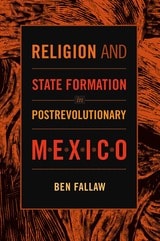
cover of Religion and State Formation in Postrevolutionary Mexico

Religion and State Formation in Postrevolutionary Mexico

Ben Fallaw

Duke University Press, 2012

The religion question—the place of the Church in a Catholic country after an anticlerical revolution—profoundly shaped the process of state formation in Mexico. From the end of the Cristero War in 1929 until Manuel Ávila Camacho assumed the presidency in late 1940 and declared his faith, Mexico's unresolved religious conflict roiled regional politics, impeded federal schooling, undermined agrarian reform, and flared into sporadic violence, ultimately frustrating the secular vision shared by Plutarco Elías Calles and Lázaro Cárdenas.

Ben Fallaw argues that previous scholarship has not appreciated the pervasive influence of Catholics and Catholicism on postrevolutionary state formation. By delving into the history of four understudied Mexican states, he is able to show that religion swayed regional politics not just in states such as Guanajuato, in Mexico's central-west "Rosary Belt," but even in those considered much less observant, including Campeche, Guerrero, and Hidalgo. Religion and State Formation in Postrevolutionary Mexico reshapes our understanding of agrarian reform, federal schooling, revolutionary anticlericalism, elections, the Segunda (a second Cristero War in the 1930s), and indigenism, the Revolution's valorization of the Mesoamerican past as the font of national identity.
[more]
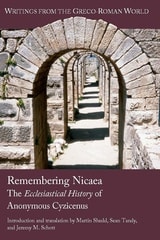
cover of Remembering Nicaea: The Ecclesiastical History of Anonymous Cyzicenus

Remembering Nicaea

The Ecclesiastical History of Anonymous Cyzicenus

Martin Shedd

SBL Press, 2024

Remembering Nicaea presents the first complete English translation of Anonymous Cyzicenus’s Ecclesiastical History, the fullest surviving account of the Council of Nicaea (325 CE). The introduction features new arguments for the dating of the text, a discussion of Anonymous Cyzicenus’s sources and their modification, and an evaluation of the larger purpose of the Ecclesiastical History as a unique and instructive source for the christological controversies of the fifth century CE. Appendixes include the text of the Byzantine epistolary supplement found in all manuscripts, the Pinakes, testimony about the work from the ninth-century patriarch of Constantinople, Photius, and the prefatory letter to the 1599 critical edition. This unique combination of history and legend preserves otherwise-lost sources for students and scholars of church history.
[more]
cover of Respectably Catholic and Scientific: Evolution and Birth Control Between the World Wars

Respectably Catholic and Scientific

Evolution and Birth Control Between the World Wars

Alexander Pavuk

Catholic University of America Press, 2021
Respectfully Catholic and Scientific traces the unexpected manner in which several influential liberal-progressive Catholics tried to shape how evolution and birth control were framed and debated in the public square in the era between the World Wars-- and the unintended consequences of their efforts. A small but influential cadre of Catholic priests professionally trained in social sciences, Frs. John Montgomery Cooper, John A. Ryan, and John A. O’Brien, gained a hearing from mainline public intellectuals largely by engaging in dialogue on these topics using the lingua franca of the age, science, to the near exclusion of religious argumentation. The Catholics’ approach was more than just tactical. It also derived from the subtle influence of Catholic theological Modernism, with its strong enthusiasm for science, and from an inclination toward scientism inherited from the Progressive Era’s social science milieu. All three shared a fervent desire to translate the Catholic ethos, as they understood it, into the vocabulary of the modern age while circumventing anti-Catholic attitudes in the process. However, their method resulted in a series of unintended consequences whereby their arguments were not infrequently co-opted and used against both them and the institutional church they served. Alexander Pavuk considers the complex role of both liberal religious figures and scientific elites in evolution and birth control discourse, and how each contributed in unexpected ways to the reconstruction of those topics in public culture. The reconstruction saw the topics themselves shift from matters considered largely within moral frameworks into bodies of kno
[more]
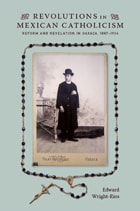
cover of Revolutions in Mexican Catholicism: Reform and Revelation in Oaxaca, 1887–1934

Revolutions in Mexican Catholicism

Reform and Revelation in Oaxaca, 1887–1934

Edward Wright-Rios

Duke University Press, 2009

In Revolutions in Mexican Catholicism, Edward Wright-Rios investigates how Catholicism was lived and experienced in the Archdiocese of Oaxaca, a region known for its distinct indigenous cultures and vibrant religious life, during the turbulent period of modernization in Mexico that extended from the late nineteenth century through the early twentieth. Wright-Rios centers his analysis on three “visions” of Catholicism: an enterprising archbishop’s ambitious religious reform project, an elderly indigenous woman’s remarkable career as a seer and faith healer, and an apparition movement that coalesced around a visionary Indian girl. Deftly integrating documentary evidence with oral histories, Wright-Rios provides a rich, textured portrait of Catholicism during the decades leading up to the Mexican Revolution of 1910 and throughout the tempestuous 1920s.

Wright-Rios demonstrates that pastors, peasants, and laywomen sought to enliven and shape popular religion in Oaxaca. The clergy tried to adapt the Vatican’s blueprint for Catholic revival to Oaxaca through institutional reforms and attempts to alter the nature and feel of lay religious practice in what amounted to a religious modernization program. Yet some devout women had their own plans. They proclaimed their personal experiences of miraculous revelation, pressured priests to recognize those experiences, marshaled their supporters, and even created new local institutions to advance their causes and sustain the new practices they created. By describing female-led visionary movements and the ideas, traditions, and startling innovations that emerged from Oaxaca’s indigenous laity, Wright-Rios adds a rarely documented perspective to Mexican cultural history. He reveals a remarkable dynamic of interaction and negotiation in which priests and parishioners as well as prelates and local seers sometimes clashed and sometimes cooperated but remained engaged with one another in the process of making their faith meaningful in tumultuous times.
[more]
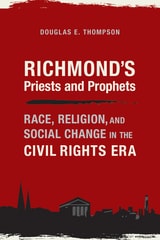
cover of Richmond's Priests and Prophets: Race, Religion, and Social Change in the Civil Rights Era

Richmond's Priests and Prophets

Race, Religion, and Social Change in the Civil Rights Era

Douglas E. Thompson

University of Alabama Press, 2017

Explores the ways in which white Christian leaders in Richmond, Virginia navigated the shifting legal and political battles around desegregation even as members of their congregations struggled with their own understanding of a segregated society

Douglas E. Thompson’s Richmond’s Priests and Prophets: Race, Religion, and Social Change in the Civil Rights Era presents a compelling study of religious leaders’ impact on the political progression of Richmond, Virginia, during the time of desegregation. Scrutinizing this city as an entry point into white Christians’ struggles with segregation during the 1950s, Thompson analyzes the internal tensions between ministers, the members of their churches, and an evolving world.
 
In the mid-twentieth-century American South, white Christians were challenged repeatedly by new ideas and social criteria. Neighborhood demographics were shifting, public schools were beginning to integrate, and ministers’ influence was expanding. Although many pastors supported the transition into desegregated society, the social pressure to keep life divided along racial lines placed Richmond’s ministers on a collision course with forces inside their own congregations. Thompson reveals that, to navigate the ideals of Christianity within a complex historical setting, white religious leaders adopted priestly and prophetic roles.
 
Moreover, the author argues that, until now, the historiography has not viewed white Christian churches with the nuance necessary to understand their diverse reactions to desegregation. His approach reveals the ways in which desegregationists attempted to change their communities’ minds, while also demonstrating why change came so slowly—highlighting the deeply emotional and intellectual dilemma of many southerners whose worldview was fundamentally structured by race and class hierarchies.
[more]