Results by title
153 books match the query 'Cities and towns' and 8 start with r
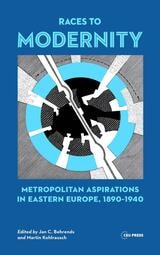
Races to Modernity
Metropolitan Aspirations in Eastern Europe, 1890–1940Martin Kohlrausch
Central European University Press, 2014
The comparative presentation of the birth of metropolises like St. Petersburg, Helsinki, Kiev, Belgrade, or Athens confirms the importance of the Western model as well as the influence of international experts on city planning at the periphery of Europe. In addition, this volume presents an alternative perspective that aims to understand the genesis of Eastern European cities with a metropolitan character or metropolitan aspirations as a process sui generis. The rapid expansion of metropolitan cities such as London and Paris began in the 17th and 18th centuries. Large parts of Central and Eastern Europe underwent urbanization and industrialization with considerable delay. Nevertheless beginning in the second half of the 19th century, the towns in the Romanov and Habsburg empires, as well as in the Balkans grew into cities and metropolitan areas. They changed at an astonishing pace. This transformation has long been interpreted as an attempt to overcome the economic and cultural backwardness of the region and to catch up to Western Europe.
[more]
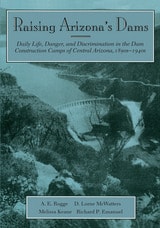
Raising Arizona's Dams
Daily Life, Danger, and Discrimination in the Dam Construction Camps of Central Arizona, 1890s-1940sA. E. Rogge, D. Lorne McWatters, Melissa Keane, and Richard P. Emanuel
University of Arizona Press, 1995
This is the engrossing story of the unsung heroes who did the day-to-day work of building Arizona's dams, focusing on the lives of laborers and their families who created temporary construction communities during the building of seven major dams in central Arizona. The book focuses primarily on the 1903-1911 Roosevelt Dam camps and the 1926-1927 Camp Pleasant at Waddell Dam, although other camps dating from the 1890s through the 1940s are discussed as well. The book is liberally illustrated with historic photographs of the camps and the people who occupied them while building the dams.
[more]
Regional and Metropolitan Growth and Decline in the US
William H. Frey
Russell Sage Foundation, 1988
During the 1970s, several striking population shifts attracted widespread attention and colorful journalistic labels. Urban gentrification, the rural renaissance, the rise of the Sunbelt—these phenomena signaled major reversals in long-term patterns of population distribution. In Regional and Metropolitan Growth and Decline in the United States, authors Frey and Speare place such reversals in context by examining a rich array of census data. This comprehensive study describes new population distribution patterns, explores their consequences, and evaluates competing explanations of current trends. The authors also provide an in-depth look at the changing race, status, and household demographics of the nation's largest cities and discuss the broad societal forces precipitating such changes. Frey and Speare conclude that the 1970s represented a "transition decade" in the history of population distribution and that patterns now emerging do not suggest a return to the past. With impressive scope and detail, this volume offers an unmatched picture of regional growth and decline across the United States. A Volume in the Russell Sage Foundation Census Series.
[more]
Remaking the Urban Social Contract
Health, Energy, and the EnvironmentEdited by Michael A. Pagano
University of Illinois Press, 2016
This new volume draws from provocative discussions on the urban social contract among policy makers, researchers, public intellectuals, and citizens at the 2015 UIC Urban Forum. Michael A. Pagano presents papers that emphasize political agreements, disagreements, challenges, and controversies on health, energy, and environmental policies. Authors explore the substantive and philosophical changes in the urban social contract and offer proposals for remaking it in the new century. Topics range from big-picture analyses to specifics covering areas like public services, the smart cities movement, and greening strategies.
Contributors: Alba Alexander, Megan Houston, Dennis R. Judd, Cynthia Klein-Banai, William C. Kling, Howard A. Learner, David A. McDonald, David C. Perry, Emily Stiehl, Anthony Townsend, Natalia Villamizar-Duarte, and Moira Zellner.
[more]
Renewal
Liberal Protestants and the American City after World War IIMark Wild
University of Chicago Press, 2019
In the decades following World War II, a movement of clergy and laity sought to restore liberal Protestantism to the center of American urban life. Chastened by their failure to avert war and the Holocaust, and troubled by missionaries’ complicity with colonial regimes, they redirected their energies back home.
Renewal explores the rise and fall of this movement, which began as an effort to restore the church’s standing but wound up as nothing less than an openhearted crusade to remake our nation’s cities. These campaigns reached beyond church walls to build or lend a hand to scores of organizations fighting for welfare, social justice, and community empowerment among the increasingly nonwhite urban working class. Church leaders extended their efforts far beyond traditional evangelicalism, often dovetailing with many of the contemporaneous social currents coursing through the nation, including black freedom movements and the War on Poverty.
Renewal illuminates the overlooked story of how religious institutions both shaped and were shaped by postwar urban America.
[more]
Risky Cities
The Physical and Fiscal Nature of Disaster CapitalismAlbert S. Fu
Rutgers University Press, 2022
Over half the world’s population lives in urban regions, and increasingly disasters are of great concern to city dwellers, policymakers, and builders. However, disaster risk is also of great interest to corporations, financiers, and investors. Risky Cities is a critical examination of global urban development, capitalism, and its relationship with environmental hazards. It is about how cities live and profit from the threat of sinkholes, garbage, and fire. Risky Cities is not simply about post-catastrophe profiteering. This book focuses on the way in which disaster capitalism has figured out ways to commodify environmental bads and manage risks. Notably, capitalist city-building results in the physical transformation of nature. This necessitates risk management strategies –such as insurance, environmental assessments, and technocratic mitigation plans. As such capitalists redistribute risk relying on short-term fixes to disaster risk rather than address long-term vulnerabilities.
[more]
Roman Cities
G. Michael Woloch
University of Wisconsin Press, 1984
Roman Cities combines G. Michael Woloch’s translation of Les villes romaines, Pierre Grimal’s noted French work on Roman city planning, archeology, and urban history, with Woloch’s additional notes and descriptions of the cities mentioned by Grimal, as well as other important Roman cities. The book provides a brief history and description of more than a hundred Roman cities, an extensive master bibliography, and a comprehensive glossary. Roman Cities will interest both scholars and students of Roman history and archeology, city planning, urban geography, and the social sciences. The glossary and bibliography make the book of value to specialists pursuing a particular topic and to students, history buffs, and amateur archaeologists seeking to broaden their understanding of the Roman city planning methods that are such an integral part of our modern urban heritage.
Roman Cities provides the first comprehensive study in English of major Roman cities, including an excellent coverage of the Roman legacy which was transmitted to medieval and modern trends in architecture and urban planning..
Roman Cities provides the first comprehensive study in English of major Roman cities, including an excellent coverage of the Roman legacy which was transmitted to medieval and modern trends in architecture and urban planning..
[more]

Rural Development in China
Prospect and RetrospectHsiao-tung Fei
University of Chicago Press, 1989
This collection of essays written from 1947-1986 by Fei Hsiao-tung, China's most distinguished sociologist and anthropologist, presents a rich and representative sampling of the research that has characterized his long career. In 1936, Fei conducted field work in Kaixian'gong, a village in Jiangsu province in east China. This village became the subject of his now classic study Peasant Life in China, in which he argued that, because of China's huge population and the scarcity of cultivable land, household industries such as production of raw silk were vital to the peasants' economic survival. His conclusions, long rejected by China's policymakers, have recently been embraced by the government under the political leadership of Deng Xiaopeng.
Returning to Kaixian'gong in 1957 and again in the 1980s, Fei examined the changes that had occurred since his initial research. Three essays that resulted from these follow-up studies are included in this collection, providing a rare summary and analysis of developments in the village between 1936 and 1986. Also included here are four articles based on Fei's 1983-84 research in other areas of Jiangsu province. His explorations of the contrast between the wealth of southern Jiangsu and the long-standing poverty of the northern half of the province address key issues of public policy in China today. Useful to students of rural sociology as well as of Chinese history, politics, economics, and anthropology, this collection will provide an overview not only of developments in the small towns of China but also of Fei's thought.
Returning to Kaixian'gong in 1957 and again in the 1980s, Fei examined the changes that had occurred since his initial research. Three essays that resulted from these follow-up studies are included in this collection, providing a rare summary and analysis of developments in the village between 1936 and 1986. Also included here are four articles based on Fei's 1983-84 research in other areas of Jiangsu province. His explorations of the contrast between the wealth of southern Jiangsu and the long-standing poverty of the northern half of the province address key issues of public policy in China today. Useful to students of rural sociology as well as of Chinese history, politics, economics, and anthropology, this collection will provide an overview not only of developments in the small towns of China but also of Fei's thought.
[more]