Results by title
90 books match the query 'Civilization, Modern' and 6 start with r
Racial Blackness and the Discontinuity of Western Modernity
Edited by Justin A. Joyce, Dwight A. McBride, and John Carlos Rowe
University of Illinois Press, 2013
Reclaiming Modernity
Essays on a Paradoxical NostalgiaLarry Bennett
University of Illinois Press, 2025
Larry Bennett explores the complexities of nostalgia with considerations of the historic preservation of brutalist architecture, specifically Bertrand Goldberg’s Prentice Women’s Hospital in Chicago; the memoirs and recollections of early and mid-twentieth-century Brooklyn and Detroit; and the turntable’s rebirth as a musical instrument alongside the vinyl LP’s resurgence as a prized way of consuming music. Bennett tracks modernity as expressed through ideas, artistic products, and widespread social practices. His consideration of nostalgia focuses on our inclination to rediscover value in people, places, and social habits diminished by the passage of time.
Provocative and multidisciplinary, Reclaiming Modernity delves into the paradox of how we feel nostalgia for ideas and times that emerged from an impulse to shun nostalgia.
Reflections on a Disruptive Decade
Essays from the SixtiesEugene Davidson
University of Missouri Press, 2000
As editor of Modern Age in the 1960s, Eugene Davidson introduced each quarterly issue with a thought-provoking contemplation of one or another of the decade's dizzying events. Gathered together here for the first time, the essays in Reflections on a Disruptive Decade present an intellectual conservative's perspective on an era which, because it underscores so many of the political divisions still with us today, continues to hold our fascination.
Davidson deals with the marvelous but confused realm of post-1945 international politics, in which the American people faced a new enemy, one often baffling and terrifying. The Cuban missile crisis was probably the most uncertain moment in foreign policy during this century. Although the crisis was resolved without bloodshed, there was intense danger of irrationality, for the Russians foolhardily had sent nuclear missiles to Cuba.
Other topics Davidson addresses are the Civil Rights movement, the policies and programs of Lyndon Johnson's Great Society, and the East-West battles of ideology and arms in Europe, Vietnam, and the Middle East. With remarkable shrewdness, Davidson illuminates many contradictions and excesses of the decade's liberal ascendancy, and presciently detects signs pointing to a resurgence of the nation's conservative forces.
Although more than thirty years have passed, Davidson's essays still contain great clarity, and his appraisals are still keen. Reflections on a Disruptive Decade is a truly remarkable addition to the work of this distinguished scholar.
Revolution
Modern Uprisings in Ancient TimeMiriam Leonard
University of Chicago Press, 2025
Despite its Latin etymology, “revolution” in its modern understanding arguably did not exist in antiquity, and revolution as we know it today is considered by many theorists to be a term born in modernity. While they certainly had times of momentous political upheaval, the Greeks and Romans tended to understand such events as part of a narrative of political continuity rather than novelty or rupture. Nevertheless, modern revolutions have repeatedly appropriated tropes of classical discourse, such as freedom, tyranny, tragedy, and fraternity.
With this book, Miriam Leonard offers a conceptual history of revolution, unraveling modernity’s yearning for the new and questioning why ancient concepts continue to play such an important role in political uprisings. Leonard looks at examples of appeals to antiquity during the French and Haitian Revolutions, in anticolonial struggles, and feminist and queer movements and considers works of theorists such as Karl Marx, Hannah Arendt, and Sigmund Freud that foreground an engagement with antiquity.
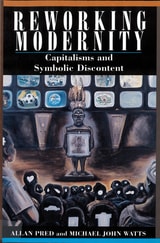
Reworking Modernity
Capitalisms and Symbolic DiscontentPred, Allan
Rutgers University Press, 1992
Using both grand conceptualizations and grounded case studies, Allan Pred and Michael Watts look at how people cope with and give meaning to capitalism and modernity in different times and places. As capital accumulation has grown and taken new forms, it has affected technology and labor relations which in turn have affected people's daily lives. These changes have not always been either welcome or easy. Pred and Watts focus on the symbolic discontent and cultural confrontations that accompany capitalism. They depict people struggling over the meaning of change in their lives and over new relations of power.
Modernity is experienced differently in different times and places. To illustrate this point, Pred and Watts offer four case studies that range across time and space. These studies remind us that there are multiple capitalisms and mutiple reactions to capitalisms. Watts begins with a study of a Muslim millenarian movement that arose alongside the Nigerian oil boom of the 1970s. When a Muslim prophet and disenfranchised followers tried to create a distinctive community and identity, they came into brutal conflict with state authorities. Thousands died in the resulting oppression. Watts's next case is less bloody, at least in the short run. He tell us what happened when technological change was introduced in rice production in West African peasant society. Peasants were drawn into the world economy as contract farmers. This changed work relations and affected everyday life in peasant households. Families began to fight over who would work and under what conditions. They struggled over gender indentity and property rights. We move back in time and across space for ther third case study. Pred discusses changes in the daily life of the Stockholm working class at the end of the nineteenth century. He writes of the various forms their discontent took as they struggled with economic restructuring. Even conflict over street names took on special meaning. For the last case Pred takes us to a steel mill in California. When a South Korean company became half owner of the mill, there was money for modernization and the threat of layoffs was reduced. But the workers remained unhappy. They protested low wages, unsafe conditions, and unfair recruitment practices. Their labor issues turned into issues of nationalism, morality and identity. All four case studies demonstrate the shock of modernity and how the resulting struggles affect daily life.
Ruins of Modernity
Julia Hell and Andreas Schönle, eds.
Duke University Press, 2009
Several contributors discuss ideas about ruins developed by philosophers such as Immanuel Kant, Georg Simmel, and Walter Benjamin. One contributor examines how W. G. Sebald’s novel The Rings of Saturn betrays the ruins erased or forgotten in the Hegelian philosophy of history. Another analyzes the repressed specter of being bombed out of existence that underpins post-Second World War modernist architecture, especially Le Corbusier’s plans for Paris. Still another compares the ways that formerly dominant white populations relate to urban-industrial ruins in Detroit and to colonial ruins in Namibia. Other topics include atomic ruins at a Nevada test site, the connection between the cinema and ruins, the various narratives that have accrued around the Inca ruin of Vilcashuamán, Tolstoy’s response in War and Peace to the destruction of Moscow in the fire of 1812, the Nazis’ obsession with imperial ruins, and the emergence in Mumbai of a new “kinetic city” on what some might consider the ruins of a modernist city. By focusing on the concept of ruin, this collection sheds new light on modernity and its vast ramifications and complexities.
Contributors. Kerstin Barndt, Jon Beasley-Murray, Russell A. Berman, Jonathan Bolton, Svetlana Boym, Amir Eshel, Julia Hell, Daniel Herwitz, Andreas Huyssen, Rahul Mehrotra, Johannes von Moltke, Vladimir Paperny, Helen Petrovsky, Todd Presner, Helmut Puff, Alexander Regier, Eric Rentschler, Lucia Saks, Andreas Schönle, Tatiana Smoliarova, George Steinmetz, Jonathan Veitch, Gustavo Verdesio, Anthony Vidler