Results by title
148 books match the query 'Colonization' and 5 start with r
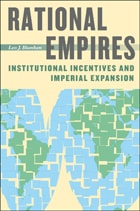
Rational Empires
Institutional Incentives and Imperial ExpansionLeo J. Blanken
University of Chicago Press, 2012
The nineteenth century marked the high point of imperialism, when tsarist Russia expanded to the Pacific and the sun was said never to set on the British Empire. Imperialism remains a perennial issue in international relations today, and nowhere is this more evident than in the intensifying competition for global resources.
Leo J. Blanken explains imperialism through an analysis of the institutions of both the expanding state and its targets of conquest. While democratic states favoring free trade generally resort to imperialism only to preempt aggressive rivals—or when they have reason to believe another state’s political institutions will not hold up when making bargains—authoritarian states tend toward imperialism because they don’t stand to benefit from free trade. The result is three distinct strategies toward imperialism: actors fighting over territory, actors peaceably dividing territory among themselves, and actors refraining from seizing territory altogether. Blanken examines these dynamics through three case studies: the scramble for Africa, the unequal treaties imposed on Qing Dynasty China, and the evolution of Britain’s imperial policy in India. By separating out the different types of imperialism, Blanken provides insight into its sources, as well as the potential implications of increased competition in the current international arena.
Recent Developments in Southeastern Archaeology
From Colonization to ComplexityDavid G. Anderson
University Press of Colorado, 2012
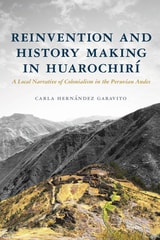
Reinvention and History Making in Huarochirí
A Local Narrative of Colonialism in the Peruvian AndesCarla Hernández Garavito
University of Arizona Press, 2026
Using archaeological and historical datasets and spatial modeling, this book centers on local memory and experience throughout colonized landscapes as the thread that connects the long history of Indigenous engagement with expanding colonial empires and the emergent Peruvian nation. The author builds on Andean epistemological frameworks to argue that in the face of drastic sociopolitical changes, the people of Huarochirí turned to their own history. They created analogies and shared spaces between local and Inka landscapes and materiality and incorporated written representations and ideas of settled lives to validate their claims.
This exciting new work moves the field of Andean archaeology into conversations with decolonial and decolonizing methodologies and shows how Indigenous communities captured and made sense of their long history, reframing colonialism as a local experience.
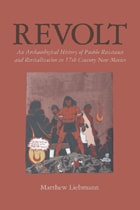
Revolt
An Archaeological History of Pueblo Resistance and Revitalization in 17th Century New MexicoMatthew Liebmann
University of Arizona Press, 2014
Published in cooperation with the William P. Clements Center for Southwest Studies, Southern Methodist University.
The Pueblo Revolt of 1680 is the most renowned colonial uprisings in the history of the American Southwest. Traditional text-based accounts tend to focus on the revolt and the Spaniards' reconquest in 1692—completely skipping over the years of indigenous independence that occurred in between. Revolt boldly breaks out of this mold and examines the aftermath of the uprising in colonial New Mexico, focusing on the radical changes it instigated in Pueblo culture and society.
In addition to being the first book-length history of the revolt that incorporates archaeological evidence as a primary source of data, this volume is one of a kind in its attempt to put these events into the larger context of Native American cultural revitalization. Despite the fact that the only surviving records of the revolt were written by Spanish witnesses and contain certain biases, author Matthew Liebmann finds unique ways to bring a fresh perspective to Revolt.
Most notably, he uses his hands-on experience at Ancestral Pueblo archaeological sites—four Pueblo villages constructed between 1680 and 1696 in the Jemez province of New Mexico—to provide an understanding of this period that other treatments have yet to accomplish. By analyzing ceramics, architecture, and rock art of the Pueblo Revolt era, he sheds new light on a period often portrayed as one of unvarying degradation and dissention among Pueblos. A compelling read, Revolt's "blood-and-thunder" story successfully ties together archaeology, history, and ethnohistory to add a new dimension to this uprising and its aftermath.
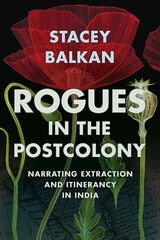
Rogues in the Postcolony
Narrating Extraction and Itinerancy in IndiaStacey Balkan
West Virginia University Press, 2022
Rogues in the Postcolony is a study of Anglophone Indian picaresque novels that dramatize the impacts of extractive capitalism and colonial occupation on local communities in several Indian states. In this materialist history of development on the subcontinent, Stacey Balkan considers works by Amitav Ghosh, Indra Sinha, and Aravind Adiga that critique violent campaigns of enclosure and dispossession at the hands of corporate entities like the English East India Company and its many legatees. By foregrounding the intersections among landscape ideology, agricultural improvement, extractive capitalism, and aesthetic expression, Rogues in the Postcolony also attends to the complicity of popular aesthetic forms with political and economic policy, as well as the colonial and extractivist logics that often frame discussions around the so-called Anthropocene epoch.
Bringing together questions about settler-colonial practices and environmental injustice, Rogues in the Postcolony concludes with an investigation of new extractivist frontiers, including solar capitalism, and considers the possibility of imagining life after extraction on the Indian subcontinent and beyond.