Results by title
198 books match the query 'Community' and 13 start with r
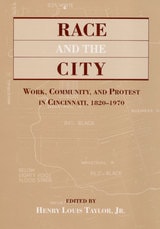
RACE & THE CITY
Work, Community, and Protest in Cincinnati, 1820-1970Edited by Henry Louis Taylor, Jr.
University of Illinois Press, 1993
of black Cincinnati. These studies offer insight into both the dynamics of racism and a
community's changing responses to it." -- Peter Rachleff, author of Black Labor in
Richmond
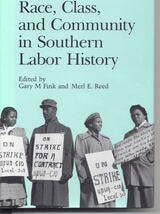
Race, Class, and Community in Southern Labor History
Gary M. Fink
University of Alabama Press, 1994
Exploring the intertwined histories of race, labor, and community in the American South.
Under the leadership of Gary M. Fink and Merl E. Reed, Georgia State University hosts the Southern Labor Studies Conferences approximately every two years. The conferences have yielded two previous volumes, published in 1977 and 1981, and this volume, which contains selected papers from the seventh conference held in 1991.
As evidence by the quality of these essays, the field of southern labor history has come into its own. Research interest is peaking: the practitioners are younger scholars, and much of their work emphasizes the new social and political history. While the topics covered in this volume usually reflect that methodology, their chronology ranges from the antebellum period to the 1970s, suggesting the variety of sources and changing research approaches that can be used in rendering new meaning to the past. Although the subject of gender was generally a minor theme in these sessions, work now being done leaves no doubt that at some future conference gender will attract a commanding amount of attention.
In introducing and describing their respective areas, the associate editors, Robert H. Zieger (textile workers), Joe W. Trotter (African Americans), and Clifford Kuhn (labor politics), have provided a rich historiographical background.
The essays in this volume will enlighten the reader on many important aspects of the history of southern labor, and they will also raise new questions to be explained by other scholars and future conferences.
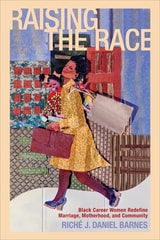
Raising the Race
Black Career Women Redefine Marriage, Motherhood, and CommunityBarnes, Riché J. Daniel
Rutgers University Press, 2015
Popular discussions of professional women often dwell on the conflicts faced by the woman who attempts to “have it all,” raising children while climbing up the corporate ladder. Yet for all the articles and books written on this subject, there has been little work that focuses on the experience of African American professional women or asks how their perspectives on work-family balance might be unique.
Raising the Race is the first scholarly book to examine how black, married career women juggle their relationships with their extended and nuclear families, the expectations of the black community, and their desires to raise healthy, independent children. Drawing from extensive interviews with twenty-three Atlanta-based professional women who left or modified careers as attorneys, physicians, executives, and administrators, anthropologist Riché J. Daniel Barnes found that their decisions were deeply rooted in an awareness of black women’s historical struggles. Departing from the possessive individualistic discourse of “having it all,” the women profiled here think beyond their own situation—considering ways their decisions might help the entire black community.
Giving a voice to women whose perspectives have been underrepresented in debates about work-family balance, Barnes’s profiles enable us to perceive these women as fully fledged individuals, each with her own concerns and priorities. Yet Barnes is also able to locate many common themes from these black women’s experiences, and uses them to propose policy initiatives that would improve the work and family lives of all Americans.

Reading Galileo's Letters
Experiments in Friendship, Knowledge, and CommunityEdited by Paula Findlen and Hannah Marcus
University of Chicago Press, 2027
Essays by many of the foremost experts on Galileo offer an interdisciplinary approach to the legendary scientist’s correspondence.
The Tuscan mathematician, physicist, and astronomer Galileo Galilei (1564–1642) is one of history’s most iconic and controversial figures. Letters form the backbone of what one early Galileo scholar called the “private Galileo,” and his correspondence is indeed a record of his family and friendships; his intellectual evolution; his professional interactions with other scientific figures; and his relations with patrons, brokers, and publishers. Last, but hardly least, his letters are a unique cultural artifact of Galileo the writer and master of vernacular prose.
Galileo’s correspondence crossed Europe in public mail pouches, through diplomatic messengers, and was written in code. Today, there are 3,272 surviving letters to or from Galileo and his many friends, family members, disciples, and rivals across Europe. This volume examines these letters as an essential aspect of Galileo’s personal and scientific career. They are what the editors call his “experiments in friendship,” which enabled, abetted, and often served as early drafts of the theories in his published works. This collaborative volume brings together different approaches, case studies, and forms of expertise—historical and literary, intellectual and material, archival and digital. It is a must-read for all Galileo enthusiasts and anyone interested in how to make the most of a rich record of correspondence.
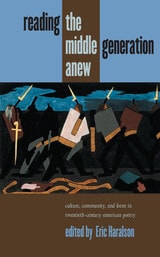
Reading the Middle Generation Anew
Culture, Community, and Form in Twentieth-Century American PoetryEric Haralson
University of Iowa Press, 2006
In addition to having worked during the broad middle of the last century, these poets constitute the center of twentieth-century American poetry in the larger sense, refuting invidious connotations of “middle” as coming after the great moderns and being superseded by a proliferating postmodern experimentation. This middle generation mediates the so-called American century and its prodigious body of poetry, even as it complicates historical and aesthetic categorizations.
Taking diverse formal and thematic angles on these poets—deconstructionist, biographical-historical, and more formalist accounts—this book re-examines their between-ness and ambivalence: their various positionings and repositionings in aesthetic, political, and personal matters. The essays study the interplay between these writers and such shifting formations as religious discourse, consumerism, militarism and war, the ideology of America as “nature’s nation,” and U.S. race relations and ethnic conflicts. Reading the Middle Generation Anew also shows the legacy of the middle generation, the ways in which their lives and writings continue to be a shaping force in American poetry. This fresh and invigorating collection will be of great interest to literary scholars and poets.
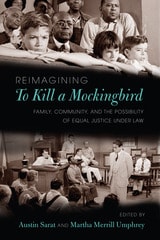
Reimagining "To Kill a Mockingbird"
Family, Community, and the Possibility of Equal Justice under LawAustin Sarat
University of Massachusetts Press, 2013
The readings in this volume peel back the film's visual representation of the many-layered social world of Maycomb, Alabama, offering sometimes counterintuitive insights through the prism of a number of provocative contemporary theoretical and interpretive questions. What, they ask, is the relationship between the subversion of social norms and the doing of justice or injustice? Through what narrative and visual devices are some social hierarchies destabilized while others remain hegemonic? How should we understand the sacrifices characters make in the name of justice, and comprehend their failures in achieving it?
Asking such questions casts light on the film's eccentricities and internal contradictions and suggests the possibility of new interpretations of a culturally iconic text. The book examines the context that gave meaning to the film's representation of race and how debates about family, community, and race are played out and reframed in law.
Contributors include Colin Dayan, Thomas L. Dumm, Susan Sage Heinzelman, Linda Ross Meyer, Naomi Mezey, Imani Perry, and Ravit Reichman.
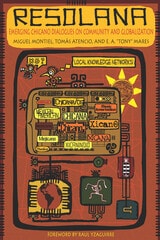
Resolana
Emerging Chicano Dialogues on Community and GlobalizationMiguel Montiel
University of Arizona Press, 2009
Coming from diverse backgrounds in social work, sociology, public administration, literature, history, and education, three modern resolaneros take the twin concepts of resolana and el oro del barrio on a breathtaking journey from their rural roots to their application in an urban setting and on to a holistic view of globalization. The authors offer a humane perspective on transborder cultures and all communities struggling to maintain their cultural and linguistic identities. They share an optimistic view of how ordinary people everywhere can take back control of their own destinies. This book is about uncovering subjugated knowledge—el oro del barrio—through resolana, a dynamic process of thought and action.
Resolana will inspire dialogue and creativity from those interested in sociology, political science, social work, and Chicano studies, as well as public-policy makers and the general public.
Restoring the Balance
First Nations Women, Community, and CultureEric Guimond
University of Manitoba Press, 2009
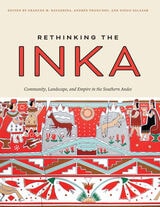
Rethinking the Inka
Community, Landscape, and Empire in the Southern AndesEdited by Frances M. Hayashida, Andrés Troncoso, and Diego Salazar
University of Texas Press, 2022
2023 Book Award, Society for American Archaeology
A dramatic reappraisal of the Inka Empire through the lens of Qullasuyu.
The Inka conquered an immense area extending across five modern nations, yet most English-language publications on the Inka focus on governance in the area of modern Peru. This volume expands the range of scholarship available in English by collecting new and notable research on Qullasuyu, the largest of the four quarters of the empire, which extended south from Cuzco into contemporary Bolivia, Argentina, and Chile.
From the study of Qullasuyu arise fresh theoretical perspectives that both complement and challenge what we think we know about the Inka. While existing scholarship emphasizes the political and economic rationales underlying state action, Rethinking the Inka turns to the conquered themselves and reassesses imperial motivations. The book’s chapters, incorporating more than two hundred photographs, explore relations between powerful local lords and their Inka rulers; the roles of nonhumans in the social and political life of the empire; local landscapes remade under Inka rule; and the appropriation and reinterpretation by locals of Inka objects, infrastructure, practices, and symbols. Written by some of South America’s leading archaeologists, Rethinking the Inka is poised to be a landmark book in the field.
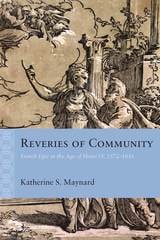
Reveries of Community
French Epic in the Age of Henri IV, 1572–1616Katherine S. Maynard
Northwestern University Press, 2018
Traditionally united by une foi, une loi, un roi (one faith, one law, one king), France under Henri IV was cleaved into warring factions of Catholics and Huguenots. The country suffered episodes of bloodshed such as the St. Bartholomew’s Day Massacre, even as attempts were made to attenuate the violence through frequent edicts, including those of St. Germain (1570) and Nantes (1598). Maynard examines the rich and often dismissed body work written during these bloody decades: Pierre de Ronsard’s Franciade, Guillaume Salluste Du Bartas’s La Judit and La Sepmaine, Sébastian Garnier’s La Henriade, Agrippa d’Aubigné’s Les Tragiques, and others. She traces how French poets, taking classics such as Virgil’s Aeneid and Homer’s Iliad as their models, reimagined possibilities for French reconciliation and unity.
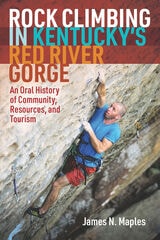
Rock Climbing in Kentucky's Red River Gorge
An Oral History of Community, Resources, and TourismJames N. Maples
West Virginia University Press, 2021
Rock Climbing in Kentucky’s Red River Gorge documents, for the first time, fifty years of oral history from this famous climbing community. Through extensive interviews, Maples reconstructs the growth of rock climbing in the region—including a twice-failed dam project, mysterious first routes, unauthorized sport-route growth on public lands, and a controversial archaeological dig. The book details five decades of collaborations to secure ongoing access to some of the world’s most beautiful and technically demanding routes and the challenges along the way.
More than a recounting of the past, however, Rock Climbing in Kentucky’s Red River Gorge uses the region’s extraordinary history to argue that climbing has the potential to be a valuable source of sustainable economic activity in rural areas throughout Appalachia today and in the years to come. The book concludes by offering policy recommendations and lessons learned about building beneficial partnerships among climbers, local communities, and public land managers to encourage community development and ecotourism alongside preservation.
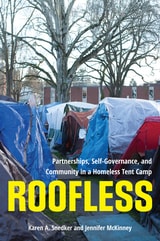
Roofless
Partnerships, Self-Governance, and Community in a Homeless Tent CampKaren A. Snedker
Rutgers University Press, 2027
Roofless critically examines homelessness and responses to it in the United States through the growing practice of forming tent camps. Karen A. Snedker and Jennifer McKinney position Seattle's "Tent City 3," (the US city with the third-largest homeless population), as an organizational model for other local governments to consider implementing in addressing their homelessness crises. Snedker and McKinney document this tent city's development through a census they conducted from 2019 to 2020, though the efforts behind Tent City 3 have a history dating back two decades. Through such an examination, the authors reveal surprising points of view and outcomes, including grassroots partnerships between city agencies, nonprofits, religious organizations, and educational institutions. In the context of rising homelessness in the US, understanding and having insight into the residents' experience of sanctioned unsheltered homelessness, compared to instances of unsanctioned encampments, allows readers to acquire a complete, nuanced picture of tent-based homelessness. As such, Roofless provides valuable insight to audiences ranging from scholars of sociology and social work, policymakers, homelessness advocates, and politicians.
Rooms with a View
The Stages of Community in the Modern TheaterRichard L. Barr
University of Michigan Press, 1998