Results by title
80 books match the query 'Community development' and 6 start with r
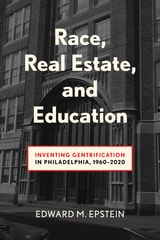
Race, Real Estate and Education
Inventing Gentrification in Philadelphia, 1960-2020Edward M. Epstein
Temple University Press, 2025
Epstein outlines the citywide context for the plan to create “University City” in West Philadelphia. He recounts the attempts to correct the segregation, overcrowding, and authoritarian management that plagued Philadelphia’s public schools. As the West Philadelphia Corporation, the proxy for the universities and hospitals, initiated gentrification efforts, the local community resisted and protested, causing the project to fail. The effort was revived with spectacular success, however, with the launch of the well-funded Penn Alexander School in 2001.
Race, Real Estate, and Education shows how the pursuit of urbanist ideals sometimes deepens neighborhood injustice. Epstein’s exploration of whether Philadelphia’s overall approach was beneficial or misguided presents a cautionary tale.
In the series Urban Life, Landscape, and Policy
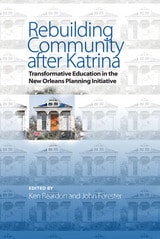
Rebuilding Community after Katrina
Transformative Education in the New Orleans Planning InitiativeKen Reardon
Temple University Press, 2015
Rebuilding Community after Katrina chronicles the innovative and ambitious partnership between Cornell University’s City and Regional Planning department and ACORN Housing, an affiliate of what was the nation’s largest low-income community organization. These unlikely allies came together to begin to rebuild devastated neighborhoods in New Orleans after Hurricane Katrina.
The editors and contributors to this volume allow participants’ voices to show how this partnership integrated careful, technical analysis with aggressive community outreach and organizing. With essays by activists, organizers, community members, and academics on the ground, Rebuilding Community after Katrina presents insights on the challenges involved in changing the way politicians and analysts imagined the future of New Orleans’ Ninth Ward.
What emerges from this complex drama are lessons about community planning, organizational relationships, and team building across multi-cultural lines. The accounts presented in Rebuilding Community after Katrina raise important and sensitive questions about the appropriate roles of outsiders in community-based planning processes.
Redlining To Reinvestment
edited by Gregory D. Squires
Temple University Press, 1992
After decades of suffering redlining and disinvestment by financial institutions, many communities have learned to fight back successfully. In more than seventy U.S. cities, over 300 community-based organizations have negotiated at least eighteen billion dollars in reinvestment commitments in recent years. In original essays, well-known community activists and activist academics tell the stories of some of the most successful reinvestment campaigns in Boston, Pittsburgh, Detroit, Chicago, Milwaukee, Atlanta, and California.
In the series Conflicts in Urban and Regional Development, edited by John R. Logan and Todd Swanstrom.
Reinventing Citizenship
Black Los Angeles, Korean Kawasaki, and Community ParticipationKazuyo Tsuchiya
University of Minnesota Press, 2014
In the 1960s and 1970s, the United States and Japan went through massive welfare expansions that sparked debates about citizenship. At the heart of these disputes stood African Americans and Koreans. Reinventing Citizenship offers a comparative study of African American welfare activism in Los Angeles and Koreans’ campaigns for welfare rights in Kawasaki. In working-class and poor neighborhoods in both locations, African Americans and Koreans sought not only to be recognized as citizens but also to become legitimate constituting members of communities.
Local activists in Los Angeles and Kawasaki ardently challenged the welfare institutions. By creating opposition movements and voicing alternative visions of citizenship, African American leaders, Tsuchiya argues, turned Lyndon B. Johnson’s War on Poverty into a battle for equality. Koreans countered the city’s and the nation’s exclusionary policies and asserted their welfare rights. Tsuchiya’s work exemplifies transnational antiracist networking, showing how black religious leaders traveled to Japan to meet Christian Korean activists and to provide counsel for their own struggles.
Reinventing Citizenship reveals how race and citizenship transform as they cross countries and continents. By documenting the interconnected histories of African Americans and Koreans in Japan, Tsuchiya enables us to rethink present ideas of community and belonging.
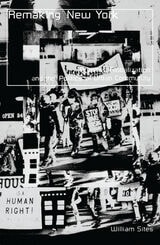
Remaking New York
Primitive Globalization And The Politics Of Urban CommunityWilliam Sites
University of Minnesota Press, 2003
Uses New York City to discuss the ways that policy has mismanaged the effects of globalization
Inequality increases, instability grows, communities fragment: this is the fate of a city in the wake of globalization—but is globalization really the cause? Proposing a new perspective on politics, globalization, and the city, this provocative book argues that such urban problems result in part from U.S. policies that can be changed.
William Sites develops the concept of primitive globalization, identifying a pattern of reactive politics—ad hoc measures to subsidize business, displace the urban poor, and dismantle the welfare state—that uproots social actors (corporations, citizens, urban residents) and facilitates a damaging, short-term-oriented type of international integration. In light of this theory, Sites examines the transformation of New York City since the 1970s, focusing on the logic of political action at national, local, and neighborhood levels. In the process, the story of late twentieth-century New York and its Lower East Side community emerges as something different: not a tale of globalist transformation or of local resurgence but a distinctly American case, one in which urban politics and the state, in their own right, exacerbate inequality and community fragmentation within the city.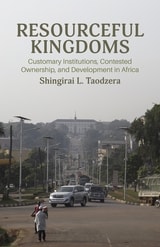
Resourceful Kingdoms
Customary Institutions, Contested Ownership, and Community Development in AfricaShingirai Taodzera
Ohio University Press, 0
Resourceful Kingdoms investigates the struggle for control over Uganda’s emerging oil sector, centering on the Bunyoro Kingdom’s unsuccessful effort to secure ownership of resources discovered on its ancestral lands. Drawing on extensive fieldwork, the book shows how the military-backed National Resistance Movement government consolidated authority over an estimated two billion barrels of oil, while Bunyoro communities experienced displacement, land loss, political tension, and significant environmental harm even before production began. The Bunyoro case reflects a wider pattern in which rural, resource-rich populations across Africa are marginalized as governments and multinational corporations convert natural resources into state-centered revenues.
The book further explores how indigenous kingdoms might come to own resources and channel revenues toward sustainable, culturally grounded development. Through comparative case studies of Uganda’s powerful Buganda Kingdom and South Africa’s Bafokeng Kingdom—widely recognized for community-based mineral ownership and effective wealth management—Resourceful Kingdoms illustrates how traditional institutions can pair with corporate structures, private land ownership, and diversified investment strategies to strengthen community prosperity.
From this analysis emerges strategic coexistence, a new framework that outlines how kingdoms can secure resource rights independent of shifting state policies or corporate social-responsibility initiatives. Presented as both a philosophy and a set of practical steps, strategic coexistence urges kingdoms to formalize land ownership, build strong indigenous governance systems, create community-owned corporations, reinvest resource revenues in long-term development, and transition away from dependence on extractive industries. Resourceful Kingdoms ultimately repositions African kingdoms as dynamic, contemporary governance institutions with significant potential to influence natural resource administration and advance community well-being.