Results by title
56 books match the query 'Community organization' and 4 start with r
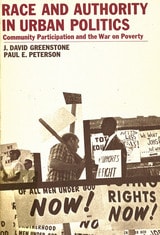
Race and Authority in Urban Politics
David J. Greenstone
Russell Sage Foundation, 1974
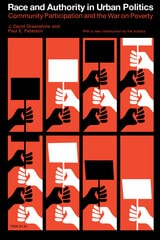
Race and Authority in Urban Politics
Community Relations and the War on PovertyDavid Greenstone and Paul E. Peterson
University of Chicago Press, 1976
In a series of lively chapters, Greenstone and Peterson show how the coalitions that formed around the community action question developed not out of electoral or organizational interests alone but were strongly influenced by prevailing conceptions of the nature of authority in America. The book stresses the way in which both machine and reform structures affected the ability of minority groups to organize effectively and to form alliances in urban politics. It considers the wide-ranging critiques made of the Community Action Program by conservative, liberal, and radical analysts and finds that all of them fail to appreciate the significance and intensity of the racial cleavage in American politics.
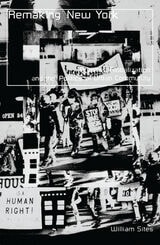
Remaking New York
Primitive Globalization And The Politics Of Urban CommunityWilliam Sites
University of Minnesota Press, 2003
Uses New York City to discuss the ways that policy has mismanaged the effects of globalization
Inequality increases, instability grows, communities fragment: this is the fate of a city in the wake of globalization—but is globalization really the cause? Proposing a new perspective on politics, globalization, and the city, this provocative book argues that such urban problems result in part from U.S. policies that can be changed.
William Sites develops the concept of primitive globalization, identifying a pattern of reactive politics—ad hoc measures to subsidize business, displace the urban poor, and dismantle the welfare state—that uproots social actors (corporations, citizens, urban residents) and facilitates a damaging, short-term-oriented type of international integration. In light of this theory, Sites examines the transformation of New York City since the 1970s, focusing on the logic of political action at national, local, and neighborhood levels. In the process, the story of late twentieth-century New York and its Lower East Side community emerges as something different: not a tale of globalist transformation or of local resurgence but a distinctly American case, one in which urban politics and the state, in their own right, exacerbate inequality and community fragmentation within the city.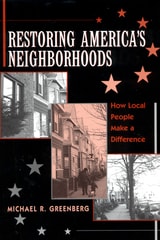
Restoring America's Neighborhoods
How Local People Make a DifferenceMichael R Greenberg
Rutgers University Press, 1999
What does it take to mobilize a grass-roots force dedicated to bringing new life into a decaying neighborhood? Can any one person or group successfully halt physical deterioration, drug-related crime, or the encroachment of clusters of factories, highways, and other noxious land uses? Michael Greenberg demonstrates in this book that it can and has been done against all odds.
Restoring America's Neighborhoods profiles twenty-four such cases from across the United States. It tells the story of people determined to make the blighted, crime-ridden urban enclaves in which they live and work a better place for everybody. These are people from many different walks of life: ministers working to bring jobs to their communities; city planners and federal employees trying to relocated residents of potential disaster areas; and locals taking matters into their own hands to create a healthier, more pleasing living environment for their children. Greenberg's is a heartening account of courage and unwavering resolve as well as of hope that individuals can make a difference, that violent criminals and uncaring bureaucrats need not carry the day. He calls them "streetfighters," a fitting tribute to their efforts to take back their neighborhoods, block by block and street by street.