Results by title
264 books match the query 'Composition' and 23 start with r
Race, Rhetoric, and Research Methods
Alexandria Lockett
University Press of Colorado, 2021
Racing Translingualism in Composition
Toward a Race-Conscious Translingualismedited by Tom Do and Karen Rowan
Utah State University Press, 2022
This collection extends the disciplinary conversations about translingualism by foregrounding the role race and racism play in the construction and maintenance of language differences. In doing so, the contributors examine the co-naturalization of race and language in order to theorize a race-conscious translingual praxis. The book begins by offering generative critiques of translingualism, centering on the ways in which the approach’s democratic orientation to language avoids issues of race, language, and power and appeals to colorblind racist tropes of equal opportunity. Following these critiques, contributors demonstrate the important intersections of race and translingualism by drawing upon voices typically marginalized by monolingual language ideologies and pedagogies. Finally, Racing Translingualism concludes by attending to the pedagogical implications of a race-conscious translingual praxis in writing and literacy education.
Making the case for race-conscious, rather than colorblind, theories and pedagogies, Racing Translingualism offers a unique take on how translingualism is theorized and practiced and moves the field forward through its direct consideration of the links between language, race, and racism.
Contributors: Lindsey Albracht, Steven Alvarez, Bethany Davila, Tom Do, Jaclyn Hilberg, Bruce Horner, Aja Martinez, Esther Milu, Stephanie Mosher, Yasmine Romero, Karen Rowan, Rachael Shapiro, Shawanda Stewart, Brian Stone, Victor Villanueva, Missy Watson

Radical Transparency
Perspectives on Graduate Education in Writing StudiesJustin H. Cook
Utah State University Press, 2027
Radical Transparency brings together candid, powerful accounts of what it means to live, work, and labor as a graduate student in writing studies in today’s academy. At a moment when higher education is defined by precarity, burnout, widening inequities, and political uncertainty, this collection names, without sanitizing, the emotional, embodied, and institutional realities that shape graduate education.
Blending scholarly analysis with personal narrative, the chapters document graduate student experiences across writing studies, rhetoric and composition, and related fields. Contributors take up issues often rendered invisible in official program materials and institutional discourse, including disability and access, queer and crip temporalities, financial and labor precarity, mentoring breakdowns, emotional labor, care work, grief, and the hidden curricula that govern graduate life. Together, these chapters reveal how graduate students navigate systems that demand resilience while frequently withholding transparency, support, and care. Organized around three intersecting threads—navigating precarity, building networks of care, and reimagining academic work—Radical Transparency also introduces an emotional-labor tagging system that allows readers to trace recurring forms of labor and affective demand as they surface in different institutional contexts.
Whether read cover to cover or approached nonlinearly, the text invites readers to see connections accumulate—and patterns emerge. Radical Transparency is for graduate students who suspect they’re not broken. It is for faculty and administrators willing to sit with discomfort, accountability, and complicity. And it is for anyone who believes that transparency without action is insufficient and that telling the truth, collectively and aloud, is a form of resistance.
Re-imagining Doctoral Writing
Cecile Badenhorst
University Press of Colorado, 2021
Reaching All Writers
A Pedagogical Guide for Evolving College Writing ClassroomsJoanne Baird Giordano
Utah State University Press, 2023
Using threshold concepts and transfer as a foundation, the authors provide an invaluable resource for multiple contexts: instructors working off the tenure track and/or at multiple institutions; two-year college programs without a writing program administrator; and writing program graduate teaching assistant training courses. Each chapter includes an overview of a threshold concept, disciplinary background readings, practical teaching strategies, assignment and learning activity ideas, assessment principles, examples from student and instructor perspectives, and questions for reflection and discussion.
Reaching All Writers describes effective teaching practices to help all college writing instructors, regardless of their institutional contexts, make changes that support equitable and inclusive learning opportunities—with a focus on teaching students whose backgrounds and learning experiences are different from those with more educational or economic privilege. Both new and experienced teachers adapting first-year college writing courses will find the book’s blend of practical strategies and disciplinary knowledge a useful companion for facilitating new classroom and program needs or designing new teaching assistant training courses.
Reading and Writing Instruction in the Twenty-First Century
Recovering and Transforming the Pedagogy of Robert ScholesEllen C. Carillo
Utah State University Press, 2021
In this volume, Scholes’s scholarship is included alongside original essays, providing a resource for those considering everything from the place of the English major in the twenty-first century to best practices for helping students navigate misinformation and disinformation. Reading and Writing Instruction in the Twenty-First Century not only keeps Scholes’s legacy alive but carries it on through a commitment, in Scholes’s (1998) own words, to “offer our students . . . the cultural equipment they are going to need when they leave us.”
Contributors:
Angela Christie, Paul T. Corrigan, Lynée Lewis Gaillet, Doug Hesse, Alice S. Horning, Emily J. Isaacs, Christopher La Casse, Robert Lestón, Kelsey McNiff, Thomas P. Miller, Jessica Rivera-Mueller, Christian Smith, Kenny Smith
Reconceptualizing Response
Using Instructor Feedback to Promote Linguistic JusticeKelly Blewett
Utah State University Press, 2026
Reconceptualizing Response reframes instructor feedback, one of the most consequential practices in rhetoric and writing studies, as a site of linguistic justice. Instructor response is not merely technical commentary; it is contested terrain where students’ identities, experiences, and language varieties must be named, supported, and celebrated.
Contributors represent a wide range of institutional contexts—including two-year colleges, four-year universities, HBCUs, HSIs, SLACs, and PWIs—and write from diverse positionalities, amplifying current debates and productive tensions in the field. Organized around four key moves—looking back, looking within, looking up, and looking around—the book invites readers to critically examine the ideologies underlying feedback practices; recognize how instructors' positionality, values, and beliefs are communicated through feedback; align feedback with students’ needs; and reconsider the broader classroom ecology required for justice. Bridging linguistic justice and feedback studies, this collection provides concrete tools and frameworks, as well as sample rubrics, course policies, and fresh approaches to assessment.
Ideal for graduate students, writing program administrators, faculty teaching future writing instructors, and anyone seeking to transform classroom practice, Reconceptualizing Response offers guiding questions for reflection and practical strategies for change. This volume reimagines instructor response as a catalyst for equity, consciousness-raising, and transformation, calling instructors not only to comment on writing but also to use feedback to dismantle oppressive logics and foster linguistic justice.
Reconstructing Response to Student Writing
A National Study from across the CurriculumDan Melzer
Utah State University Press, 2023
Presenting the results of a national study of teacher and peer response and student self-assessment at institutions of higher education across the United States, Melzer analyzes teacher and peer response to over 1,000 pieces of student writing as well as 128 student portfolio reflection essays. He draws on his analysis and on a comprehensive review of the literature on response to introduce a constructivist heuristic for response aimed at both composition instructors and instructors across disciplines. Melzer argues that teachers and researchers should focus less on teacher response to individual pieces of student writing and more on engaging in dialogue with student self-assessment and peer response, focusing on growth and transfer rather than products and grades.
Reconstructing Response to Student Writing, especially when taken together with Melzer’s previous book Assignments across the Curriculum, provides a comprehensive and large-scale view of college writing and responding across the curriculum in the United States.
Redefining Roles
The Professional, Faculty, and Graduate Consultant’s Guide to Writing CentersMegan Swihart Jewell
Utah State University Press, 2021
Thirty-two authors, consultants, and administrators from diverse centers—from large public four-year institutions to a private, online for-profit university—provide both theoretical frameworks and practical applications in eighteen chapters. Ten chapters focus on graduate consultants and address issues of authority, training, professional development, and mentoring, and eight focus on professional and faculty consultant training as well as specific issues of identity and authority. By sharing these voices, Redefining Roles broadens the very idea of writing centers while opening the door to more dialogue on the important role these practitioners play.
Redefining Roles is designed for writing center practitioners, scholars, and staff. It is also a necessary addition to help campus administrators in the ongoing struggle to validate the intellectually complex work that such staff performs.
Contributors: Fallon N. Allison, Vicki Behrens, Cassie J. Brownell, Matt Burchanoski, Megan Boeshart Burelle, Danielle Clapham, Steffani Dambruch, Elise Dixon, Elizabeth Festa, Will Fitzsimmons, Alex Frissell, Alex Funt, Genie Giaimo, Amanda Gomez, Lisa Lamson, Miriam E. Laufer, Kristin Messuri, Rebecca Nowacek, Kimberly Fahle Peck, Mark Pedretti, Irina Ruppo, Arundhati Sanyal, Anna Scanlon, Matthew Sharkey-Smith, Kelly A. Shea, Anne Shiell, Anna Sicari, Catherine Siemann, Meagan Thompson, Lisa Nicole Tyson, Marcus Weakley, Alex Wulff
Reflection-in-Motion
Reimagining Reflection in the Writing ClassroomJaclyn Fiscus-Cannaday
Utah State University Press, 2024
underrepresented viewpoints about how reflection works in the writing classroom. Jaclyn Fiscus-Cannaday examines how its availability is subject to teacher/student power dynamics, the literacies welcomed (or not) in the class, the past and present pedagogies that students are engaging with and attending to, and the interactions among humans, materials, and emotions within the rhetorical context. She adopts an intersectional feminist perspective for an inclusive view of how practitioners name, identify, and practice reflection in the everyday moments of writing classrooms.
Fiscus-Cannaday invokes a Black feminist qualitative research method that Venus Evans-Winters calls a “mosaic.” When researchers collect both traditional and nontraditional texts to create a full view of students’ and teachers’ interviews at three institutions (a Hispanic Serving Institution, a Historically Black College and University, and an Asian American Native American Pacific Islander Serving Institution), she finds that practitioners often build definitions from past experiences with reflection—and then use those definitions as terministic screens to decide if an activity can be named, identified, and practiced as reflection. These definitions hold different rhetorical effects: reflection-for-introspection, reflection-for-learning, reflection-for-mindfulness, and reflection-for-awareness.
Reflection is used for these different rhetorical effects, but because classrooms so often focus on the Westernized view and its emphasis on growth, reflection has the underused and undertheorized potential rhetorical effect of helping students investigate their identities and positionalities, acknowledge deep-rooted ideologies, and consider new perspectives so they can better work across difference. Reflection-in-Motion will inspire teachers and writing program administrators to listen to how students define and practice reflection and why—thus making room for more capacious definitions of reflection and student-centered practices of what reflection can do and be.
Reformers, Teachers, Writers
Curricular and Pedagogical InquiriesNeal Lerner
Utah State University Press, 2019
Lerner’s mixed-methods approach—quantitative, qualitative, textual, historical, narrative, and theoretical—reflects the importance and effects of curriculum in a wide variety of settings, whether in writing centers, writing classrooms, or students’ out-of-school lives, as well as the many methodological approaches available to understand curriculum in writing studies. The richness of this approach allows for multiple considerations of the distinction and relationship between pedagogy and curriculum. Chapters are grouped into three parts: disciplinary inquiries, experiential inquiries, and empirical inquiries, exploring the presence and effect of curriculum and its relationship to pedagogy in multiple sites, both historical and contemporary, and for multiple stakeholders.
Reformers, Teachers, Writers calls out writing studies’ inattention to curriculum, which hampers efforts to enact meaningful reform and to have an impact on larger conversations about education and writing. The book will be invaluable to scholars, teachers, and administrators interested in rhetoric and composition, writing studies, and education.
Reinventing (with) Theory in Rhetoric and Writing Studies
Essays in Honor of Sharon CrowleyAndrea Alden
Utah State University Press, 2019
For Crowley, theory is a basic building block of rhetoric “produced by and within specific times and locations as a means of opening other ways of believing or acting.” Doing theory, in this sense, is the practice of surveying the common sense of the community (doxa) and discovering the available means of persuasion (invention). The ultimate goal of doing theory is not to prescribe certain actions but to ascertain what options exist for rhetors to see the world differently, to discover new possibilities for thought and action, and thereby to effect change in the world.
The scholarship collected in Reinventing (with) Theory in Rhetoric and Writing Studies takes Crowley’s notion of theory as an invitation to develop new avenues for believing and acting. By reinventing the understanding of theory and its role in the field, this collection makes an important contribution to scholarship in rhetorical studies and writing studies. It will be valuable to scholars, teachers, and students interested in diverse theoretical directions in rhetoric and writing studies as well as in race, gender, and disability theories, religious rhetorics, digital rhetoric, and the history of rhetoric.
Publication supported in part by the Texas Tech University Humanities Center.
Contributors: Jason Barrett-Fox, Geoffrey Clegg, Kirsti Cole, Joshua Daniel-Wariya, Diane Davis, Rebecca Disrud, Bre Garrett, Catherine C. Gouge, Debra Hawhee, Matthew Heard, Joshua C. Hilst, David G. Holmes, Bruce Horner, William B. Lalicker, Jennifer Lin LeMesurier, James C. McDonald, Timothy Oleksiak, Dawn Penich-Thacker, J. Blake Scott, Victor J. Vitanza, Susan Wyche
Representations
Doing Asian American RhetoricLuMing Mao and Morris Young
Utah State University Press, 2008
Mao, Young, and their contributors propose that Asian American discourse should be seen as a spacious form, one that deliberately and selectively incorporates Asian “foreign-ness” into the English of Asian Americans. These authors offer the concept of a dynamic “togetherness-in-difference” as a way to theorize the contact and mutual influence. Chapters here explore a rich diversity of histories, theories, literary texts, and rhetorical practices. Collectively, they move the scholarly discussion toward a more nuanced, better balanced, critically informed representation of the forms of Asian American rhetorics and the cultural work that they do.
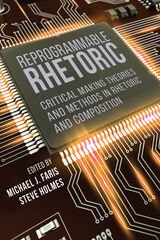
Reprogrammable Rhetoric
Critical Making Theories and Methods in Rhetoric and CompositionMichael J. Faris
Utah State University Press, 2022
This collection offers nuanced theoretical perspectives on material and cultural rhetorics alongside practical tutorials for students, researchers, and teachers to explore critical making across traditional areas such as wearable sensors, Arduinos, Twitter bots, multimodal pedagogy, Raspberry Pis, and paper circuitry, as well as underexplored areas like play, gaming, text mining, bots, and electronic monuments.
Designed to be taught in upper division undergraduate and graduate classrooms, these tutorials will benefit non-expert and expert critical makers alike. All contributed codes and scripts are also available on Utah State University Press’s companion website to encourage downloading, cloning, and repurposing.
Contributors: Aaron Beveridge, Kendall Gerdes, Kellie Gray, Matthew Halm, Steven Hammer, Cana Uluak Itchuaqiyaq, John Jones, M.Bawar Khan, Bree McGregor, Sean Morey, Ryan Omizo, Andrew Pilsch, David Rieder, David Sheridan, Wendi Sierra, Nicholas Van Horn
Response to Reform
Composition and the Professionalization of TeachingMargaret J. Marshall
Southern Illinois University Press, 2003
Response to Reform: Composition and the Professionalization of Teaching critiques the politics of labor and gender biases inherent in the composition workplace that prevent literacy teachers from attaining professional status and respect. Scrutinizing the relationship between scholarship and teaching, Margaret J. Marshall calls for a reconceptualization of what it means to prepare for and enter the field of composition instruction.
Interrogating the approach the education system takes to certify teachers without actually “professionalizing” their careers, Marshall contends that these programs rely on outdated rhetorics of labor that only widen the gap between teaching and other professional jobs. Such attempts to re-educate literacy teachers exploit and marginalize their work, and thus prevent them from claiming the status of academic professionals. In providing an overview of the history of and language used to literacy instruction, she also points out that while women are overrepresented in composition instruction, they are underrepresented in tenure track and administrative positions.
To correct and combat these inequities, Marshall advocates an alternate alignment of power structures and rhetorical choices. In a wide-ranging survey that sheds new light on the composition workplace as well as higher education at large, Response to Reform: Composition and the Professionalization of Teaching boldly asks us to do away with the reductive language we inherit from the past that characterize teaching and professionalization, as well as our customary responses to public criticism of education. The result is a new articulation of composition as a meritorious profession.
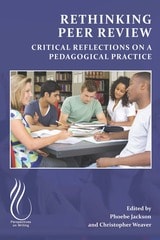
Rethinking Peer Review
Critical Reflections on a Pedagogical PracticePhoebe Jackson
University Press of Colorado, 2024
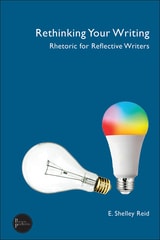
Rethinking Your Writing
Rhetoric for Reflective WritersE. Shelley Reid
University Press of Colorado, 2025
Created from the start as an online book, Rethinking also helps support instructors as they engage students with many kinds of writing tasks, from typical first-year assignments like narratives and research-based arguments to writing that happens in response to more complex rhetorical situations, such as community-based writing, writing in multiple genres, and writing across disciplines:
- The modular, cross-linked design helps faculty assign and students locate information needed for any writing situation.
- In-depth, student-friendly sections guide students’ thinking on vital but less visible elements of writing, such as threshold concepts, rhetorical analysis, reflective practice, peer review, writers’ dispositions, critical reading, research processes, and questions of equity.
- A book-wide focus on how writers choose their approaches based on their goals, resources, and constraints supports learners who are exploring new genres and audiences, and lays the groundwork for discussion of how writers use tools like Generative AI.
- More than 70 innovative writing exercises help writers explore and practice relevant strategies.
In Rethinking Your Writing, E. Shelley Reid provides a versatile guide that can be tailored to the needs of almost any course or classroom. Whether you select a single module to supplement your current resources or use the text throughout your course, this book is designed to help you engage your students and deepen their understanding of how writers learn and succeed in school, their careers, and beyond.
Revising Moves
Writing Stories of (Re)MakingChristina LaVecchia
Utah State University Press, 2024
In these narrative-driven essays written by a wide range of writing professionals, Revising Moves describes revision as a messy, generative, and often collaborative act. These meditations reveal how revision is both a micro practice tracked by textual change and a macro phenomenon rooted in family life, institutional culture, identity commitments, and political and social upheaval. Contributors depict revision as a holistic undertaking and a radically contextualized, distributed practice that showcases its relationality to everything else. Authors share their revision processes when creating scholarly works, institutional and self-promoting documents, and creative projects. Through narrative the volume opens a window to what is often unseen in a finished text: months or years of work, life events that disrupt or alter writing plans, multiple draft changes, questions about writerly identity and positionality, layers of (sometimes contradictory) feedback, and much more.
Reworking English in Rhetoric and Composition
Global Interrogations, Local InterventionsEdited by Bruce Horner and Karen Kopelson
Southern Illinois University Press, 2014
In Reworking English in Rhetoric and Composition, editors Bruce Horner and Karen Kopelson gather leading scholars and new voices in the field of rhetoric and composition to offer a dynamic new perspective on English as it is used today. This provocative volume explores the myriad ways in which English is constantly redefined, revised, and redirected through specific, located acts of writing, rhetoric, teaching, and learning. Contributors provide insightful contributions to the study of English from both national and international perspectives, revealing the language as a fluid and constantly changing manner of expression that challenges established notions.
In part one, “Reworking Language,” writers call into question the idea of language as a static, stable entity. In part two, “Locations and Migrations: Global/Local Interrogations,” contributors explore the impact of writing and teaching English in both in the United States and abroad, from Arkansas and Oklahoma to China, Jamaica, and Lebanon. Part three, “Pedagogical/Institutional Interventions,” addresses English in institutional settings and the implications for future pedagogical work. Each essay in this revolutionary volume substantiates two key premises for the rethinking of English: first, that languages are susceptible to constant change through the very acts of writing, teaching, and learning, and second, that this reworking occurs as it moves between various temporal and spatial locations.
Throughout the volume, the variety and flexibility of English across the globe are both advocated and revealed, rejecting dominant Anglophone perspectives and instead placing language in cross-cultural contexts. Brimming with informative and thought-provoking insights, Reworking English in Rhetoric and Composition breathes new life into the field and provides direction for scholars and teachers looking to the future of English.
Rewriting Partnerships
Community Perspectives on Community-Based LearningRachael W. Shah
Utah State University Press, 2020
Winner of the IARSLCE 2021 Publication of the Year Award and the Coalition for Community Writing Outstanding Book Award.
Community members are rarely tapped for their insights on engaged teaching and research, but without these perspectives, it is difficult to create ethical and effective practices. Rewriting Partnerships calls for a radical reorientation to the knowledges of community partners. Emphasizing the voices of community members themselves—the adult literacy learners, secondary students, and youth activists who work with college students—the book introduces Critical Community-Based Epistemologies, a deeply practical approach to knowledge construction that centers the perspectives of marginalized participants.
Drawing on interviews with over eighty community members, Rewriting Partnerships features community knowledges in three common types of community-engaged learning: youth working with college students in a writing exchange program, nonprofit staff who serve as clients for student projects, and community members who work with graduate students. Interviewees from each type of partnership offer practical strategies for creating more ethical collaborations, including how programs are built, how projects are introduced to partners, and how graduate students are educated. The book also explores three approaches to partnership design that create space for community voices at the structural level: advisory boards, participatory evaluation, and community grading.
Immediately applicable to teachers, researchers, community partners, and administrators involved in community engagement, Rewriting Partnerships offers concrete strategies for creating more community-responsive partnerships at the classroom level as well as at the level of program and research design. But most provocatively, the book challenges common assumptions about who can create knowledge about community-based learning, demonstrating that community partners have the potential to contribute significantly to community engagement scholarship and program decision-making.
Rewriting Work
Lora Anderson
University Press of Colorado, 2024
Rewriting
How to Do Things with Texts, Second EditionJoseph Harris
Utah State University Press, 2017
“Like all writers, intellectuals need to say something new and say it well. But for intellectuals, unlike many other writers, what we have to say is bound up with the books we are reading . . . and the ideas of the people we are talking with.”
What are the moves that an academic writer makes? How does writing as an intellectual change the way we work from sources? In Rewriting, Joseph Harris draws the college writing student away from static ideas of thesis, support, and structure, and toward a more mature and dynamic understanding. Harris wants college writers to think of intellectual writing as an adaptive and social activity, and he offers them a clear set of strategies—a set of moves—for participating in it. Introducing remixing as an additional signature move and updated with new attention to digital writing, the second edition both extends and rethinks the ideas of the original.
Rhetoric and Composition as Intellectual Work
Edited by Gary A. Olson
Southern Illinois University Press, 2002
In response to those who insist that rhetoric and composition should remain only a service discipline, editor Gary A. Olson’s Rhetoric and Composition as Intellectual Work demonstrates that it already is an intellectual discipline, that for at least a quarter of a century the field has developed an impressive tradition of intellectual work in a remarkable assortment of subject areas. Rhetoric and Composition as Intellectual Work suggests the diversity of intellectual projects that have and will continue to make rhetoric and composition more than a service to the university, more than a field devoted solely to improving writing pedagogy, and more than a preliminary to literary studies.
This collection of nineteen essays by some of the most distinguished scholars in the discipline illustrates that rhetoric and composition has much to contribute to the intellectual milieu of the contemporary university, as the field continues to push its disciplinary borders and discover new sites of investigation.