Results by title
80 books match the query 'Composition and exercises' and 7 start with r
Race, Rhetoric, and Research Methods
Alexandria Lockett
University Press of Colorado, 2021
Racing Translingualism in Composition
Toward a Race-Conscious Translingualismedited by Tom Do and Karen Rowan
Utah State University Press, 2022
This collection extends the disciplinary conversations about translingualism by foregrounding the role race and racism play in the construction and maintenance of language differences. In doing so, the contributors examine the co-naturalization of race and language in order to theorize a race-conscious translingual praxis. The book begins by offering generative critiques of translingualism, centering on the ways in which the approach’s democratic orientation to language avoids issues of race, language, and power and appeals to colorblind racist tropes of equal opportunity. Following these critiques, contributors demonstrate the important intersections of race and translingualism by drawing upon voices typically marginalized by monolingual language ideologies and pedagogies. Finally, Racing Translingualism concludes by attending to the pedagogical implications of a race-conscious translingual praxis in writing and literacy education.
Making the case for race-conscious, rather than colorblind, theories and pedagogies, Racing Translingualism offers a unique take on how translingualism is theorized and practiced and moves the field forward through its direct consideration of the links between language, race, and racism.
Contributors: Lindsey Albracht, Steven Alvarez, Bethany Davila, Tom Do, Jaclyn Hilberg, Bruce Horner, Aja Martinez, Esther Milu, Stephanie Mosher, Yasmine Romero, Karen Rowan, Rachael Shapiro, Shawanda Stewart, Brian Stone, Victor Villanueva, Missy Watson
Reprogrammable Rhetoric
Critical Making Theories and Methods in Rhetoric and CompositionMichael J. Faris
Utah State University Press, 2022
This collection offers nuanced theoretical perspectives on material and cultural rhetorics alongside practical tutorials for students, researchers, and teachers to explore critical making across traditional areas such as wearable sensors, Arduinos, Twitter bots, multimodal pedagogy, Raspberry Pis, and paper circuitry, as well as underexplored areas like play, gaming, text mining, bots, and electronic monuments.
Designed to be taught in upper division undergraduate and graduate classrooms, these tutorials will benefit non-expert and expert critical makers alike. All contributed codes and scripts are also available on Utah State University Press’s companion website to encourage downloading, cloning, and repurposing.
Contributors: Aaron Beveridge, Kendall Gerdes, Kellie Gray, Matthew Halm, Steven Hammer, Cana Uluak Itchuaqiyaq, John Jones, M.Bawar Khan, Bree McGregor, Sean Morey, Ryan Omizo, Andrew Pilsch, David Rieder, David Sheridan, Wendi Sierra, Nicholas Van Horn
Rethinking Your Writing
Rhetoric for Reflective WritersE. Shelley Reid
University Press of Colorado, 2025
Created from the start as an online book, Rethinking also helps support instructors as they engage students with many kinds of writing tasks, from typical first-year assignments like narratives and research-based arguments to writing that happens in response to more complex rhetorical situations, such as community-based writing, writing in multiple genres, and writing across disciplines:
- The modular, cross-linked design helps faculty assign and students locate information needed for any writing situation.
- In-depth, student-friendly sections guide students’ thinking on vital but less visible elements of writing, such as threshold concepts, rhetorical analysis, reflective practice, peer review, writers’ dispositions, critical reading, research processes, and questions of equity.
- A book-wide focus on how writers choose their approaches based on their goals, resources, and constraints supports learners who are exploring new genres and audiences, and lays the groundwork for discussion of how writers use tools like Generative AI.
- More than 70 innovative writing exercises help writers explore and practice relevant strategies.
In Rethinking Your Writing, E. Shelley Reid provides a versatile guide that can be tailored to the needs of almost any course or classroom. Whether you select a single module to supplement your current resources or use the text throughout your course, this book is designed to help you engage your students and deepen their understanding of how writers learn and succeed in school, their careers, and beyond.
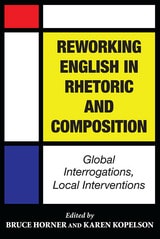
Reworking English in Rhetoric and Composition
Global Interrogations, Local InterventionsEdited by Bruce Horner and Karen Kopelson
Southern Illinois University Press, 2014
In Reworking English in Rhetoric and Composition, editors Bruce Horner and Karen Kopelson gather leading scholars and new voices in the field of rhetoric and composition to offer a dynamic new perspective on English as it is used today. This provocative volume explores the myriad ways in which English is constantly redefined, revised, and redirected through specific, located acts of writing, rhetoric, teaching, and learning. Contributors provide insightful contributions to the study of English from both national and international perspectives, revealing the language as a fluid and constantly changing manner of expression that challenges established notions.
In part one, “Reworking Language,” writers call into question the idea of language as a static, stable entity. In part two, “Locations and Migrations: Global/Local Interrogations,” contributors explore the impact of writing and teaching English in both in the United States and abroad, from Arkansas and Oklahoma to China, Jamaica, and Lebanon. Part three, “Pedagogical/Institutional Interventions,” addresses English in institutional settings and the implications for future pedagogical work. Each essay in this revolutionary volume substantiates two key premises for the rethinking of English: first, that languages are susceptible to constant change through the very acts of writing, teaching, and learning, and second, that this reworking occurs as it moves between various temporal and spatial locations.
Throughout the volume, the variety and flexibility of English across the globe are both advocated and revealed, rejecting dominant Anglophone perspectives and instead placing language in cross-cultural contexts. Brimming with informative and thought-provoking insights, Reworking English in Rhetoric and Composition breathes new life into the field and provides direction for scholars and teachers looking to the future of English.
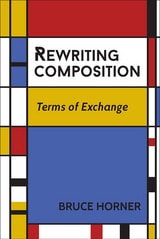
Rewriting Composition
Terms of ExchangeBruce Horner
Southern Illinois University Press, 2016
Each chapter of Rewriting Composition focuses on one key term, discussing how limitations set by dominant definitions shape and direct what compositionists do and how they think about their work. The first chapter, “Composition,” critiques a discourse of composition as lacking and therefore as in need of being either put to an end, renamed, aligned with other fields, or supplemented with work in other disciplines or other forms of composition. Rather than seeing composition as something to be abandoned, replaced, or supplemented, Horner suggests ways of productively engaging with the ordinary work of composition whose ostensible lack is assumed in the dominant discourse. Subsequent chapters apply this reconsideration to other key terms, critiquing dominant conceptions of “language” and English as stable; examining how “labor” in composition is divorced from the productive force of social relations to which language work contributes; rethinking the terms of value by which the labor of composition teachers, administrators, and students is measured; and questioning the application of conventional definitions of professional academic disciplinarity to composition. By exposing limitations in dominant conceptions of the work of composition and by modeling and opening up space for new conceptions of key terms, Rewriting Composition offers teachers of composition and rhetoric, writing scholars, and writing program administrators the critical tools necessary for charting the future of composition studies.
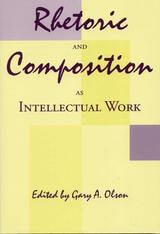
Rhetoric and Composition as Intellectual Work
Edited by Gary A. Olson
Southern Illinois University Press, 2002
In response to those who insist that rhetoric and composition should remain only a service discipline, editor Gary A. Olson’s Rhetoric and Composition as Intellectual Work demonstrates that it already is an intellectual discipline, that for at least a quarter of a century the field has developed an impressive tradition of intellectual work in a remarkable assortment of subject areas. Rhetoric and Composition as Intellectual Work suggests the diversity of intellectual projects that have and will continue to make rhetoric and composition more than a service to the university, more than a field devoted solely to improving writing pedagogy, and more than a preliminary to literary studies.
This collection of nineteen essays by some of the most distinguished scholars in the discipline illustrates that rhetoric and composition has much to contribute to the intellectual milieu of the contemporary university, as the field continues to push its disciplinary borders and discover new sites of investigation.