75 books match the query 'Confederate States of America' and 4 start with r
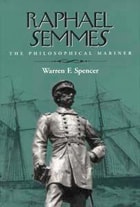
cover of Raphael Semmes: The Philosophical Mariner

Raphael Semmes

The Philosophical Mariner

Warren F. Spencer

University of Alabama Press, 1997

Naval hero for all the South, Raphael Semmes (1809-1877) sailed two famous Confederate raiders. He outfitted CSS Sumter in 1861 and captured 18 Union merchant ships in six months before the raider was blockaded at Gibraltar. Next he took command of CSS Alabama, an English-built raider, and terrorized U.S. merchant vessels on the high seas from August 1862 until the raider was sunk in battle off Cherbourg in June 1864. During that two-year period, he captured more enemy merchant ships than any other cruiser captain in maritime history. He is considered one of the greatest ship's commanders that America has produced.

In this first, full-scale biography that relies on Semmes's private papers, unpublished diaries, and correspondence, Spencer has produced a well-balanced and comprehensive account of the man, as well as the naval officer. The biographer paints a vivid portrait of Semmes—the intellectual, the family man, lawyer, romanticist, nationalist—providing a greater understanding of the man behind the heroic deeds.

Semmes was born in Maryland to a slave-holding family and entered the United States Navy in 1826. In 1849, he moved his family to Mobile, Alabama, to be near the navy base at Pensacola, Florida, and to practice law during leaves. Semmes was an astute student, not only of international and maritime law but also of weather patterns; astronomy; flora and fauna; naval, social, and cultural history; and the classics. His study of constitutional law led him to side with his adopted state in 1861, a move that set the stage for his place in history.


[more]
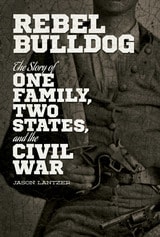
cover of Rebel Bulldog: The Story of One Family, Two States, and the Civil War

Rebel Bulldog

The Story of One Family, Two States, and the Civil War

Jason Lantzer

Indiana Historical Society Press, 2017
Rebel Bulldog tells the story of Preston Davidson, a Northerner who fought for the Confederacy, and his family who lived in Indiana and Virginia. It is a story that examines antebellum religion, education, reform, and politics, and how they affected the identity of not just one young man, but of a nation caught up in a civil war. Furthermore, it discusses how a native-born Hoosier reached the decision to fight for the South, while detailing a unique war experience and the postwar life of a proud Rebel who returned to the North after the guns fell silent and tried to remake his life in a very different state and nation than the ones he had left in 1860. Using the lives of Preston and his family as a lens to help us glimpse the past, Rebel Bulldog delves into the human experience on multiple levels, asks us to reconsider what we think we know of the Civil War, and complicates, while it complements the existing literature. It is a story that perhaps could only have happened in Indiana.
[more]
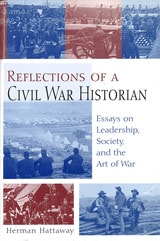
cover of Reflections of a Civil War Historian: Essays on Leadership, Society, and the Art of War

Reflections of a Civil War Historian

Essays on Leadership, Society, and the Art of War

Herman Hattaway & Foreword by Frank E. Vandiver

University of Missouri Press, 2003
Born in New Orleans, Herman Hattaway grew up in the Deep South. While it might not seem such a stretch for him to have become one of the foremost authorities on the Civil War and Southern history, Hattaway was actually at a loss for a career choice when he stumbled into the class of Professor T. Harry Williams at Louisiana State University. Williams’s lectures and writings were so inspiring to Hattaway that he became a regular in his classes, receiving his B.A., M.A., and Ph.D. all under the professor’s tutelage.
This collection of essays is a compendium of Hattaway’s writings from throughout his more-than-forty-year career. He is the author or coauthor of five books that were selections of the History Book Club—Jefferson Davis: Confederate President; Shades of Blue and Gray: An Introductory Military History of the Civil War; Why the South Lost the Civil War; How the North Won: A Military History of the Civil War; and General Stephen D. Lee. He is also the author of the text for Gettysburg to Vicksburg: The Five Original Civil War Battlefield Parks.
Hattaway is a captivating historian who always seeks to engage others in the study of history. He has made many important scholarly contributions to our understanding of the Civil War, including new information on the military use of balloons, the relevance of religion in warfare, and the nature of good (and bad) military leadership. This book will appeal to the many historians and others who have been influenced by Hattaway over the years. It demonstrates how he has evolved as a historian and brings to light many essays that were never before published or published only in specialized journals.
[more]
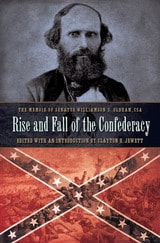
cover of Rise and Fall of the Confederacy: The Memoir of Senator Williamson S. Oldham, CSA

Rise and Fall of the Confederacy

The Memoir of Senator Williamson S. Oldham, CSA

Edited & Intro by Clayton E. Jewett

University of Missouri Press, 2006

Williamson S. Oldham was a shrewd and candid observer of the Civil War scene. Representing the always contrary and suspicious Texans in the Confederate Senate, he was a major opponent of President Jefferson Davis and spoke out vehemently against conscription—which he considered an abusive violation of individual rights—and against military interference in the cotton trade.
Oldham’s memoir provides a firsthand look at the Civil War from the perspective of a government insider. In it, he sheds light on such topics as military strategy, foreign relations, taxes, and conflicts between state officials and the Confederate government. Perhaps more important, his travels between Texas and Richmond—both during and after the war—allowed him to observe the many changes taking place in the South, and he made note of both the general sentiment of citizens and the effect of political and military measures on the country.
Throughout the memoir, Oldham consistently stresses the centrality of politics to a society and the necessity of legislating for the will of the people even in times of war. In assessing the Confederacy’s defeat, he points not to military causes but to Congress’s giving in to the will of the president and military leaders rather than ruling for and representing the people.
Clayton E. Jewett has edited and annotated Oldham’s memoir to produce the only fully edited publication of this important document, significantly expanded here over any version previously published. His introduction helps clarify Oldham’s position on many of the topics he discusses, making the memoir accessible to scholar and Civil War buff alike, while his annotations reflect his deep knowledge of the intrigue of wartime political life in both Texas and Richmond.
Oldham’s memoir offers important new insight into not only political leadership and conflicts in a young nation but also the question of why the South lost the Civil War, dispelling many myths about the defeat and bolstering interpretations of the Confederacy’s decline that point more to political than to military causes. Rise and Fall of the Confederacy is one of the major political and social documents of the Confederacy and will be a boon to all scholars of the Civil War era.
[more]