Results by title
103 books match the query 'Conservation' and 4 start with r

Return of the Gar
Mark Spitzer
University of North Texas Press, 2015
Revenant Ecologies
Defying the Violence of Extinction and ConservationAudra Mitchell
University of Minnesota Press, 2024
Engaging a broad spectrum of ecological thought to articulate the ethical scale of global extinction
As global rates of plant and animal extinctions mount, anxieties about the future of the earth’s ecosystems are fueling ever more ambitious efforts at conservation, which draw on Western scientific principles to manage species and biodiversity. In Revenant Ecologies, Audra Mitchell argues that these responses not only ignore but also magnify powerful forms of structural violence like colonialism, racism, genocide, extractivism, ableism, and heteronormativity, ultimately contributing to the destruction of unique life forms and ecosystems.
Critiquing the Western discourse of global extinction and biodiversity through the lens of diverse Indigenous philosophies and other marginalized knowledge systems, Revenant Ecologies promotes new ways of articulating the ethical enormity of global extinction. Mitchell offers an ambitious framework—(bio)plurality—that focuses on nurturing unique, irreplaceable worlds, relations, and ecosystems, aiming to transform global ecological–political relations, including through processes of land return and critically confronting discourses on “human extinction.”
Highlighting the deep violence that underpins ideas of “extinction,” “conservation,” and “biodiversity,” Revenant Ecologies fuses political ecology, global ethics, and violence studies to offer concrete, practical alternatives. It also foregrounds the ways that multi-life-form worlds are actively defying the forms of violence that drive extinction—and that shape global efforts to manage it.
Retail e-book files for this title are screen-reader friendly with images accompanied by short alt text and/or extended descriptions.
Revolutionary Parks
Conservation, Social Justice, and Mexico’s National Parks, 1910–1940Emily Wakild
University of Arizona Press, 2011
Revolutionary Parks tells the surprising story of how forty national parks were created in Mexico during the latter stages of the first social revolution of the twentieth century. By 1940 Mexico had more national parks than any other country. Together they protected more than two million acres of land in fourteen states. Even more remarkable, Lázaro Cárdenas, president of Mexico in the 1930s, began to promote concepts akin to sustainable development and ecotourism.
Conventional wisdom indicates that tropical and post-colonial countries, especially in the early twentieth century, have seldom had the ability or the ambition to protect nature on a national scale. It is also unusual for any country to make conservation a political priority in the middle of major reforms after a revolution. What emerges in Emily Wakild’s deft inquiry is the story of a nature protection program that takes into account the history, society, and culture of the times. Wakild employs case studies of four parks to show how the revolutionary momentum coalesced to create early environmentalism in Mexico.
According to Wakild, Mexico’s national parks were the outgrowth of revolutionary affinities for both rational science and social justice. Yet, rather than reserves set aside solely for ecology or politics, rural people continued to inhabit these landscapes and use them for a range of activities, from growing crops to producing charcoal. Sympathy for rural people tempered the radicalism of scientific conservationists. This fine balance between recognizing the morally valuable, if not always economically profitable, work of rural people and designing a revolutionary state that respected ecological limits proved to be a radical episode of government foresight.
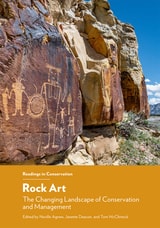
Rock Art
The Changing Landscape of Conservation and ManagementNeville Agnew
J. Paul Getty Trust, The, 2026
Painted and engraved marks and images on rock surfaces represent the oldest and most widespread form of human expression. Found globally in its original landscapes, with some images dating back fifty thousand years or more, the world’s rock art constitutes the most important body of latent knowledge about our deep past. Today, however, mass tourism, vandalism, theft, land development, and climate change are posing increasingly dire threats to this irreplaceable heritage.
This richly illustrated volume is the first interdisciplinary anthology to focus on the conservation and management of rock art sites. Its 133 readings survey the arc of published writings on the subject, ranging from early academic theories and oral narratives of Traditional peoples to an abundant selection of recent scholarship covering current best practices and advances in portable instrumentation that can be used in the field. Initial sections probe the origins and significance of these often-enigmatic forms, then survey scientific and technological methods of dating, monitoring, and documenting them. Subsequent readings discuss rock art’s physical characteristics and weathering, its importance to Indigenous communities, the decolonization of site management, the role of governments, the value of public outreach, and climate change. The volume closes with a selection of case studies drawn from major sites worldwide.