Results by title
103 books match the query 'Conservatism & Liberalism' and 7 start with r
Radical American Partisanship
Mapping Violent Hostility, Its Causes, and the Consequences for DemocracyNathan P. Kalmoe and Lilliana Mason
University of Chicago Press, 2022
Political violence is rising in the United States, with Republicans and Democrats divided along racial and ethnic lines that spurred massive bloodshed and democratic collapse earlier in the nation’s history. The January 6, 2021 insurrection and the partisan responses that ensued are a vivid illustration of how deep these currents run. How did American politics become so divided that we cannot agree on how to categorize an attack on our own Capitol?
For over four years, through a series of surveys and experiments, Nathan P. Kalmoe and Lilliana Mason have been studying radicalism among ordinary American partisans. In this groundbreaking book, they draw on new evidence—as well as insights from history, psychology, and political science—to put our present partisan fractiousness in context and to explain broad patterns of political and social change. Early chapters reveal the scope of the problem, who radical partisans are, and trends over time, while later chapters identify the conditions that partisans say justify violence and test how elections, political violence, and messages from leaders enflame or pacify radical views. Kalmoe and Mason find that ordinary partisanship is far more dangerous than pundits and scholars have recognized. However, these findings are not a forecast of inevitable doom; the current climate also brings opportunities to confront democratic threats head-on and to create a more inclusive politics. Timely and thought-provoking, Radical American Partisanship is vital reading for understanding our current political landscape.
Rebels All!
Rebels All! A Short History of the Conservative Mind in Postwar AmericaMattson, Kevin
Rutgers University Press, 2008
Outstanding Academic Title of 2008
Do you ever wonder why conservative pundits drop the word “faggot” or talk about killing and then Christianizing Muslims abroad? Do you wonder why the right’s spokespeople seem so confrontational, rude, and over-the-top recently? Does it seem strange that conservative books have such apocalyptic titles? Do you marvel at why conservative writers trumpeted the “rebel” qualities of George W. Bush just a few years back?
There is no doubt that the style of the political right today is tough, brash, and by many accounts, not very conservative sounding. After all, isn’t conservatism supposed to be about maintaining standards, upholding civility, and frowning upon rebellion? Historian Kevin Mattson explains the apparent contradictions of the party in this fresh examination of the postwar conservative mind. Examining a big cast of characters that includes William F. Buckley, Whittaker Chambers, Norman Podhoretz, Irving Kristol, Kevin Phillips, David Brooks, and others, Mattson shows how right-wing intellectuals have always, but in different ways, played to the populist and rowdy tendencies in America’s political culture. He boldly compares the conservative intellectual movement to the radical utopians among the New Left of the 1960s and he explains how conservatism has ingested central features of American culture, including a distrust of sophistication and intellectualism and a love of popular culture, sensation, shock, and celebrity.
Both a work of history and political criticism, Rebels All! shows how the conservative mind made itself appealing, but also points to its endemic problems. Mattson’s conclusion outlines how a recast liberalism should respond to the conservative ascendancy that has marked our politics for the last thirty years.

Right On?
Political Change and Continuity in George W. Bush's AmericaEdited by Iwan Morgan, Philip D. Davies
University of London Press, 2006
Contributors include John Dumbrell (University of Leicester, UK), Martin Durham (University of Wolverhampton, UK), Godfrey Hodgson (Rothermere American Institute, Oxford University, UK), Steven Hurst (Manchester Metropolitan University, UK), Klaus Larres (Royal Holloway College, University of London, UK), Bob McKeever (University of Reading, UK), John Owens (University of Westminster, UK), Rob Singh (Birkbeck College, University of London, UK), and Alex Waddan (University of Sunderland, UK).
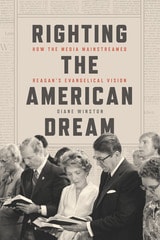
Righting the American Dream
How the Media Mainstreamed Reagan's Evangelical VisionDiane Winston
University of Chicago Press, 2023
After two years in the White House, an aging and increasingly unpopular Ronald Reagan looked like a one-term president, but in 1983 something changed. Reagan spoke of his embattled agenda as a spiritual rather than a political project and cast his vision for limited government and market economics as the natural outworking of religious conviction. The news media broadcast this message with enthusiasm, and white evangelicals rallied to the president’s cause. With their support, Reagan won reelection and continued to dismantle the welfare state, unraveling a political consensus that stood for half a century.
In Righting the American Dream, Diane Winston reveals how support for Reagan emerged from a new religious vision of American identity circulating in the popular press. Through four key events—the “evil empire” speech, AIDS outbreak, invasion of Grenada, and rise in American poverty rates—Winston shows that many journalists uncritically adopted Reagan’s religious rhetoric and ultimately mainstreamed otherwise unpopular evangelical ideas about individual responsibility. The result is a provocative new account of how Reagan together with the press turned America to the right and initiated a social revolution that continues today.
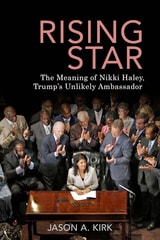
Rising Star
The Meaning of Nikki Haley, Trump’s Unlikely AmbassadorJason A. Kirk
University of Arkansas Press, 2021
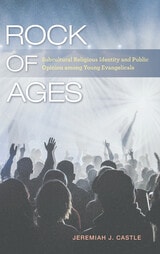
Rock of Ages
Subcultural Religious Identity and Public Opinion among Young EvangelicalsJeremiah J. Castle
Temple University Press, 2019
Evangelicals and Republicans have been powerful—and active—allies in American politics since the 1970s. But as public opinions have changed, are young evangelicals’ political identities and attitudes on key issues changing too? And if so, why? In Rock of Ages, Jeremiah Castle answers these questions to understand their important implications for American politics and society.
Castle develops his own theory of public opinion among young evangelicals to predict and explain their political attitudes and voting behavior. Relying on both survey data and his own interviews with evangelical college students, he shows that while some young evangelicals may be more liberal in their attitudes on some issues, most are just as firmly Republican, conservative, and pro-life on abortion as the previous generation.
Rock of Ages considers not only what makes young evangelicals different from the previous generation, but also what that means for both the church and American politics.
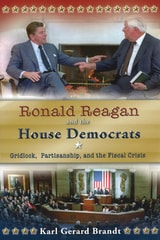
Ronald Reagan and the House Democrats
Gridlock, Partisanship, and the Fiscal CrisisKarl Gerard Brandt
University of Missouri Press, 2009