Results by title
90 books match the query 'Constitutional history' and 2 start with r
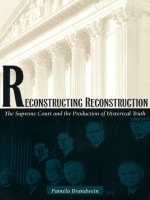
Reconstructing Reconstruction
The Supreme Court and the Production of Historical TruthPamela Brandwein
Duke University Press, 1999
Was slavery over when slaves gained formal emancipation? Was it over when the social, economic, and political situation for African Americans no longer mimicked the conditions of slavery? If the Thirteenth Amendment abolished it in 1865, why did most of the disputed points during the Reconstruction debates of 1866–75 concern issues of slavery? In this book Pamela Brandwein examines the post–Civil War struggle between competing political and legal interpretations of slavery and Reconstruction to reveal how accepted historical truth was established.
Delving into the circumstances, assumptions, and rhetoric that shaped the “official” story of Reconstruction, Brandwein describes precisely how a dominant interpretation of events ultimately emerged and what its implications have been for twentieth-century judicial decisions, particularly for Supreme Court rulings on civil rights. While analyzing interpretive disputes about slavery, Brandwein offers a detailed rescoring of post–Civil War legislative and constitutional history, including analysis of the original understanding of the Fourteenth Amendment. She identifies the perspectives on Reconstruction that were endorsed or rejected by the Supreme Court. Explaining what it meant—theoretically and practically—to resolve Reconstruction debates with a particular definition of slavery, Brandwein recounts how the Northern Democratic definition of “ending” slavery was not the only definition, just the one that prevailed. Using a familiar historical moment to do new interpretive work, she outlines a sociology of constitutional law, showing how subjective narrative construction can solidify into opaque institutional memory.
Delving into the circumstances, assumptions, and rhetoric that shaped the “official” story of Reconstruction, Brandwein describes precisely how a dominant interpretation of events ultimately emerged and what its implications have been for twentieth-century judicial decisions, particularly for Supreme Court rulings on civil rights. While analyzing interpretive disputes about slavery, Brandwein offers a detailed rescoring of post–Civil War legislative and constitutional history, including analysis of the original understanding of the Fourteenth Amendment. She identifies the perspectives on Reconstruction that were endorsed or rejected by the Supreme Court. Explaining what it meant—theoretically and practically—to resolve Reconstruction debates with a particular definition of slavery, Brandwein recounts how the Northern Democratic definition of “ending” slavery was not the only definition, just the one that prevailed. Using a familiar historical moment to do new interpretive work, she outlines a sociology of constitutional law, showing how subjective narrative construction can solidify into opaque institutional memory.
[more]
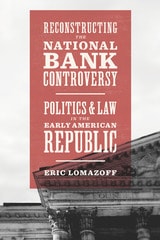
Reconstructing the National Bank Controversy
Politics and Law in the Early American RepublicEric Lomazoff
University of Chicago Press, 2018
The Bank of the United States sparked several rounds of intense debate over the meaning of the Constitution’s Necessary and Proper Clause, which authorizes the federal government to make laws that are “necessary” for exercising its other powers. Our standard account of the national bank controversy, however, is incomplete. The controversy was much more dynamic than a two-sided debate over a single constitutional provision and was shaped as much by politics as by law.
With Reconstructing the National Bank Controversy, Eric Lomazoff offers a far more robust account of the constitutional politics of national banking between 1791 and 1832. During that time, three forces—changes within the Bank itself, growing tension over federal power within the Republican coalition, and the endurance of monetary turmoil beyond the War of 1812 —drove the development of our first major debate over the scope of federal power at least as much as the formal dimensions of the Constitution or the absence of a shared legal definition for the word “necessary.” These three forces—sometimes alone, sometimes in combination—repeatedly reshaped the terms on which the Bank’s constitutionality was contested. Lomazoff documents how these three dimensions of the polity changed over time and traces the manner in which they periodically led federal officials to adjust their claims about the Bank’s constitutionality. This includes the emergence of the Coinage Clause—which gives Congress power to “coin money, regulate the value thereof”—as a novel justification for the institution. He concludes the book by explaining why a more robust account of the national bank controversy can help us understand the constitutional basis for modern American monetary politics.
With Reconstructing the National Bank Controversy, Eric Lomazoff offers a far more robust account of the constitutional politics of national banking between 1791 and 1832. During that time, three forces—changes within the Bank itself, growing tension over federal power within the Republican coalition, and the endurance of monetary turmoil beyond the War of 1812 —drove the development of our first major debate over the scope of federal power at least as much as the formal dimensions of the Constitution or the absence of a shared legal definition for the word “necessary.” These three forces—sometimes alone, sometimes in combination—repeatedly reshaped the terms on which the Bank’s constitutionality was contested. Lomazoff documents how these three dimensions of the polity changed over time and traces the manner in which they periodically led federal officials to adjust their claims about the Bank’s constitutionality. This includes the emergence of the Coinage Clause—which gives Congress power to “coin money, regulate the value thereof”—as a novel justification for the institution. He concludes the book by explaining why a more robust account of the national bank controversy can help us understand the constitutional basis for modern American monetary politics.
[more]