Results by title
67 books match the query 'Consumer Behavior' and 3 start with r
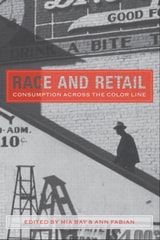
Race and Retail
Consumption across the Color LineBay, Mia
Rutgers University Press, 2015
Race has long shaped shopping experiences for many Americans. Retail exchanges and establishments have made headlines as flashpoints for conflict not only between blacks and whites, but also between whites, Mexicans, Asian Americans, and a wide variety of other ethnic groups, who have at times found themselves unwelcome at white-owned businesses.
Race and Retail documents the extent to which retail establishments, both past and present, have often catered to specific ethnic and racial groups. Using an interdisciplinary approach, the original essays collected here explore selling and buying practices of nonwhite populations around the world and the barriers that shape these habits, such as racial discrimination, food deserts, and gentrification. The contributors highlight more contemporary issues by raising questions about how race informs business owners’ ideas about consumer demand, resulting in substandard quality and higher prices for minorities than in predominantly white neighborhoods. In a wide-ranging exploration of the subject, they also address revitalization and gentrification in South Korean and Latino neighborhoods in California, Arab and Turkish coffeehouses and hookah lounges in South Paterson, New Jersey, and tourist capoeira consumption in Brazil.
Race and Retail illuminates the complex play of forces at work in racialized retail markets and the everyday impact of those forces on minority consumers. The essays demonstrate how past practice remains in force in subtle and not-so-subtle ways.
[more]
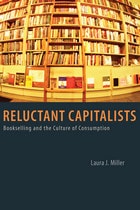
Reluctant Capitalists
Bookselling and the Culture of ConsumptionLaura J. Miller
University of Chicago Press, 2006
Over the past half-century, bookselling, like many retail industries, has evolved from an arena dominated by independent bookstores to one in which chain stores have significant market share. And as in other areas of retail, this transformation has often been a less-than-smooth process. This has been especially pronounced in bookselling, argues Laura J. Miller, because more than most other consumer goods, books are the focus of passionate debate. What drives that debate? And why do so many people believe that bookselling should be immune to questions of profit?
In Reluctant Capitalists, Miller looks at a century of book retailing, demonstrating that the independent/chain dynamic is not entirely new. It began one hundred years ago when department stores began selling books, continued through the 1960s with the emergence of national chain stores, and exploded with the formation of “superstores” in the 1990s. The advent of the Internet has further spurred tremendous changes in how booksellers approach their business. All of these changes have met resistance from book professionals and readers who believe that the book business should somehow be “above” market forces and instead embrace more noble priorities.
Miller uses interviews with bookstore customers and members of the book industry to explain why books evoke such distinct and heated reactions. She reveals why customers have such fierce loyalty to certain bookstores and why they identify so strongly with different types of books. In the process, she also teases out the meanings of retailing and consumption in American culture at large, underscoring her point that any type of consumer behavior is inevitably political, with consequences for communities as well as commercial institutions.
[more]

Resistance to Innovation
Its Sources and ManifestationsShaul Oreg and Jacob Goldenberg
University of Chicago Press, 2015
Every year, about 25,000 new products are introduced in the United States. Most of these products fail—at considerable expense to the companies that produce them. Such failures are typically thought to result from consumers’ resistance to innovation, but marketers have tended to focus instead on consumers who show little resistance, despite these “early adopters” comprising only 20 percent of the consumer population.
Shaul Oreg and Jacob Goldenberg bring the insights of marketing and organizational behavior to bear on the attitudes and behaviors of the remaining 80 percent who resist innovation. The authors identify two competing definitions of resistance: In marketing, resistance denotes a reluctance to adopt a worthy new product, or one that offers a clear benefit and carries little or no risk. In the field of organizational behavior, employees are defined as resistant if they are unwilling to implement changes regardless of the reasons behind their reluctance. Seeking to clarify the act of rejecting a new product from the reasons—rational or not—consumers may have for doing so, Oreg and Goldenberg propose a more coherent definition of resistance less encumbered by subjective, context-specific factors and personality traits. The application of this tighter definition makes it possible to disentangle resistance from its sources and ultimately offers a richer understanding of consumers’ underlying motivations. This important research is made clear through the use of many real-life examples.
Shaul Oreg and Jacob Goldenberg bring the insights of marketing and organizational behavior to bear on the attitudes and behaviors of the remaining 80 percent who resist innovation. The authors identify two competing definitions of resistance: In marketing, resistance denotes a reluctance to adopt a worthy new product, or one that offers a clear benefit and carries little or no risk. In the field of organizational behavior, employees are defined as resistant if they are unwilling to implement changes regardless of the reasons behind their reluctance. Seeking to clarify the act of rejecting a new product from the reasons—rational or not—consumers may have for doing so, Oreg and Goldenberg propose a more coherent definition of resistance less encumbered by subjective, context-specific factors and personality traits. The application of this tighter definition makes it possible to disentangle resistance from its sources and ultimately offers a richer understanding of consumers’ underlying motivations. This important research is made clear through the use of many real-life examples.
[more]