Results by title
54 books match the query 'Contemporary (1945-)' and 4 start with r
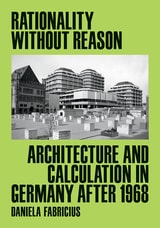
Rationality Without Reason
Architecture and Calculation in Germany After 1968Daniela Fabricius
University of Minnesota Press, 2027
A critical examination of the rational turn in postwar West German architecture
Postwar West German architecture experienced a “rational turn” characterized by a dramatic push toward ideals of optimization, economy, and accuracy based in calculation. Analyzing how architects reckoned with the political and cultural legacy of fascism and were driven by the desire to quantify and manage unpredictability in the human environment, Rationality Without Reason shows how they translated their design and production methods into numbers through protodigital technology and computational processes.
Daniela Fabricius examines architectural practices within the wider context of the shifting intellectual and cultural landscape as rationalism devolved between the student movements of 1968 and the reign of postmodernism in the 1980s. Showing how rationalism’s limitations and contradictions became increasingly apparent, she demonstrates how the intensity of these approaches ultimately led to a form of rationalism devoid of reason. Fabricius explores how the development of increasingly autonomous systems and formalist methods strayed from important economic, social, and ethical concerns and impeded the potential for developing more liberatory forms of architecture.
Using case studies involving the Ulm School for Design and the research-based work of Frei Otto and Oswald Mathias Ungers, Rationality Without Reason traces how debates around scientific thinking evolved throughout the Cold War era and offers a critical look at the utopian promises associated with supposedly rational systems of knowledge. Through an interdisciplinary approach steeped in archival research, Fabricius highlights how the logic of quantification is bound to be unsustainable without serious ethical considerations.
Retail e-book files for this title are screen-reader friendly with images accompanied by short alt text and/or extended descriptions.
Reconstruction Fiction
Housing and Realist Literature in Postwar BritainPaula Derdiger
The Ohio State University Press, 2020
Relearning from Las Vegas
Aron Vinegar
University of Minnesota Press, 2009
Evaluates for the first time one of the foundational works in architecture criticism
Immediately on its publication in 1972, Learning from Las Vegas, by Robert Venturi, Denise Scott Brown, and Steven Izenour, was hailed as a transformative work in the history and theory of architecture, liberating those in architecture who were trying to find a way out of the straitjacket of architectural orthodoxies. Resonating far beyond the professional and institutional boundaries of the field, the book contributed to a thorough rethinking of modernism and was subsequently taken up as an early manifestation and progenitor of postmodernism.
Going beyond analyzing the original text, the essays provide insights into the issues surrounding architecture, culture, and philosophy that have been influenced by Learning from Las Vegas. For the contributors, as for scholars in an array of fields, the pioneering book is as relevant to architectural debates today as it was when it was first published.Contributors: Ritu Bhatt, Karsten Harries, Jean-Claude Lebensztejn, John McMorrough, Katherine Smith, Dell Upton, Nigel Whitely.
Resisting Postmodern Architecture
Critical Regionalism before GlobalisationStylianos Giamarelos
University College London, 2022
Since its first appearance in 1981, critical regionalism has enjoyed a celebrated worldwide reception as an architectural theory that defends the cultural identity of a place resisting the homogenizing onslaught of globalization. Its principles of acknowledging the climate, history, materials, culture, and topography of a specific place are integrated into architects’ education across the globe. But at the same time, the richer cross-cultural history of critical regionalism has frequently been reduced to schematic juxtapositions of “the global” with “the local.”
This book uses more than fifty interviews and previously unpublished archival material from six countries to resituate critical regionalism within the wider framework of debates around postmodern architecture, the diverse contexts from which it emerged, and the cultural media complex that conditioned its reception. In so doing, it explores the intersection of three areas of growing historical and theoretical interest—postmodernism, critical regionalism, and globalization—and shows how the “periphery” was not just a passive recipient, but also an active generator of architectural theory and practice.