Results by title
83 books match the query 'Country & Bluegrass' and 6 start with r

Ramblin' Rose
The Life and Career of Rose MaddoxJonny Whiteside
Vanderbilt University Press, 1997
A groundbreaking study of one of the pioneering women of country music, whose biography sheds new light on both the role of women in postwar America and the growth of the music business in California.
It's a Depression-era saga right out of Steinbeck. The strongwilled matriarch of a rural Alabama family uproots her husband and six children and drives them westward on foot and by boxcar, through sheer willpower, on a journey of two thousand miles to California where a new life begins. Four years later, at age eleven, youngest daughter Rose Maddox steps to the microphone for the first time to sing on radio with the family band. Within a week, the Maddox Brothers & Rose receive a thousand letters, launching the group on a country music career that ultimately ranges from the rodeo shows of the West to the bright lights of Nashville's Grand Ole Opry.
In this meticulously researched biography, veteran music journalist Jonny Whiteside recounts the colorful story of this pioneering woman who literally grew up in the male-dominated enclaves of country music and struggled to make a place for herself there. In Rose Maddox, Whiteside has found an exceptional protagonist for his story: a fiery, strongwilled entertainer whose music has had an influence far beyond her handful of hits on the record charts, and who in many ways, Whiteside convincingly argues, prefigured the coming of rock and roll. In the process, Whiteside introduces us to a host of memorable characters--stars like Hank Williams and Roy Acuff; behind-the-scenes movers and shakers like record men Cliffie Stone and Bill McCall; and, at the heart of the story, the irrepressible Maddox family themselves, whose freewheeling music so faithfully reflected the hurlyburly world of California's displaced migrant workers.
Ramblin' Rose is a long-overdue work of research and synthesis that documents not only the life of an unsung musical trailblazer but also the vibrant, roughhewn West Coast country music scene that once rivaled Nashville and left an indelible imprint on the popular music of today.
Co-published with the Country Music Foundation Press
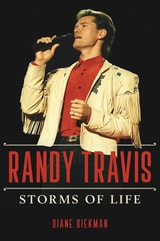
Randy Travis
Storms of LifeDiane Diekman
University of Illinois Press, 2025
Randy Travis’s 1986 breakthrough put him at the forefront of Nashville’s new traditionalist sound and, in the words of Garth Brooks, saved country music. The singer’s warm baritone and all-time classic songs like “Forever and Ever, Amen” landed him atop the charts sixteen times. His cross-genre appeal brought a level of multiplatinum success that no country artist before him had ever achieved.
Diane Diekman’s biography follows the life and career of one of country music’s most beloved figures. Steered from a troubled path as a teen, Travis served a long apprenticeship under manager and future wife Lib Hatcher before being rejected by the Nashville music industry as “too country.” The single “On the Other Hand” and his smash debut album did away with the doubters and began a dominant four-year run that stretched into ongoing success as a recording artist, trailblazing live performer, and actor in film and television. Diekman uses dozens of interviews and in-depth research to fill in the details of Travis’s pre-fame life and his enormous impact on country, popular, and gospel music. From there, she pivots to telling the story of the singer’s difficult divorce from Hatcher, subsequent problems with alcohol and run-ins with the law, and the challenges he overcame in the aftermath of a devastating 2013 stroke.
Informed by a wealth of new research and interviews, Randy Travis is the first in-depth biography of the country music legend.
Reading Country Music
Steel Guitars, Opry Stars, and Honky Tonk BarsCecelia Tichi, ed.
Duke University Press, 1998
Bringing together a wide range of scholars and critics from literature, communications, history, sociology, art, and music, this anthology looks at everything from the inner workings of the country music industry to the iconography of certain stars to the development of distinctive styles within the country music genre. Essays include a look at the shift from "hard-core" to "soft-shell" country music in recent years; Johnny Cash as lesbian icon; gender, class, and region in Dolly Parton’s star image; and bluegrass’s gothic tradition. Originally published as a special issue of South Atlantic Quarterly, this expanded book edition includes new articles on the spirituality of Willie Nelson, the legacy and tradition of stringed music, and the revival of Stephen Foster’s blackface musical, among others.
Contributors. Mary A. Bufwack, Don Cusic, Curtis W. Ellison, Mark Fenster, Vivien Green Fryd, Teresa Goddu, T. Walter Herbert, Christine Kreyling, Michael Kurek, Amy Schrager Lang, Charmaine Lanham, Bill Malone, Christopher Metress, Jocelyn Neal, Teresa Ortega, Richard A. Peterson, Ronnie Pugh, John W. Rumble, David Sanjek, Cecelia Tichi, Pamela Wilson, Charles K. Wolfe
Real Country
Music and Language in Working-Class CultureAaron A. Fox
Duke University Press, 2004
Fox spent hundreds of hours observing, recording, and participating in talk and music-making in homes, beer joints, and garage jam sessions. He renders the everyday life of Lockhart’s working-class community in detail, right down to the ice cold beer, the battered guitars, and the technical skills of such local musical legends as Randy Meyer and Larry “Hoppy” Hopkins. Throughout, Fox focuses on the human voice. His analyses of conversations, interviews, songs, and vocal techniques show how feeling and experience are expressed, and how local understandings of place, memory, musical aesthetics, working-class social history, race, and gender are shared. In Real Country, working-class Texans re-imagine their past and give voice to the struggles and satisfactions of their lives in the present through music.
River of Tears
Country Music, Memory, and Modernity in BrazilAlexander Sebastian Dent
Duke University Press, 2009
Since 1998, Alexander Sebastian Dent has analyzed rural music in the state of São Paulo, interviewing and spending time with listeners, musicians, songwriters, journalists, record-company owners, and radio hosts. Dent not only describes the production and reception of this music, he also explains why the genre experienced such tremendous growth as Brazil transitioned from an era of dictatorship to a period of intense neoliberal reform. Dent argues that rural genres reflect a widespread anxiety that change has been too radical and has come too fast. In defining their music as rural, Brazil’s country musicians—whose work circulates largely in cities—are criticizing an increasingly inescapable urban life characterized by suppressed emotions and an inattentiveness to the past. Their performances evoke a river of tears flowing through a landscape of loss—of love, of life in the countryside, and of man’s connections to the natural world.

Ryan Adams
Losering, a Story of WhiskeytownBy David Menconi
University of Texas Press, 2012
Before he achieved his dream of being an internationally known rock personality, Ryan Adams had a band in Raleigh, North Carolina. Whiskeytown led the wave of insurgent-country bands that came of age with No Depression magazine in the mid-1990s, and for many people it defined the era. Adams was an irrepressible character, one of the signature personalities of his generation, and as a singer-songwriter he blew people away with a mature talent that belied his youth. David Menconi witnessed most of Whiskeytown’s rocket ride to fame as the music critic for the Raleigh News & Observer, and in Ryan Adams, he tells the inside story of the singer’s remarkable rise from hardscrabble origins to success with Whiskeytown, as well as Adams’s post-Whiskeytown self-reinvention as a solo act.
Menconi draws on early interviews with Adams, conversations with people close to him, and Adams’s extensive online postings to capture the creative ferment that produced some of Adams’s best music, including the albums Strangers Almanac and Heartbreaker. He reveals that, from the start, Ryan Adams had an absolutely determined sense of purpose and unshakable confidence in his own worth. At the same time, his inability to hold anything back, whether emotions or torrents of songs, often made Adams his own worst enemy, and Menconi recalls the excesses that almost, but never quite, derailed his career. Ryan Adams is a fascinating, multifaceted portrait of the artist as a young man, almost famous and still inventing himself, writing songs in a blaze of passion.