Results by title
459 books match the query 'Criminology' and 20 start with r
RSF
The Russell Sage Foundation Journal of the Social Sciences: Criminal Justice Contact and InequalityKristin Turney
Russell Sage Foundation, 2019
Several articles explore the ramifications of ongoing surveillance. Amanda Geller and Jeffrey Fagan survey adolescents who come into contact with law enforcement and find that intrusive police stops contribute to heightened cynicism toward the legal system, suggesting that aggressive policing weakens youths’ deference to law and legal authorities. Robert Vargas and coauthors study police-dispatcher radio communications and show that data breaches where the dispatcher reveals confidential identifying information about individuals reporting criminal activity are more common in predominantly black and Latino neighborhoods. Because police scanners are accessible by the public, these breaches make residents more vulnerable to criminals, gangs, or predatory businesses. Other contributors explore the effects of criminal justice contact on family life. Frank Edwards examines how families’ interactions with the child welfare system differ by race and shows that black and Native American families living in counties with high arrest rates are more likely to be investigated for child abuse and neglect than similar families in counties with low arrest rates. For whites, by contrast, poverty—rather than arrests—is the strongest predictor for contact with the child welfare system. In an ethnographic study of bail bond agents, Joshua Page and coauthors find that this industry uses predatory methods to extract bail from the female relatives and partners of incarcerated individuals, increasing financial hardship particularly among low-income women of color.
The criminal justice system is an institution of social stratification in the United States. By documenting how regimes of punishment and surveillance extend far beyond prison, this issue advances our understanding of how social inequalities are perpetuated by a supposedly impartial system.
RSF
The Russell Sage Foundation Journal of the Social Sciences: Special Issue: Racial Bias in Law Enforcement, Criminal Justice, and IncarcerationSuzanne Nichols
Russell Sage Foundation, 2025
RSF
The Russell Sage Foundation Journal of the Social Sciences: State Monetary Sanctions and the Costs of the Criminal Legal System: How the System of Monetary Sanctions OperatesAlexes Harris
Russell Sage Foundation, 2022
RSF
The Russell Sage Foundation Journal of the Social Sciences: State Monetary Sanctions and the Costs of the Criminal Legal System: The Consequences of Monetary SanctionsAlexes Harris
Russell Sage Foundation, 2022
RSF
The Russell Sage Foundation Journal of the Social Sciences: The Criminal Justuce System as a Labor Market InsitutionSandra Susan Smith
Russell Sage Foundation, 2020
Inmate labor fuels prisons. The incarcerated work in prison industries that collaborate with private corporations. Fair labor laws do not apply to prisons, where it is common for inmates to earn less than one dollar per hour. But involvement with the criminal justice system continues to shape and hinder the future employment and earnings of the formerly incarcerated long after they have been released. In this issue of RSF, edited by sociologist Sandra Susan Smith and legal scholar Jonathan Simon, an interdisciplinary group of scholars analyze how the criminal justice system acts as a de facto labor market institution by compelling or coercing labor from the justice-involved.
The social and economic effects of criminal justice involvement are widespread, with almost seven million people under some form of direct supervision. The contributors to this issue examine how the criminal justice system affects the livelihood and families of both the incarcerated and formerly incarcerated. Cody Warner, Joshua Kaiser, and Jason Houle explore how “hidden sentences” --restricted access to voting rights, public housing, and professional licensing--negatively impact labor market outcomes for young adults with criminal records. Michele Cadigan and Garbriela Kirk look at the burden of court fees and fines, or legal financial obligations, that place a strain on the work commitments and resources of low-income people. Joe LaBriola sheds new light on how employment affects recidivism; he shows that parolees who find high-quality jobs, such as in the manufacturing industry, are less likely to return to prison than those employed in low-quality jobs. Noah Zatz and Michael Stoll demonstrate how the threat of imprisonment for nonpayment of child support coerces labor among noncustodial fathers, particularly African-American men. Allison Dwyer Emory and her coauthors show that previously incarcerated fathers are less likely to pay either formal or informal cash child support or offer in-kind assistance to their children’s mothers.
This issue of RSF is a timely contribution to the field of scholarly literature that illuminates the far and often destructive reach that the criminal justice system has on those whose lives it touches. It advances our understanding of how the system functions as a labor market institution and the price it extracts from those involved with it.
RSF
The Russell Sage Foundation Journal of the Social Sciences: The Underground Gun Market: Implications for Regulation and EnforcementPhilip J. Cook
Russell Sage Foundation, 2017
Cook and Pollack initiate the discussion with a comprehensive introduction that includes an original framework for understanding the legality of transactions that arm dangerous offenders. Several contributors review trends in gun ownership across the nation and investigate how guns enter the underground market. Deborah Azrael and coauthors conduct a comprehensive survey of gun owners and find 270 million guns in private circulation. They estimate that 70 million firearms changed hands during a recent five-year period. Most of those transactions were sales by licensed dealers; Garen Wintemute reports on a survey of dealers that assesses the wide disparities among them as sources of guns to offenders. Charles Wellford and coauthors use trace data and prison interviews to study how criminals obtain their guns in three jurisdictions that differ widely with respect to gun regulations and culture.
Other contributors explore the effects of gun regulations and legislation on illegal supply chains. Daniel Webster and coauthors study the effects of Maryland’s 2013 Firearm Safety Act, which required all handgun purchasers to obtain a license. They find that 41 percent of surveyed parolees reported that it was more difficult to obtain a handgun after the law passed due to increased cost, lack of trusted sources, or people being less willing to buy handguns on their behalf. Analyzing over three decades of data on handguns recovered in Boston, Anthony Braga shows that fewer guns are illegally obtained from states that adopt legislation restricting buyers to one gun per month. George Tita and coauthors report the results of an inmate survey in Los Angeles in which they explored respondents’ knowledge of gun laws. These findings suggest that laws aimed at legal gun transactions may also decrease the entry of guns into the underground market.
The rate of gun violence in the U.S. surpasses that of any other advanced nation. This issue of RSF offers new empirical research on the underground market that arms dangerous criminals and provides a rich foundation for policies designed to curb gun violence.
Race and Police
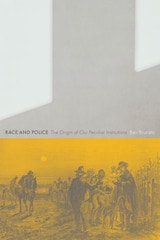
The Origin of Our Peculiar InstitutionsBen Brucato
Rutgers University Press, 2024
Race and Police corrects the Eurocentrism in the orthodox history of American police and in predominating critical theories of police. That orthodoxy rests on an origin story that begins with Sir Robert Peel and the London Metropolitan Police Service. Predating the Met by more than a century, America’s first police, often called slave patrols, did more than maintain order—it fabricated a racial order. Prior to their creation, all white citizens were conscripted to police all Blacks. Their participation in the coercive control of Blacks gave definition to their whiteness. Targeted as threats to the security of the economy and white society, being policed defined Blacks who, for the first time, were treated as a single racial group. The boundaries of whiteness were first established on the basis of who was required to regulate slaves, given a specific mandate to prevent Black insurrection, a mandate that remains core to the police role to this day.
Race, Gender, and Punishment
From Colonialism to the War on TerrorEdited by Mary Bosworth and Jeanne Flavin
Rutgers University Press, 2006
In Race, Gender, and Punishment, Mary Bosworth and Jeanne Flavin bring together twelve original essays by prominent scholars to examine not only the discrimination that is evident, but also the structural and cultural forces that have influenced and continue to perpetuate the current situation. Contributors point to four major factors that have impacted public sentiment and criminal justice policy: colonialism, slavery, immigration, and globalization. In doing so they reveal how practices of punishment not only need particular ideas about race to exist, but they also legitimate them.
The essays unearth troubling evidence that testifies to the nation's brutally racist past, and to white Americans' continued fear of and suspicion about racial and ethnic minorities. The legacy of slavery on punishment is considered, but also subjects that have received far less attention such as how colonizers' notions of cultural superiority shaped penal practices, the criminalization of reproductive rights, the link between citizenship and punishment, and the global export of crime control strategies.
Uncomfortable but necessary reading, this book provides an original critique of why and how the criminal justice system has emerged as such a racist institution.
Rape by the Numbers
Producing and Contesting Scientific Knowledge about Sexual ViolenceEthan Czuy Levine
Rutgers University Press, 2021
Reading Prisoners
Literature, Literacy, and the Transformation of American Punishment, 1700–1845Schorb, Jodi
Rutgers University Press, 2014
Readings In American Indian Law
Jo Carrillo
Temple University Press, 1998
Courses in federal Indian law are often aimed at understanding rules, not cultural conflicts. This book expands doctrinal discussions into understandings of culture, strategy, history, identity, and hopes for the future. Contributions from law, history, anthropology, ethnohistory, biography, sociology, socio-legal studies, and fiction offer an array of alternative paradigms as strong antidotes to our usual conceptions of federal Indian law.
Each selection reveals an aspect of how federal Indian law is made, interpreted, implemented, or experienced. Throughout, the book centers on the ever present and contentious issue of identity. At the point where identity and law intersect lies an important new way to contextualize the legal concerns of Native Americans.
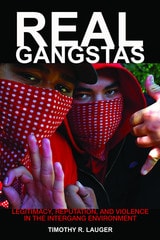
Real Gangstas
Legitimacy, Reputation, and Violence in the Intergang EnvironmentLauger, Timothy R
Rutgers University Press, 2012
Street gangs are a major concern for residents in many inner-city communities. However, gangs’ secretive and, at times, delinquent tendencies limit most people’s exposure to the realities of gang life. Based on eighteen months of qualitative research on the streets of Indianapolis, Real Gangstas provides a unique and intimate look at the lives of street gang members as they negotiate a dangerous peer environment in a major midwestern city.
Timothy R. Lauger interviewed and observed a mix of fifty-five gang members, former gang members, and non-gang street offenders. He spent much of his fieldwork time in the company of a particular gang, the “Down for Whatever Boyz,” who allowed him to watch and record many of their day-to-day activities and conversations. Through this extensive research, Lauger is able to understand and explain the reasons for gang membership, including a chaotic family life, poverty, and the need for violent self-assertion in order to foster the creation of a personal identity.
Although the book exposes many troubling aspects of gang life, it is not a simple descriptive or a sensationalistic account of urban despair and violence. Steeped in the tradition of analytical ethnography, the study develops a central theoretical argument: combinations of street gangs within cities shape individual gang member behavior within those urban settings. Within Indianapolis, members of rival gangs interact on a routine basis within an ambiguous and unstable environment. Participants believe that many of their contemporaries claiming gang affiliations are not actually “real” gang members, but instead are imposters who gain access to the advantages of gang membership through fraud and pretense. Consequently, the ability to discern “real” gang members—or to present oneself successfully as a real gang member—is a critical part of gangland Indianapolis.
Real Gangstas offers an objective and fair characterization of active gang members, successfully balancing the seemingly conflicting idea that they generally seem like normal teenagers, yet are abnormally concerned with—and too often involved in—violence. Lauger takes readers to the edge of an actual gang conflict, providing a rare and up-close look at the troubling processes that facilitate hostility and violence.
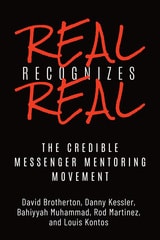
Real Recognizes Real
The Credible Messenger Mentoring MovementDavid C. Brotherton, Danny Kessler, Bahiyyah M. Muhammad, Rodrigo Martinez, and Louis Kontos
Temple University Press, 2027
The Credible Messenger Mentoring Initiative (CMMI), launched in New York City in 2012, is a transformative program where adults who had been in the justice system serve as mentors, role models, and life coaches for 16- to 24-year-olds. The program socializes and empowers these at-risk and formerly incarcerated youth offenders, diverting them from juvenile justice institutions and rehabilitation centers. It aims to build trust, deepen their ties to their community and family, and help them become peacemakers and role models for other youths.
Real Recognizes Real is the first in-depth study of the CMMI, focusing on the Washington, DC branch of the program, which is becoming a model for a new movement of anti-violent interventions. It shows the advantages of the CMMI being built on the love that members of a community have for one another rather than on outside intervention. The authors also explain how this state-run, non-profit program reduced recidivism rates and helped its participants, youth and mentors alike, develop more meaningful and lasting relationships.
Featuring interviews with youths and their mentors, Real Recognizes Real evaluates the successes, challenges, failures, and lessons of the CMMI, while emphasizing its value in the campaign for juvenile justice reform.
In the series Studies in Transgression
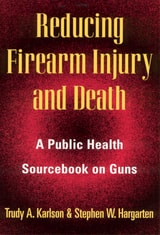
Reducing Firearm Injury and Death
A Public Health Sourcebook on GunsTrudy A. Karlson
Rutgers University Press, 1997
There are few issues more explosive than guns. "Guns don't kill people, people kill people," is an often-heard response to calls for firearm control. But are there ways to make guns safer without placing further restrictions on gun owners? Can guns be engineered to reduce the number and severity of injuries?
This book is about guns and new solutions for addressing problems they create. Trudy Karlson and Stephen Hargarten, two experts in public health and injury control, show readers how guns are products, designed to injure and kill, and how changes in the design, technology, and marketing of firearms can lead to reductions in the number of injuries and fatalities.
Just as innovations in the design and technology of motor vehicles succeeded in creating safer cars, Karlson and Hargarten describe how responsible changes to gun products can reduce the number of serious injuries and fatalities. The injury control perspective illustrates how the characteristics of guns and ammunition are associated with their ability to cause injury and death. It also provides options for how guns can be re-engineered to ensure a greater degree of safety and protection. Reducing Firearm Injury and Death teaches basic facts about guns and gun injuries, and by reframing the problem of firearms as a public health issue, offers hope for saving lives.
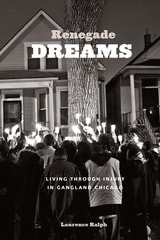
Renegade Dreams
Living through Injury in Gangland ChicagoLaurence Ralph
University of Chicago Press, 2014
Going deep into a West Side neighborhood most Chicagoans only know from news reports—a place where children have been shot just for crossing the wrong street—Ralph unearths the fragile humanity that fights to stay alive there, to thrive, against all odds. He talks to mothers, grandmothers, and pastors, to activists and gang leaders, to the maimed and the hopeful, to aspiring rappers, athletes, or those who simply want safe passage to school or a steady job. Gangland Chicago, he shows, is as complicated as ever. It’s not just a warzone but a community, a place where people’s dreams are projected against the backdrop of unemployment, dilapidated housing, incarceration, addiction, and disease, the many hallmarks of urban poverty that harden like so many scars in their lives. Recounting their stories, he wrestles with what it means to be an outsider in a place like this, whether or not his attempt to understand, to help, might not in fact inflict its own damage. Ultimately he shows that the many injuries these people carry—like dreams—are a crucial form of resilience, and that we should all think about the ghetto differently, not as an abandoned island of unmitigated violence and its helpless victims but as a neighborhood, full of homes, as a part of the larger society in which we all live, together, among one another.
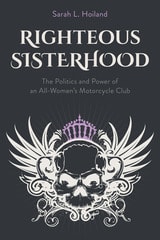
Righteous Sisterhood
The Politics and Power of an All-Women's Motorcycle ClubSarah L. Hoiland
Temple University Press, 2025
Granted unprecedented access to the MC’s initiation rituals, annual ceremonies, and the extensive socialization process, Hoiland investigates this fascinating subculture, why women choose to join, and why, in some cases, they exit or become exiled.
Righteous Sisterhood also reveals complex and contradictory gender and political dynamics within the club and within the larger subculture. The MC provides a unique, liberatory, womanist space within the larger male-dominated MC social world, but these women remain outsiders, with political voices that are lost in the misogyny of alt-right spaces. As Hoiland emphasizes, the quest for righteous sisterhood is about finding individual excellence and camaraderie while seeking recognition and immortality within the MC.
Rivers on Fire and Corporate Liars
The Monitoring and Sanctioning of U.S. Water Pollution CrimesJoshua Ozymy
Rutgers University Press, 2026
For over four decades, the US federal government has undertaken efforts to police and prosecute environmental crimes to protect public health and the natural environment. Yet, we still know very little about how US federal agencies have monitored and sanctioned water pollution violations and if these actions actually deter crime. In Rivers on Fire and Corporate Liars, Joshua Ozymy and Melissa Jarrell Ozymy examined over one thousand federal water pollution investigations and prosecutions undertaken by the US EPA and Department of Justice from 1983 to 2023 to answer these questions. Their analysis provides the most comprehensive empirical examination to date of how the criminal enforcement of water pollution has evolved over time, patterns in prosecutions, and how criminals were sanctioned.
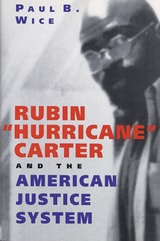
Rubin ' Hurricane' Carter and the American Justice System
Wice, Paul B
Rutgers University Press, 2000
Winner of the 2001 New Jersey Author's Award by the New Jersey Academic Alliance
Paul Wice takes the famous case of Rubin “Hurricane” Carter to another level of scrutiny as he puts the criminal justice system itself on trial. The case illustrates many of the strengths and weaknesses of our nation’s much maligned criminal justice system while affirming the power and resoluteness of the human spirit.
Early on the morning of June 17, 1966, the sound of gunfire echoed through the quite streets of Paterson, New Jersey, as four people were shot, three fatally, inside the Lafayette Bar and Grill. Twenty-nine-year-old Rubin “Hurricane” Carter, a prominent professional boxer, along with his companion, John Artis, were arrested and charged with committing this brutal crime. Prosecutors would later theorize that the murders were racially motivated — Carter and Artis are black, the victims white — to avenge the killing of a black Paterson tavern owner. Despite barely credible and oft-times contradictory evidence presented by both sides, a year after the killings Carter and Artis were convicted of murder and sentenced to life in prison. A second jury upheld the previous convictions in 1976. Artis was imprisoned until 1981, when he was released on parole. Carter remained in jail until 1988, when acting prosecutor John Goceljak elected not to pursue a third trial following the reversal of the 1976 retrial by the Federal District Court, a decision ultimately affirmed by the Circuit Court of Appeals and the U.S. Supreme Court. With the release of the widely discussed movie on Carter starring Denzel Washington, the case has again become visible and controversial.
Wice follows the torturous legal path of this case as it wound its way through first the New Jersey then the federal justice system for the next twenty-two years. His interpretations are informed by interviews with key members of both the prosecution and defense as well as previously unused court documents and transcripts. Wice evaluates the Carter case within a larger theoretical framework to illustrate many of the critical weaknesses of the adversary system and appeals process that is so basic to the American judicial system. Here is what can happen when police and prosecutors act unprofessionally, when critical witnesses lie, and when the justice system itself is unwilling to correct its errors or admit its mistakes.
Running the Numbers
Race, Police, and the History of Urban GamblingMatthew Vaz
University of Chicago Press, 2020
How the politics of gambling became snarled in disputes over race, power, and law enforcement.
Every day in the United States, people test their luck in numerous lotteries, from state-run games to massive programs like Powerball and Mega Millions. Yet few are aware that the origins of today’s lotteries can be found in an African American gambling economy that flourished in urban communities in the mid-twentieth century. In Running the Numbers, Matthew Vaz reveals how the politics of gambling became enmeshed in disputes over racial justice and police legitimacy.
As Vaz highlights, early urban gamblers favored low-stakes games built around combinations of winning numbers. When these games became one of the largest economic engines in nonwhite areas like Harlem and Chicago’s south side, police took notice of the illegal business—and took advantage of new opportunities to benefit from graft and other corrupt practices. Eventually, governments found an unusual solution to the problems of illicit gambling and abusive police tactics: coopting the market through legal state-run lotteries, which could offer larger jackpots than any underground game. By tracing this process and the tensions and conflicts that propelled it, Vaz brilliantly calls attention to the fact that, much like education and housing in twentieth-century America, the gambling economy has also been a form of disputed terrain upon which racial power has been expressed, resisted, and reworked.

Running the Numbers
Race, Police, and the History of Urban GamblingMatthew Vaz
University of Chicago Press, 2020
How the politics of gambling became snarled in disputes over race, power, and law enforcement.
Every day in the United States, people test their luck in numerous lotteries, from state-run games to massive programs like Powerball and Mega Millions. Yet few are aware that the origins of today’s lotteries can be found in an African American gambling economy that flourished in urban communities in the mid-twentieth century. In Running the Numbers, Matthew Vaz reveals how the politics of gambling became enmeshed in disputes over racial justice and police legitimacy.
As Vaz highlights, early urban gamblers favored low-stakes games built around combinations of winning numbers. When these games became one of the largest economic engines in nonwhite areas like Harlem and Chicago’s south side, police took notice of the illegal business—and took advantage of new opportunities to benefit from graft and other corrupt practices. Eventually, governments found an unusual solution to the problems of illicit gambling and abusive police tactics: coopting the market through legal state-run lotteries, which could offer larger jackpots than any underground game. By tracing this process and the tensions and conflicts that propelled it, Vaz brilliantly calls attention to the fact that, much like education and housing in twentieth-century America, the gambling economy has also been a form of disputed terrain upon which racial power has been expressed, resisted, and reworked.