190 books match the query 'Critical theory' and 9 start with r
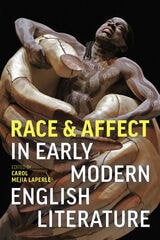
cover of Race and Affect in Early Modern English Literature

Race and Affect in Early Modern English Literature

Carole Mejia LaPerle

Arizona Center for Medieval and Renaissance Studies, 2021

This collection brings together critical race studies and affect theory to examine the emotional dimensions of race in early modern literature. 

Race and Affect in Early Modern English Literature puts the fields of critical race studies and affect theory into dialogue. Doing so opens a new set of questions: What are the emotional experiences of racial formation and racist ideologies? How do feelings—through the physical senses, emotional passions, or sexual encounters—come to signify race? What is the affective register of anti-blackness that pervades canonical literature? How can these visceral forms of racism be resisted in discourse and in practice? By investigating how race feels, this book offers new ways of reading and interpreting literary traditions, religious differences, gendered experiences, class hierarchies, sexuality, and social identities. So far scholars have shaped the discussion of race in the early modern period by focusing on topics such as genealogy, language, economics, religion, skin color, and ethnicity. This book, however, offers something new: it considers racializing processes as visceral, affective experiences.

[more]
cover of Reason after Its Eclipse: On Late Critical Theory

Reason after Its Eclipse

On Late Critical Theory

Martin Jay

University of Wisconsin Press, 2017

Martin Jay tackles a question as old as Plato and still pressing today: what is reason, and what roles does and should it have in human endeavor? Applying the tools of intellectual history, he examines the overlapping, but not fully compatible, meanings that have accrued to the term "reason" over two millennia, homing in on moments of crisis, critique, and defense of reason.

After surveying Western ideas of reason from the ancient Greeks through Kant, Hegel, and Marx, Jay engages at length with the ways leading theorists of the Frankfurt School—Horkheimer, Marcuse, Adorno, and most extensively Habermas—sought to salvage a viable concept of reason after its apparent eclipse. They despaired, in particular, over the decay in the modern world of reason into mere instrumental rationality. When reason becomes a technical tool of calculation separated from the values and norms central to daily life, then choices become grounded not in careful thought but in emotion and will—a mode of thinking embraced by fascist movements in the twentieth century.

Is there a more robust idea of reason that can be defended as at once a philosophical concept, a ground of critique, and a norm for human emancipation? Jay explores at length the ommunicative rationality advocated by Habermas and considers the range of arguments, both pro and con, that have greeted his work.

[more]
cover of Reparative Craft: Eve Kosofsky Sedgwick as a Textile Artist

Reparative Craft

Eve Kosofsky Sedgwick as a Textile Artist

Jason Edwards

Duke University Press, 2026

Eve Kosofsky Sedgwick is primarily known for her foundational work in queer and affect theory, but her artistic work with textiles remains largely unexplored. In Reparative Craft, Jason Edwards examines a range of her textile art from a ten-year period in which she was also writing Touching Feeling. Employing the reparative approach that Sedgwick pioneered and analyzing her works from a series of four exhibitions, Reparative Craft demonstrates the necessity of connecting Sedgwick’s fiber art practice to her work as a theorist. Richly illustrated and presented in full color, this volume invites readers to connect Sedgwick’s art with her theory, presenting a new model of reparative reading that exemplifies ideas of queer and trans craft so vital to Sedgwick’s body of work.
[more]
cover of Repeating Žižek

Repeating Žižek

Agon Hamza, ed.

Duke University Press, 2015

Repeating Žižek offers a serious engagement with the ideas and propositions of philosopher Slavoj Žižek. Often subjecting Žižek's work to a Žižekian analysis, this volume's contributors consider the possibility (or impossibility) of formalizing Žižek's ideas into an identifiable philosophical system. They examine his interpretations of Hegel, Plato, and Lacan, outline his debates with Badiou, and evaluate the implications of his analysis of politics and capitalism upon Marxist thought. Other essays focus on Žižek's approach to Christianity and Islam, his "sloppy" method of reading texts, his relation to current developments in neurobiology, and his theorization of animals. The book ends with an afterword by Žižek in which he analyzes Shakespeare's and Beckett's plays in relation to the subject. The contributors do not reach a consensus on defining a Žižekian school of philosophy—perhaps his idiosyncratic and often heterogeneous ideas simply resist synthesis—but even in their repetition of Žižek, they create something new and vital.

Contributors. Henrik Jøker Bjerre, Bruno Bosteels, Agon Hamza, Brian Benjamin Hansen, Adrian Johnston, Katja Kolšek, Adam Kotsko, Catherine Malabou, Benjamin Noys, Geoff Pfeifer, Frank Ruda, Oxana Timofeeva, Samo Tomšic, Gabriel Tupinambá, Fabio Vighi, Gavin Walker, Sead Zimeri, Slavoj Žižek

 
[more]
cover of Rescuing the Enlightenment from the Europeans: Critical Theories of Decolonization

Rescuing the Enlightenment from the Europeans

Critical Theories of Decolonization

Nikita Dhawan

Duke University Press, 2026
In Rescuing the Enlightenment from the Europeans, Nikita Dhawan puts the critical project of decolonization into conversation with the Enlightenment. She explores the ethical-political challenges faced by postcolonial thought, which must be articulated using the very language of Enlightenment discourses on human rights, democracy, international law, sovereignty, and justice—even as these norms are subjects of postcolonial critique. Bridging postcolonial and Holocaust studies while also highlighting differences from decolonial approaches, she engages with thinkers ranging from Kant to the Frankfurt school to defend them against accusations of normative nihilism, antisemitism, and epistemic servitude to Europe. Dhawan argues that criticizing the Enlightenment and its legacies does not necessarily entail rejecting them, nor does engaging with Enlightenment principles mean endorsing them unconditionally. Instead, she makes a case for rescuing the best aspects of the Enlightenment in order to further the critical project of decolonization.
[more]
cover of Ressentiment: Reflections on Mimetic Desire and Society

Ressentiment

Reflections on Mimetic Desire and Society

Stefano Tomelleri

Michigan State University Press, 2015
This book is a response to Friedrich Nietzsche’s provocative question: How much and how does ressentiment condition our daily life? During the twentieth century we witnessed veritable eruptions of this insidious emotion, and we are still witnesses of its proliferation at various levels of society. This book aims to explore, according to René Girard’s mimetic theory, the anthropological and social assumptions that make up ressentiment and to investigate its genesis. The analysis of ressentiment shows that this emotion evolves from mimetic desire: it is an affective experience that people have when a rival denies them opportunities or valuable resources (including status) that they consider to be socially accessible. It is a specific figure of mimetic desire that is typical of contemporary society, where the equality that is proclaimed at the level of values contrasts with striking inequalities of power and access to material resources. This dichotomy generates increasing tension between highly competitive and egalitarian mimetic desires and growing social inequalities. The ressentiment is ambiguous, and its ambiguity is that of mimetic desire itself, which we cannot dismiss from our lives. In that it provides occasions of conflict and baseness, ressentiment can fuel violence, discord, and injustice, but it also can open opportunities for growth and justice, and for inventing institutions that are better adapted to the transformations of our contemporary society.
[more]
cover of Revolutions of Capitalism: The Politics of the Event

Revolutions of Capitalism

The Politics of the Event

Maurizio Lazzarato. Translated by Brian Whitener and Geo Maher.

Duke University Press, 2026
Framed by brilliant readings of Gilles Deleuze and Félix Guattari, Gabriel Tarde, and Mikhail Bakhtin, Maurizio Lazzarato’s Revolutions of Capitalism charts a new theory of contemporary capitalism and the politics against it. Originally published in French in 2004, this newly translated work sees capitalism as driven, not only by labor or value, but by the capture of cooperation and by the taming of possibles. Lazzarato theorizes how contemporary capitalism depends on noo-politics, or the “action of brains at a distance on other brains,” which seeks to control memory and attention and to trap the proliferation of possibles. Against this, Lazzarato reveals how current social movements attack established institutions and their vision of a single possible world to liberate the creation and actualization of a multiplicity of possible worlds.
[more]
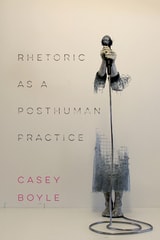
cover of Rhetoric as a Posthuman Practice

Rhetoric as a Posthuman Practice

Casey Boyle

The Ohio State University Press, 2018

In response to the pervasiveness of emerging communication technologies, Rhetoric as a Posthuman Practice argues that information be understood as an embodied, material practice. The guiding proposition for this book is that digital rhetoric now concerns how bodies, broadly construed, become informed through practice that includes not only traditional communication activities between bodies but also how information technologies organize and exercise those varying bodies.
 
Through case studies of the media art of glitch, urban explorers’ use of social media, and DIY digital networks, this book then reconsiders how practice/exercise functions when the once essential bodies of the individual and a society—the two primary categories authorized by a humanist paradigm—become less reliable categories from which we might orient rhetorical action. In sum, the book argues that rhetorical practice is irreducible to the traditions and categories of humanism and must now exercise its posthuman capacities.
 
[more]
cover of Rhetorical Knowledge in Legal Practice and Critical Legal Theory

Rhetorical Knowledge in Legal Practice and Critical Legal Theory

Francis J. Mootz III

University of Alabama Press, 2006

A clear summary of contemporary rhetorical philosophy and its intersections with hermeneutics and critical theory

This book describes the significance of rhetorical knowledge for law through detailed discussions of some of the most difficult legal issues facing courts today, including affirmative action, gay rights, and assisted suicide.

Francis J. Mootz responds to both extremes, those who argue that law is merely a rhetorical mask for the exercise of power and those who demonstrate an ideological faith in law’s autonomy, and he breaks new ground by returning to modern classics in the fields of rhetoric and hermeneutics. Drawing from Chaim Perelman's "new rhetoric" and Hans-Georg Gadamer's "philosophical hermeneutics," Mootz argues that justice is a product of rhetorical knowledge. Drawing from Nietzsche, Mootz’s conception of rhetorical knowledge opens up the dynamic possibilities of critical legal theory. 

[more]