Results by title
87 books match the query 'Criticism, Textual' and 5 start with r
REWRITING CHAUCER
CULTURE, AUTHORITY, AND THE IDEA OF THE AUTHENTIC TEXT, 1400–1602THOMAS A. PRENDERGAST
The Ohio State University Press, 1999
This collection of original essays examines how the idea of an authentic Chaucerian text was reimagined and reproduced by medieval and early modern scribes and editors to satisfy and shape the cultural expectations of their audiences. These “reproductions” of Chaucer’s works epitomize the tension between developing notions of what makes a text “authentic” and the cultural pressures that led scribes and editors to construct their own versions of Chaucer and his works.
The book begins by exploring medieval and early modern notions of origins and how they at once illuminate and problematize the recovery of Chaucerian texts. Essays in the second section examine how individual scribes and reading communities reshaped Chaucer’s texts. Finally, we see how the printing press—bringing with it a renewed concern about the idea of authenticity—led both to an increase in the number of works attributed to Chaucer and to increasing anxiety about their authenticity.
The focus on the ways in which Chaucer was rewritten in different cultural and aesthetic contexts will enable medieval and early modern critics to situate Chaucer more fully within his cultural milieu, while illuminating the ways in which his reputation as both a “laureate poet” and a “lewed compilator” affected rewritings of his works. Rewriting Chaucer, then, will appeal both to scholars interested in the critical juncture between manuscript and print culture and to those interested in how culture affects the reproduction of authoritative texts.
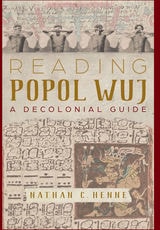
Reading Popol Wuj
A Decolonial GuideNathan C. Henne
University of Arizona Press, 2020
Popol Wujis considered one of the oldest books in the Americas. Various elements of Popol Wuj have appeared in different written forms over the last two millennia and several parts of Popol Wuj likely coalesced in hieroglyphic book form a few centuries before contact with Europeans. Popol Wuj offers a unique interpretation of the Maya world and ways of being from a Maya perspective. However, that perspective is often occluded since the extant Popol Wuj is likely a copy of a copy of a precontact Indigenous text that has been translated many times since the fifteenth century.
Reading Popol Wujoffers readers a path to look beyond Western constructions of literature to engage with this text through the philosophical foundation of Maya thought and culture. This guide deconstructs various translations to ask readers to break out of the colonial mold in approaching this seminal Maya text.
Popol Wuj, or Popol Vuh, in its modern form, can be divided thematically into three parts: cosmogony (the formation of the world), tales of the beings who inhabited the Earth before the coming of people, and chronicles of different ethnic Maya groups in the Guatemala area. Examining thirteen translations of the K’iche’ text, Henne offers a decolonial framework to read between what translations offer via specific practice exercises for reading, studying, and teaching. Each chapter provides a close reading and analysis of a different critical scene based on a comparison of several translations (English and Spanish) of a key K’iche’ word or phrase in order to uncover important philosophical elements of Maya worldviews that resist precise expression in Indo-European languages.
Charts and passages are frontloaded in each chapter so the reader engages in the comparative process before reading any leading arguments. This approach challenges traditional Western reading practices and enables scholars and students to read Popol Wuj—and other Indigenous texts—from within the worldview that created them.
Reading the Fascicles of Emily Dickinson
Dwelling in PossibilitiesEleanor Elson Heginbotham
The Ohio State University Press, 2020
We cannot know why Dickinson compiled the books or what she thought of them, but we can observe what she left in them. What she left is visible only by noting the way the poem answers in a dialogue across the pages, the way lines spilling onto a second page introduce the next poem, the way openings suggest image clusters so that each book has its own network of concerns and language—not a story or philosophical preachment but an aesthetic wholeness.
This book is the first to demonstrate that Dickinson’s poetic and philosophical creativity is most startling when the reader observes the individual lyric in the poet’s own, and only, context for them. For teacher, student, scholar, and poetry lover, Heginbotham creates an important new framework for understanding one of the most complex, clever, and profound U.S. poets.
Representing Modernist Texts
Editing as InterpretationGeorge Bornstein, Editor
University of Michigan Press, 1991
In Representing Modernist Texts, thirteen internationally known scholars provide major explorations of the topic in the work of particular writers. The issues they raise include the construction of a writer’s canon and the effect of newly available “uncanonical” manuscript materials on existing works and orderings; the replacement of the older idea of a fixed, stable text by a more contemporary notion of the text as process; and the interrogation by advanced textual theory of many of the same notions of “author,” “intention,” and “stability of the text” questioned by advanced literary theory.
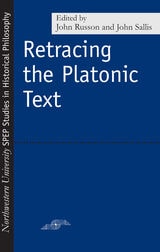
Retracing the Platonic Text
John Russon and John Sallis
Northwestern University Press, 1999