Results by title
120 books match the query 'Cultural Policy' and 7 start with r
Radicalization in Theory and Practice
Understanding Religious Violence in Western EuropeThierry Balzacq and Elyamine Settoul, Editors
University of Michigan Press, 2022
Radicalization is a major challenge of contemporary global security. It conjures up images of violent ideologies, “homegrown” terrorists and jihad in both the academic sphere and among security and defense experts. While the first instances of religious radicalization were initially limited to second-generation Muslim immigrants, significant changes are currently impacting this phenomenon. Technology is said to amplify the dissemination of radicalism, though there remains uncertainty as to the exact weight of technology on radical behaviors. Moreover, far from being restricted to young men of Muslim heritage suffering from a feeling of social relegation, radicalism concerns a significant number of converted Muslims, women and more heterogeneous profiles (social, academic and geographic), as well as individuals that give the appearance of being fully integrated in the host society. These new and striking dynamics require innovative conceptual lenses.
Radicalization in Theory and Practice identifies the mechanisms that explicitly link radical religious beliefs and radical actions. It describes its nature, singles out the mechanisms that enable radicalism to produce its effects, and develops a conceptual architecture to help scholars and policy-makers to address and evaluate radicalism—or what often passes as such. A variety of empirical chapters fed by first-hand data probe the relevance of theoretical perspectives that shape radicalization studies. By giving a prominent role to first-hand empirical investigations, the authors create a new framework of analysis from the ground up. This book enhances the quality of theorizing in this area, consolidates the quality of methodological enquiries, and articulates security studies insights with broader theoretical debates in different fields including sociology, social psychology, economics, and religious studies.

Red Creative
Culture and Modernity in ChinaJustin O'Connor and Xin Gu
Intellect Books, 2020
Red Creative is an exploration of China’s cultural economy over the last twenty years, particularly through the lens of its creative hub of Shanghai. The research presented here raises questions about the nature of contemporary ‘creative’ capitalism and the universal claims of Western modernity, offering new ways of thinking about cultural policy in China.
Taking a long-term historical perspective, Justin O’Connor and Xin Gu analyze the ongoing development of China’s cultural industries, examining the institutions, regulations, interests, and markets that underpin the Chinese cultural economy and the strategic position of Shanghai within it. Further, the authors explore cultural policy reforms in post-colonial China and articulate Shanghai’s significance in paving China’s path to modernity and entry to global capitalism. In-depth and illuminating, Red Creative carefully situates China’s contemporary cultural economy in its larger global and historical context, revealing the limits of Western thought in understanding Chinese history, culture, and society.
Regulating Difference
Religious Diversity and Nationhood in the Secular WestMarian Burchardt
Rutgers University Press, 2020
Transnational migration has contributed to the rise of religious diversity and has led to profound changes in the religious make-up of society across the Western world. As a result, societies and nation-states have faced the challenge of crafting ways to bring new religious communities into existing institutions and the legal frameworks. Regulating Difference explores how the state regulates religious diversity and examines the processes whereby religious diversity and expression becomes part of administrative landscapes of nation-states and people’s everyday lives. Arguing that concepts of nationhood are key to understanding the governance of religious diversity, Regulating Difference employs a transatlantic comparison of the Spanish region of Catalonia and the Canadian province of Quebec to show how processes of nation-building, religious heritage-making and the mobilization of divergent interpretations of secularism are co-implicated in shaping religious diversity. It argues that religious diversity has become central for governing national and urban spaces.
This book is also freely available online as an open access digital edition.
Repression, Exile, and Democracy
Uruguayan CultureSaul Sosnowski and Louise B. Popkin, eds.
Duke University Press, 1992
The first section provides a context for the volume, with its analyses of the historical, political, and social aspects of the Uruguayan experience. The following chapters explore various aspects of cultural production, including personal experiences of exile and imprisonment, popular music, censorship, literary criticism, return from exile, and the role that culture plays in redemocratization.
This book's appeal extends well beyond the study of Uruguay to scholars and students of the history and culture of other Latin American nations, as well as to fields of comparative literature and politics in general.
Contributors. Hugo Achugar, Alvarro Barros-Lémez, Lisa Block de Behar, Amanda Berenguer, Hiber Conteris, José Pedro Díaz, Eduardo Galeano, Edy Kaufman, Leo Masliah, Carina Perelli, Teresa Porzecanski, Juan Rial, Mauricio Rosencof, Jorge Ruffinelli, Saúl Sosonowski, Martin Weinstein, Ruben Yáñez
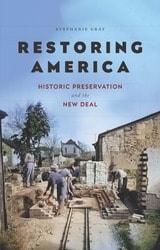
Restoring America
Historic Preservation and the New DealStephanie Gray
University of Massachusetts Press, 2025
Honorable Mention, New Deal Book Award
Exploring how the New Deal shaped history through politically driven commemoration
During the Great Depression, Americans employed historic preservation as a tool to address the political, economic, and social upheavals of the era. Inspired by the Roosevelt administration’s unprecedented support of federal arts projects, US politicians, architects, laborers, artisans, and local boosters skillfully used New Deal funds to restore, mythologize, and politicize the “historic shrines” in their communities. Restoring America illustrates how and why Americans turned to historic preservation as a strategy for managing both political realities and ambitions.
Stephanie Gray presents four thoroughly researched and diverse case studies: a colonial theater in the Deep South, a Puritan minister’s home in New England, aviator Charles Lindbergh's modest farmhouse and parklands of the Upper Midwest, and a multi-layered Spanish-German-Mexican arts village in the Central South. Collectively, these examples show how the restoration of old places emerged as a popular form of cultural production, an instrument of economic reconstruction, and a striking expression of political theater during the Depression. Moreover, these New Deal preservation projects make evident that any exercise in physically preserving the past is both conservative and progressive, reactive and proactive.
Restoring America contends that the federally funded and locally driven preservation initiatives of the 1930s and 1940s can help inform contemporary public history debates over the politics of commemoration and imagine possibilities for future preservation practice.
Revolutionary Parks
Conservation, Social Justice, and Mexico’s National Parks, 1910–1940Emily Wakild
University of Arizona Press, 2011
Revolutionary Parks tells the surprising story of how forty national parks were created in Mexico during the latter stages of the first social revolution of the twentieth century. By 1940 Mexico had more national parks than any other country. Together they protected more than two million acres of land in fourteen states. Even more remarkable, Lázaro Cárdenas, president of Mexico in the 1930s, began to promote concepts akin to sustainable development and ecotourism.
Conventional wisdom indicates that tropical and post-colonial countries, especially in the early twentieth century, have seldom had the ability or the ambition to protect nature on a national scale. It is also unusual for any country to make conservation a political priority in the middle of major reforms after a revolution. What emerges in Emily Wakild’s deft inquiry is the story of a nature protection program that takes into account the history, society, and culture of the times. Wakild employs case studies of four parks to show how the revolutionary momentum coalesced to create early environmentalism in Mexico.
According to Wakild, Mexico’s national parks were the outgrowth of revolutionary affinities for both rational science and social justice. Yet, rather than reserves set aside solely for ecology or politics, rural people continued to inhabit these landscapes and use them for a range of activities, from growing crops to producing charcoal. Sympathy for rural people tempered the radicalism of scientific conservationists. This fine balance between recognizing the morally valuable, if not always economically profitable, work of rural people and designing a revolutionary state that respected ecological limits proved to be a radical episode of government foresight.
Right to DREAM
Immigration Reform and America’s FutureWilliam A. Schwab
University of Arkansas Press, 2013