51 books match the query 'Cultural Politics' and 3 start with r
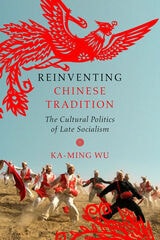
cover of Reinventing Chinese Tradition: The Cultural Politics of Late Socialism

Reinventing Chinese Tradition

The Cultural Politics of Late Socialism

Ka-ming Wu

University of Illinois Press, 2015

The final destination of the Long March and center of the Chinese Communist Party's red bases, Yan'an acquired mythical status during the Maoist era. Though the city's significance as an emblem of revolutionary heroism has faded, today's Chinese still glorify Yan'an as a sanctuary for ancient cultural traditions.

Ka-ming Wu's ethnographic account of contemporary Yan'an documents how people have reworked the revival of three rural practices--paper-cutting, folk storytelling, and spirit cults--within (and beyond) the socialist legacy. Moving beyond dominant views of Yan'an folk culture as a tool of revolution or object of market reform, Wu reveals how cultural traditions become battlegrounds where conflicts among the state, market forces, and intellectuals in search of an authentic China play out. At the same time, she shows these emerging new dynamics in the light of the ways rural residents make sense of rapid social change.

Alive with details, Reinventing Chinese Tradition is an in-depth, eye-opening study of an evolving culture and society within contemporary China.
[more]
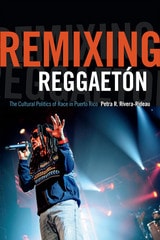
cover of Remixing Reggaetón: The Cultural Politics of Race in Puerto Rico

Remixing Reggaetón

The Cultural Politics of Race in Puerto Rico

Petra R. Rivera-Rideau

Duke University Press, 2015
Puerto Rico is often depicted as a "racial democracy" in which a history of race mixture has produced a racially harmonious society. In Remixing Reggaetón, Petra R. Rivera-Rideau shows how reggaetón musicians critique racial democracy's privileging of whiteness and concealment of racism by expressing identities that center blackness and African diasporic belonging. Stars such as Tego Calderón criticize the Puerto Rican mainstream's tendency to praise black culture but neglecting and marginalizing the island's black population, while Ivy Queen, the genre's most visible woman, disrupts the associations between whiteness and respectability that support official discourses of racial democracy. From censorship campaigns on the island that sought to devalue reggaetón, to its subsequent mass marketing to U.S. Latino listeners, Rivera-Rideau traces reggaetón's origins and its transformation from the music of San Juan's slums into a global pop phenomenon. Reggaetón, she demonstrates, provides a language to speak about the black presence in Puerto Rico and a way to build links between the island and the African diaspora.
 
[more]
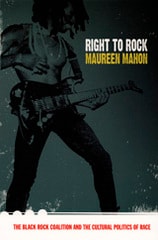
cover of Right to Rock: The Black Rock Coalition and the Cultural Politics of Race

Right to Rock

The Black Rock Coalition and the Cultural Politics of Race

Maureen Mahon

Duke University Press, 2004

The original architects of rock ’n’ roll were black musicians including Little Richard, Etta James, and Chuck Berry. Jimi Hendrix electrified rock with his explosive guitar in the late 1960s. Yet by the 1980s, rock music produced by African Americans no longer seemed to be “authentically black.” Particularly within the music industry, the prevailing view was that no one—not black audiences, not white audiences, and not black musicians—had an interest in black rock. In 1985 New York-based black musicians and writers formed the Black Rock Coalition (brc) to challenge that notion and create outlets for black rock music. A second branch of the coalition started in Los Angeles in 1989. Under the auspices of the brc, musicians organized performances and produced recordings and radio and television shows featuring black rock. The first book to focus on the brc, Right to Rock is, like the coalition itself, about the connections between race and music, identity and authenticity, art and politics, and power and change. Maureen Mahon observed and participated in brc activities in New York and Los Angeles, and she conducted interviews with more than two dozen brc members. In Right to Rock she offers an in-depth account of how, for nearly twenty years, members of the brc have broadened understandings of black identity and black culture through rock music.
[more]