Results by title
65 books match the query 'Cultures' and 3 start with r
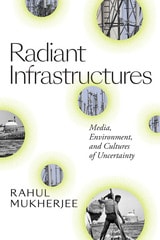
Radiant Infrastructures
Media, Environment, and Cultures of UncertaintyRahul Mukherjee
Duke University Press, 2020
In Radiant Infrastructures Rahul Mukherjee explores how the media coverage of nuclear power plants and cellular phone antennas in India—what he calls radiant infrastructures—creates environmental publics: groups of activists, scientists, and policy makers who use media to influence public opinion. In documentaries, lifestyle television shows, newspapers, and Bollywood films, and through other forms of media (including radiation-sensing technologies), these publics articulate contesting views about the relationships between modernity, wireless signals, and nuclear power. From testimonies of cancer patients who live close to cell towers to power plant operators working to contain information about radiation leaks and health risks, discussions in the media show how radiant infrastructures are at once harbingers of optimism about India's development and emitters of potentially carcinogenic radiation. In tracing these dynamics, Mukherjee expands understandings of the relationship between media and infrastructure and how people make sense of their everyday encounters with technology and the environment.
[more]
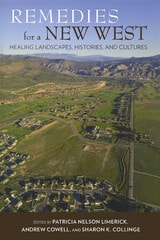
Remedies for a New West
Healing Landscapes, Histories, and CulturesEdited by Patricia Nelson Limerick, Andrew Cowell, and Sharon K. Collinge
University of Arizona Press, 2009
This wide-ranging collection of essays is intended to provoke both thought and action. The pieces collected here explore a variety of issues facing the American West—disappearing Native American languages, deteriorating air quality, suburban sprawl, species loss, grassland degradation, and many others—and suggest steps toward “healing.” More than “dealing with” or “solving,” according to the editors, healing addresses not just symptoms but their underlying causes, offering not just a temporary cure but a permanent one.
The signs of illness and trauma can seem omnipresent in today’s West: land and soil disrupted from mining, overgrazing, logging, and farming; wildlife habitat reduced and fragmented; native societies disturbed and threatened; open space diminished by cities and suburbs; wilderness destroyed by roads and recreation-seekers. But as these essays suggest, the “treatment program” for healing the West has many healthful side effects. Engaging in the kinds of projects suggested by contributors is therapeutic not only for the environment but for participants as well. Restoration, repair, and recovery can counter symptoms of despair with concentrated doses of promise and possibility.
The more “lesions” the West has, this book suggests, the more opportunities there are for westerners to revive and ultimately cure the ailing patient they have helped to create. The very idea of restoring the West to health, contributors and editors contend, unleashes our imaginations, sharpens our minds, and gives meaning to the ways we choose to live our lives. At the same time, acknowledging the profound difficulties of the work that lies ahead immunizes us against our own arrogance as we set about the task of healing the West.
[more]
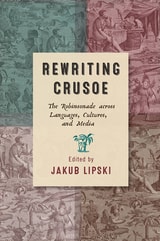
Rewriting Crusoe
The Robinsonade across Languages, Cultures, and MediaJakub Lipski
Bucknell University Press, 2020
Published in 1719, Defoe’s Robinson Crusoe is one of those extraordinary literary works whose importance lies not only in the text itself but in its persistently lively afterlife. German author Johann Gottfried Schnabel—who in 1731 penned his own island narrative—coined the term “Robinsonade” to characterize the genre bred by this classic, and today hundreds of examples can be identified worldwide. This celebratory collection of tercentenary essays testifies to the Robinsonade’s endurance, analyzing its various literary, aesthetic, philosophical, and cultural implications in historical context. Contributors trace the Robinsonade’s roots from the eighteenth century to generic affinities in later traditions, including juvenile fiction, science fiction, and apocalyptic fiction, and finally to contemporary adaptations in film, television, theater, and popular culture. Taken together, these essays convince us that the genre’s adapt- ability to changing social and cultural circumstances explains its relevance to this day.
Published by Bucknell University Press. Distributed worldwide by Rutgers University Press.
Published by Bucknell University Press. Distributed worldwide by Rutgers University Press.
[more]