Results by title
289 books match the query 'Dance' and 10 start with r
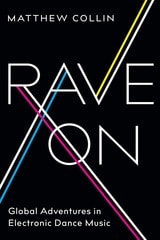
Rave On
Global Adventures in Electronic Dance MusicMatthew Collin
University of Chicago Press, 2018
Electronic dance music has been a vital force for more than three decades now, and has undergone transformation upon transformation as it has taken over the world. In this searching, lyrical account of dance music culture worldwide, Matthew Collin takes stock of its highest highs and lowest lows across its global trajectory. Through firsthand reportage and interviews with clubbers and DJs, Collin documents the itinerant musical form from its underground beginnings in New York, Chicago, and Detroit in the 1980s, to its explosions in Ibiza and Berlin, to today’s mainstream music scenes in new frontiers like Las Vegas, Shanghai, and Dubai. Collin shows how its dizzying array of genres—from house, techno, and garage to drum and bass, dubstep, and psytrance—have given voice to locally specific struggles. For so many people in so many different places, electronic dance music has been caught up in the search for free cultural space: forming the soundtrack to liberation for South African youth after Apartheid; inspiring a psychedelic party culture in Israel; offering fleeting escape from—and at times into—corporatization in China; and even undergirding a veritable “independent republic” in a politically contested slice of the former Soviet Union.
Full of admiration for the possibilities the music has opened up all over the world, Collin also unflinchingly probes where this utopianism has fallen short, whether the culture maintains its liberating possibilities today, and where it might go in the future.

Re-Choreographing Cortical & Cartographic Maps
Going West to Find East. Going East to find WestHenry Daniel
Intellect Books, 2022
This book is a transdisciplinary approach to practice-as-research, complete with an elaborate theory of practice and a set of four multi-year performance research projects through which the theory plays out. Its methodology is at times ethnographic, as the author deftly inserts himself and his Caribbean West African ancestry into a series of complex cortical and geographic maps, which become choreographic in every sense of the term.
The central argument in the book is based on a claim that human beings are cognitively embodied through their own lived experiences of movement through space and time; the spaces we inhabit and the practices we engage in are documented through cortical and cartographic maps. In short, as we inhabit and move through spaces our brains organize our experiences into unique cortical and spatial maps, which eventually determine how we see and deal with, or “become,” subjects in a world that we also help create. The argument is that through performance, we can claim the knowledge that is in the body as well as in the spaces through which it travels.
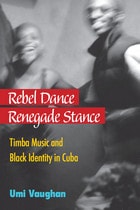
Rebel Dance, Renegade Stance
Timba Music and Black Identity in CubaUmi Vaughan
University of Michigan Press, 2013
Rebel Dance, Renegade Stanceshows how community music-makers and dancers take in all that is around them socially and globally, and publicly and bodily unfold their memories, sentiments, and raw responses within open spaces designated or commandeered for local popular dance. Umi Vaughan, an African American anthropologist, musician, dancer, and photographer "plantao" in Cuba—planted, living like a Cuban—reveals a rarely discussed perspective on contemporary Cuban society during the 1990s, the peak decade of timba, and beyond, as the Cuban leadership transferred from Fidel Castro to his brother. Simultaneously, the book reveals popular dance music in the context of a young and astutely educated Cuban generation of fierce and creative performers.
By looking at the experiences of black Cubans and exploring the notion of "Afro Cuba," Rebel Dance, Renegade Stanceexplains timba's evolution and achieved significance in the larger context of Cuban culture. Vaughan discusses a maroon aesthetic extended beyond the colonial era to the context of contemporary society; describes the dance spaces of Cuba; and examines the performance of identity and desire through the character of the "especulador." This book will find an audience with musicians, anthropologists, ethnomusicologists, interdisciplinary specialists in performance studies, cultural studies, and Latin American and Caribbean studies, as well as laypeople who are interested in Atlantic/African and African American/Africana studies and/or Cuban culture.
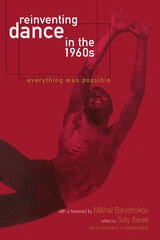
Reinventing Dance in the 1960s
Everything Was PossibleEdited by Sally Banes
University of Wisconsin Press, 2003
The 1960s was a pivotal decade in dance, an era of intense experimentation and rich invention. In this volume an impressive range of dance critics and scholars examine the pioneering choreographers and companies of the era, such as Anna Halprin’s West Coast experiments, the innovative Judson Dance Theater, avant-garde dance subcultures in New York, the work of Meredith Monk and Kenneth King, and parallel movements in Britain. The contributors include Janice Ross, Leslie Satin, Noël Carroll, Gus Solomons jr., Deborah Jowitt, Stephanie Jordan, Joan Acocella, and Sally Banes.
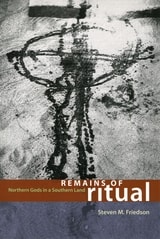
Remains of Ritual
Northern Gods in a Southern LandSteven M. Friedson
University of Chicago Press, 2009
Remains of Ritual, Steven M. Friedson’s second book on musical experience in African ritual, focuses on the Brekete/Gorovodu religion of the Ewe people. Friedson presents a multifaceted understanding of religious practice through a historical and ethnographic study of one of the dominant ritual sites on the southern coast of Ghana: a medicine shrine whose origins lie in the northern region of the country. Each chapter of this fascinating book considers a different aspect of ritual life, demonstrating throughout that none of them can be conceived of separately from their musicality—in the Brekete world, music functions as ritual and ritual as music. Dance and possession, chanted calls to prayer, animal sacrifice, the sounds and movements of wake keeping, the play of the drums all come under Friedson’s careful scrutiny, as does his own position and experience within this ritual-dominated society.
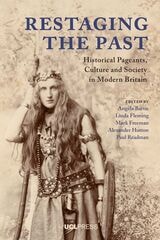
Restaging the Past
Historical Pageants, Culture and Society in Modern BritainEdited by Angela Bartie, Linda Fleming, Mark Freeman, and Alexander Hutton
University College London, 2020
Pageants were community events, bringing people together in a shared celebration and performance of the past; they also involved many prominent novelists, professional historians, and other writers, and as a result were featured repeatedly in popular and highbrow literature. Although the pageant tradition has largely died out, the contributors argue that it deserves to be acknowledged as a key aspect of community history during a period of great social and political change—and, they show, because of its former prominence, some lingering signs of “pageant fever” can still be seen in Britain today.
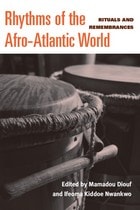
Rhythms of the Afro-Atlantic World
Rituals and RemembrancesEdited by Mamadou Diouf and Ifeoma Kiddoe Nwankwo
University of Michigan Press, 2010
"Collecting essays by fourteen expert contributors into a trans-oceanic celebration and critique, Mamadou Diouf and Ifeoma Kiddoe Nwankwo show how music, dance, and popular culture turn ways of remembering Africa into African ways of remembering. With a mix of Nuyorican, Cuban, Haitian, Kenyan, Senegalese, Trinidagonian, and Brazilian beats, Rhythms of the Afro-Atlantic World proves that the pleasures of poly-rhythm belong to the realm of the discursive as well as the sonic and the kinesthetic."
---Joseph Roach, Sterling Professor of Theater, Yale University
"As necessary as it is brilliant, Rhythms of the Afro-Atlantic World dances across, beyond, and within the Black Atlantic Diaspora with the aplomb and skill befitting its editors and contributors."
---Mark Anthony Neal, author of Soul Babies: Black Popular Culture and the Post-Soul Aesthetic
Along with linked modes of religiosity, music and dance have long occupied a central position in the ways in which Atlantic peoples have enacted, made sense of, and responded to their encounters with each other. This unique collection of essays connects nations from across the Atlantic---Senegal, Kenya, Trinidad, Cuba, Brazil, and the United States, among others---highlighting contemporary popular, folkloric, and religious music and dance. By tracking the continuous reframing, revision, and erasure of aural, oral, and corporeal traces, the contributors to Rhythms of the Afro-Atlantic World collectively argue that music and dance are the living evidence of a constant (re)composition and (re)mixing of local sounds and gestures.
Rhythms of the Afro-Atlantic World distinguishes itself as a collection focusing on the circulation of cultural forms across the Atlantic world, tracing the paths trod by a range of music and dance forms within, across, or beyond the variety of locales that constitute the Atlantic world. The editors and contributors do so, however, without assuming that these paths have been either always in line with national, regional, or continental boundaries or always transnational, transgressive, and perfectly hybrid/syncretic. This collection seeks to reorient the discourse on cultural forms moving in the Atlantic world by being attentive to the specifics of the forms---their specific geneses, the specific uses to which they are put by their creators and consumers, and the specific ways in which they travel or churn in place.
Mamadou Diouf is Leitner Family Professor of African Studies, Director of the Institute of African Studies, and Professor of History at Columbia University.
Ifeoma Kiddoe Nwankwo is Associate Professor of English at Vanderbilt University.
Jacket photograph by Elias Irizarry
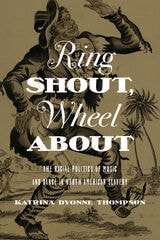
Ring Shout, Wheel About
The Racial Politics of Music and Dance in North American SlaveryKatrina D. Thompson
University of Illinois Press, 2014
In this ambitious project, historian Katrina Thompson examines the conceptualization and staging of race through the performance, sometimes coerced, of black dance from the slave ship to the minstrel stage. Drawing on a rich variety of sources, Thompson explicates how black musical performance was used by white Europeans and Americans to justify enslavement, perpetuate the existing racial hierarchy, and mask the brutality of the domestic slave trade. Whether on slave ships, at the auction block, or on plantations, whites often used coerced performances to oppress and demean the enslaved.
As Thompson shows, however, blacks' "backstage" use of musical performance often served quite a different purpose. Through creolization and other means, enslaved people preserved some native musical and dance traditions and invented or adopted new traditions that built community and even aided rebellion.
Thompson shows how these traditions evolved into nineteenth-century minstrelsy and, ultimately, raises the question of whether today's mass media performances and depictions of African Americans are so very far removed from their troublesome roots.
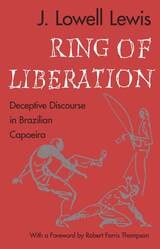
Ring of Liberation
Deceptive Discourse in Brazilian CapoeiraJ. Lowell Lewis
University of Chicago Press, 1992
Capoeira originated in early slave culture and is practiced widely today by urban Brazilians and others. At once game, sport, mock combat, and ritualized performance, it involves two players who dance and "battle" within a ring of musicians and singers. Stunning physical performances combine with music and poetry in a form as expressive in movement as it is in word.
J. Lowell Lewis explores the convergence of form and content in capoeira. The many components and characteristics of this elaborate black art form—for example, competing genre frameworks and the necessary fusion of multiple modes of expression—demand, Lewis feels, to be given "body" as well as "voice." In response, he uses Peircean semiotics and recent work in discourse and performance theory to map the connections between physical, musical, and linguistic play in capoeira and to reflect on the general relations between semiotic systems and the creation and recording of cultural meaning.
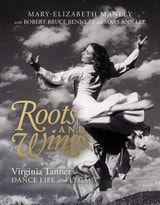
Roots and Wings
Virginia Tanner's Dance Life and LegacyMary-Elizabeth Manley with Mary Ann Lee and Robert Bruce Bennett
University of Utah Press, 2023
Roots and Wings recounts Virginia Tanner’s remarkable career as a dancer, artist, and educator. From her early experiences assisting at Evelyn Davis’s dance school in Washington, DC, to the creation of the Tanner Dance Program at the University of Utah, her influence on the field was pervasive. She channeled children’s energy, sharpened their senses, and encouraged youthful, authentic dance expression.
Manley’s extensive archival research and personal interviews depict Virginia Tanner as an innovative dance artist and ambitious leader in the field of modern dance. While exploring Tanner’s story, Roots and Wings emphasizes the value of unique instructional methodologies for teaching dance to young children and the vital role the arts play in children’s lives. Tanner’s work endures, continuing to echo with sensitivity and spirit in young dancers throughout the United States and abroad.