Results by title
304 books match the query 'Death' and 8 start with r
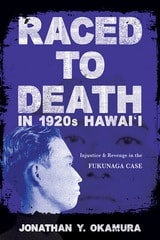
Raced to Death in 1920s Hawai i
Injustice and Revenge in the Fukunaga CaseJonathan Y. Okamura
University of Illinois Press, 2019
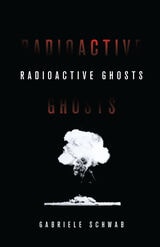
Radioactive Ghosts
Gabriele Schwab
University of Minnesota Press, 2020
A pioneering examination of nuclear trauma, the continuing and new nuclear peril, and the subjectivities they generate
Amid resurgent calls for widespread nuclear energy and “limited nuclear war,” the populations that must live with the consequences of these decisions are increasingly insecure. The nuclear peril combined with the looming threat of climate change means that we are seeing the formation of a new kind of subjectivity: humans who are in a position of perpetual ontological insecurity. In Radioactive Ghosts, Gabriele Schwab articulates a vision of these “nuclear subjectivities” that we all live with.
Focusing on the legacies of the Manhattan Project, Hiroshima, and nuclear energy politics, Radioactive Ghosts takes us on a tour of the little-seen sides of our nuclear world. Examining devastating uranium mining on Native lands, nuclear sacrifice zones, the catastrophic accidents at Chernobyl and Fukushima, and the formation of a new transspecies ethics, Schwab shows how individuals threatened with extinction are creating new adaptations, defenses, and communal spaces. Ranging from personal accounts of experiences with radiation to in-depth readings of literature, film, art, and scholarly works, Schwab gives us a complex, idiosyncratic, and personal analysis of one of the most overlooked issues of our time.
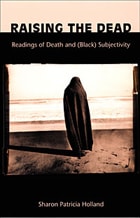
Raising the Dead
Readings of Death and (Black) SubjectivitySharon Patricia Holland
Duke University Press, 2000
Holland argues that the presence of blacks, Native Americans, women, queers, and other “minorities” in society is, like death, “almost unspeakable.” She gives voice to—or raises—the dead through her examination of works such as the movie Menace II Society, Toni Morrison’s novel Beloved, Leslie Marmon Silko’s Almanac of the Dead, Randall Kenan’s A Visitation of Spirits, and the work of the all-white, male, feminist hip-hop band Consolidated. In challenging established methods of literary investigation by putting often-disparate voices in dialogue with each other, Holland forges connections among African-American literature and culture, queer and feminist theory.
Raising the Dead will be of interest to students and scholars of American culture, African-American literature, literary theory, gender studies, queer theory, and cultural studies.
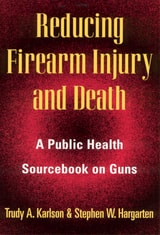
Reducing Firearm Injury and Death
A Public Health Sourcebook on GunsTrudy A. Karlson
Rutgers University Press, 1997
There are few issues more explosive than guns. "Guns don't kill people, people kill people," is an often-heard response to calls for firearm control. But are there ways to make guns safer without placing further restrictions on gun owners? Can guns be engineered to reduce the number and severity of injuries?
This book is about guns and new solutions for addressing problems they create. Trudy Karlson and Stephen Hargarten, two experts in public health and injury control, show readers how guns are products, designed to injure and kill, and how changes in the design, technology, and marketing of firearms can lead to reductions in the number of injuries and fatalities.
Just as innovations in the design and technology of motor vehicles succeeded in creating safer cars, Karlson and Hargarten describe how responsible changes to gun products can reduce the number of serious injuries and fatalities. The injury control perspective illustrates how the characteristics of guns and ammunition are associated with their ability to cause injury and death. It also provides options for how guns can be re-engineered to ensure a greater degree of safety and protection. Reducing Firearm Injury and Death teaches basic facts about guns and gun injuries, and by reframing the problem of firearms as a public health issue, offers hope for saving lives.
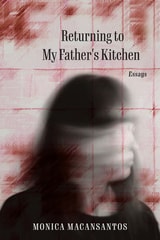
Returning to My Father's Kitchen
EssaysMonica Macansantos
Northwestern University Press, 2025
Feeling untethered after her beloved poet father passes away while she is living abroad, Monica Macansantos decides to return to the Philippines to regain her bearings. But with her father gone and her adult life rooted in the United States and New Zealand, can the land of her birth still serve as a place of healing?
In fifteen richly felt essays, Macansantos considers her family’s history in the Philippines, her own experiences as an exile, and the parent who was the heart of her family’s kitchen, whether standing at the stove to prepare dinner or sitting at the table to scribble in his notebook. Macansantos finds herself remaking her father’s chicken adobo, but also closely rereading his poems. As she reckons with his identity as an artist, she also comes into her own as a writer, and she invites us to consider whether it is possible to carry our homes with us wherever we go.
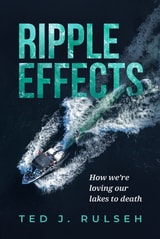
Ripple Effects
How We're Loving Our Lakes to DeathTed J. Rulseh
University of Wisconsin Press, 2022
In his engaging and conversational style, Ted Rulseh details each of these challenges and proposes achievable solutions. He draws on personal experience, interviews, academic research, and government reports to describe the state of the lakes, the stresses they are under, and avenues to successful lakeside living for a sustainable future. Ripple Effects will be a go-to source for all who love lakes and who advocate for their protection; its driving question is summed up by one of Rulseh’s interviewees: “We love this lake. What can we do to keep it healthy?”
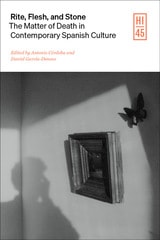
Rite, Flesh, and Stone
The Matter of Death in Contemporary Spanish CultureAntonio Córdoba
Vanderbilt University Press, 2021
Materials analyzed here—ranging from cinematic and literary fictions, to historical archives and anthropological and ethnographic sources—make explicit a dynamic scenario where actors embody a variety of positions toward death and dying, the political production of mortality, and the commemoration of the dead. Ultimately, the goal of this volume is to chart the complex network in which the disenchantment of death and its reenchantment coexist, and biopolitical control over secularized bodies overlaps with new avatars of the religious and non-theistic desires for memorialization and transcendence.

Roadside Crosses in Contemporary Memorial Culture
Holly Everett
University of North Texas Press, 2002