126 books match the query 'Decolonization' and 10 start with r

cover of Race, Ethnicity, and the Cold War: A Global Perspective

Race, Ethnicity, and the Cold War

A Global Perspective

Philip E. Muehlenbeck

Vanderbilt University Press, 2012

A white American woman is raped by a black Panamanian laborer in 1946 in the Panama Canal Zone, and the aftermath affects labor relations in the Western hemisphere for the next two decades. And numerous nations use the African continent to exercise their colonial muscle and postwar power, only to encounter the financial and military burdens that will exhaust and alienate their own citizenry half a world away. As Race, Ethnicity, and the Cold War reveals, during this dangerous era there were no longer any "isolated incidents." Like the butterfly flapping its wings and changing the weather on the other side of the globe, an instance of racial or ethnic hostility had ripple effects across a Cold War world of brinksmanship between bitter national rivals and ideological opponents.


Table of Contents

Preface

Introduction: The Borders of Race and Nation
Nico Slate

Part I: Race and the International System

Token Diplomacy: The United States, Race, and the Cold War
Michael L. Krenn

A Wind of Change? White Redoubt and the Postcolonial Moment in South Africa, 1960-1963
Ryan M. Irwin

Part II: Race, Ethnicity, and Decolonization

Race, Labor, and Security in the Panama Canal Zone: The 1946 Greaves Rape Case, Local 713, and the Isthmian Cold War Crackdown
Michael Donoghue

Race, Identity, and Diplomacy in the Papua Decolonization Struggle, 1949-1962
David Webster

"For a Better Guinea": Winning Hearts and Minds in Portuguese Guinea
Luís Nuno Rodrigues

Part III: Race and the Interplay of Domestic and International Politics

Testing the Limits of Soviet Internationalism: African Students in the Soviet Union
Maxim Matusevich

Crimes against Humanity in the Congo: Nazi Legacies and the German Cold War in Africa
Katrina M. Hagen

Race and the Cuban Revolution: The Impact of Cuba's Intervention in Angola
Henley Adams

Part IV: Ethnicity and the Interplay of Domestic and International Politics

Ethnic Nationalism in the Cold War Context: The Cyprus Issue in the Greek and Greek American Public Debate, 1954-1989
Zinovia Lialiouti and Philip E. Muehlenbeck

God Bless Reagan and God Help Canada: The Polish Canadian Action Group and Solidarność in Toronto
Eric L. Payseur

Ethnic Nationalism and the Collapse of Soviet Communism
Mark R. Beissinger
[more]
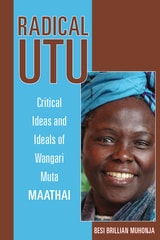
cover of Radical Utu: Critical Ideas and Ideals of Wangari Muta Maathai

Radical Utu

Critical Ideas and Ideals of Wangari Muta Maathai

Besi Brillian Muhonja

Ohio University Press, 2020
Wangari Muta Maathai was a scholar-activist known for founding the Green Belt Movement, an environmental campaign that earned her the Nobel Peace Prize. While many studies of Maathai highlight her activism, few examine Maathai as a scholar whose contributions to various disciplines and causes spanned more than three decades. In Radical Utu: Critical Ideas and Ideals of Wangari Muta Maathai, Besi Brillian Muhonja presents the words and works of Maathai as theoretical concepts attesting to her contributions to gender equality, democratic spaces, economic equity and global governance, and indigenous African languages and knowledges. Muhonja’s well-rounded portrait of Maathai’s ideas offers a corrective to the one-dimensional characterization of Maathai typical of other works.
[more]
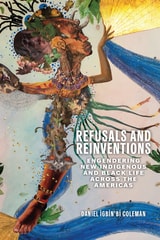
cover of Refusals and Reinventions: Engendering New Indigenous and Black Life across the Americas

Refusals and Reinventions

Engendering New Indigenous and Black Life across the Americas

Daniel Ìgbín’bí Coleman

The Ohio State University Press, 2024
In Refusals and Reinventions, artist-scholar-organizer Daniel Coleman considers his critical trajectories and participation in intersectional justice struggles in the US and Mexico, situating them within larger abolitionist and decolonial movements for Black civil rights and Native/Indigenous sovereignty. He identifies how Black and Indigenous people create, exist in, and reclaim many worlds—the pluriverse—through their artistic refusals and reinventions. Coleman thus contributes to a growing body of pluriversal thought, inspired by the Zapatista motto “a world in which many worlds fit.” Charting previously unrecognized connections among the creative struggles of Indigenous people in southern Mexico and Black people in the southern United States, Coleman draws on performance praxis, decolonial pedagogies, and Afro-diasporic and Native/Indigenous cosmologies to frame four case studies of people refusing racialized, gendered violences as world-making tools. In looking at creative responses among activists in Chiapas and in North Carolina, Coleman uses transfeminist, Black feminist, and decolonial frameworks to ask: How do creative insurgent practices give us access to our humanity? And what do praxis and engaged witnessing have to teach us about what worlds from the pluriverse hold?
[more]
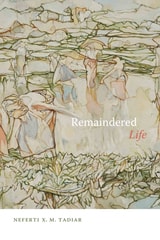
cover of Remaindered Life

Remaindered Life

Neferti X. Tadiar

Duke University Press, 2022

In Remaindered Life Neferti X. M. Tadiar offers a new conceptual vocabulary and framework for rethinking the dynamics of a global capitalism maintained through permanent imperial war. Tracking how contemporary capitalist accumulation depends on producing life-times of disposability, Tadiar focuses on what she terms remaindered life—practices of living that exceed the distinction between life worth living and life worth expending. Through this heuristic, Tadiar reinterprets the global significance and genealogy of the surplus life-making practices of migrant domestic and service workers, refugees fleeing wars and environmental disasters, criminalized communities, urban slum dwellers, and dispossessed Indigenous people. She also examines artists and filmmakers in the Global South who render forms of various living in the midst of disposability. Retelling the story of globalization from the side of those who reach beyond dominant protocols of living, Tadiar demonstrates how attending to remaindered life can open up another horizon of possibility for a radical remaking of our present global mode of life.
[more]
cover of Remapping Sovereignty: Decolonization and Self-Determination in North American Indigenous Political Thought

Remapping Sovereignty

Decolonization and Self-Determination in North American Indigenous Political Thought

David Myer Temin

University of Chicago Press, 2023

An examination of anticolonial thought and practice across key Indigenous thinkers.

Accounts of decolonization routinely neglect Indigenous societies, yet Native communities have made unique contributions to anticolonial thought and activism. Remapping Sovereignty examines how twentieth-century Indigenous activists in North America debated questions of decolonization and self-determination, developing distinctive conceptual approaches that both resonate with and reformulate key strands in other civil rights and global decolonization movements. In contrast to decolonization projects that envisioned liberation through state sovereignty, Indigenous theorists emphasized the self-determination of peoples against sovereign state supremacy and articulated a visionary politics of decolonization as earthmaking. Temin traces the interplay between anticolonial thought and practice across key thinkers, interweaving history and textual analysis. He shows how these insights broaden the political and intellectual horizons open to us today.

[more]
cover of Reparations and the Human

Reparations and the Human

David L. Eng

Duke University Press, 2025
The Holocaust and the atomic bombings of Hiroshima and Nagasaki invoked in graphic terms the specter of total human destruction. In response, a new international order of reparations and human rights arose from the ashes of World War II. This legal regime sought to subrogate the sovereignty of the nation-state in order to defend the sovereignty of the human being. While the Holocaust’s history is settled—Nazis were perpetrators and Jews were victims—there remains little historical consensus as to the victims and perpetrators of the atomic bombings. In Reparations and the Human, David L. Eng investigates a history of reparations across the Transpacific. He analyzes how concepts of reparation established during colonial settlement and the European Enlightenment shape contemporary configurations of the human and human rights, determining who can be recognized as victims, who must be seen as perpetrators, and who deserves repair. As demands for reparations now occupy center stage in debates concerning unresolved legacies of dispossession and Transatlantic slavery, Eng considers how the Cold War Transpacific provides a limit case for the politics of repair and definitions of the human.
[more]
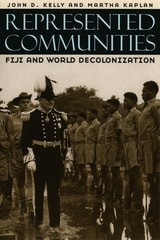
cover of Represented Communities: Fiji and World Decolonization

Represented Communities

Fiji and World Decolonization

John D. Kelly and Martha Kaplan

University of Chicago Press, 2001

In 1983 Benedict Anderson's Imagined Communities revolutionized the anthropology of nationalism. Anderson argued that "print capitalism" fostered nations as imagined communities in a modular form that became the culture of modernity.

Now, in Represented Communities, John D. Kelly and Martha Kaplan offer an extensive and devastating critique of Anderson's depictions of colonial history, his comparative method, and his political anthropology. The authors build a forceful argument around events in Fiji from World War II to the 2000 coups, showing how focus on "imagined communities" underestimates colonial history and obscures the struggle over legal rights and political representation in postcolonial nation-states. They show that the "self-determining" nation-state actually emerged with the postwar construction of the United Nations, fundamentally changing the politics of representation.

Sophisticated and impassioned, this book will further anthropology's contribution to the understanding of contemporary nationalisms.

[more]
cover of Rescuing the Enlightenment from the Europeans: Critical Theories of Decolonization

Rescuing the Enlightenment from the Europeans

Critical Theories of Decolonization

Nikita Dhawan

Duke University Press, 2026

In Rescuing the Enlightenment from the Europeans, Nikita Dhawan puts the critical project of decolonization into conversation with the Enlightenment. She explores the ethical-political challenges faced by postcolonial thought, which must be articulated using the very language of Enlightenment discourses on human rights, democracy, international law, sovereignty, and justice—even as these norms are subjects of postcolonial critique. Bridging postcolonial and Holocaust studies while also highlighting differences from decolonial approaches, she engages with thinkers ranging from Kant to the Frankfurt school to defend them against accusations of normative nihilism, antisemitism, and epistemic servitude to Europe. Dhawan argues that criticizing the Enlightenment and its legacies does not necessarily entail rejecting them, nor does engaging with Enlightenment principles mean endorsing them unconditionally. Instead, she makes a case for rescuing the best aspects of the Enlightenment in order to further the critical project of decolonization.
[more]
cover of Rewriting Islam: Decolonialism, Justice, and Contemporary Muslimah Literature

Rewriting Islam

Decolonialism, Justice, and Contemporary Muslimah Literature

Hasnul Insani Djohar

The Ohio State University Press, 2024

In Rewriting Islam, Hasnul Insani Djohar examines how women writers of the Ummah, or Muslim religious community, portray Muslim women fighting for gender and social justice while living as minorities in prosperous countries. Focusing on the body of Muslimah writing that has emerged since the US invasion of Iraq in 2003, Djohar considers fiction such as Mohja Kahf’s The Girl in the Tangerine Scarf, Randa Jarrar’s A Map of Home, Laila Lalami’s Hope and Other Dangerous Pursuits, and G. Willow Wilson’s Alif the Unseen. Djohar also examines poetry, memoirs, and short stories. Together, these works depict the diversity of Muslimah identities and cultures worldwide. Operating within postcolonial and Islamic studies frameworks, Djohar investigates how these writers contribute to larger debates around gender and globalization—including justice for immigrants and refugees, who are often blamed for social problems rather than recognized as victims of US imperialism and transnational capitalist globalization. By way of close readings and careful attention to historical, cultural, and religious contexts, Djohar illuminates how Muslimah American writers decolonize justice and white sovereignty by elevating interconnectedness, spirituality, and sisterhood across diverse communities.
[more]
cover of Rising Up, Living On: Re-Existences, Sowings, and Decolonial Cracks

Rising Up, Living On

Re-Existences, Sowings, and Decolonial Cracks

Catherine E. Walsh

Duke University Press, 2023

In Rising Up, Living On, Catherine E. Walsh examines struggles for existence in societies deeply marked by the systemic violences and entwinements of coloniality, capitalism, Christianity, racism, gendering, heteropatriarchy, and the continual dispossession of bodies, land, knowledge, and life, while revealing practices that contest and live in the cracks of these matrices of power. Through stories, narrations, personal letters, conversations, lived accounts, and weaving together the thought of many—including ancestors, artists, students, activists, feminists, collectives, and Indigenous and Africana peoples—in the Americas, the Global South, and beyond, Walsh takes readers on a journey of decolonial praxis. Here, Walsh outlines individual and collective paths that cry out and crack, ask and walk, deschool, undo the nation-state, and break down boundaries of gender, race, and nature. Rising Up, Living On is a book that sows re-existences, nurtures relationality, and cultivates the sense, hope, and possibility of life otherwise in these desperate times.
[more]