Results by title
81 books match the query 'Disasters & Disaster Relief' and 7 start with r
RSF
The Russell Sage Foundation Journal of the Social Sciences: Climate Hazards and Their Social, Political, and Economic Consequences in the United StatesMax Besbris
Russell Sage Foundation, 2026
As climate change intensifies, weather becomes more extreme and climate hazards like wildfires and hurricanes become more frequent and more destructive. While climate change affects the entire global population, the risk and consequences of experiencing climate hazards are not shared equally. In the U.S. lower socioeconomic status groups and people of color are disproportionately more at risk for experiencing climate hazards and face more difficulty recovering from them. In this issue of RSF, sociologists Max Besbris, Manuel Pastor, and Anna Rhodes, economist Wolfram Schlenker, political scientist Pamela Winston, and an interdisciplinary group of contributors examine the impact of climate change on inequality in the U.S.
The 11 articles in this issue investigate the consequences of climate hazards for inequality, examining impacts on housing, neighborhoods, and employment; the ways inequality emerges in recovery from climate-related disasters; and how politicians and other actors respond to climate change. As flood risk increases in communities across the U.S., local authorities are partnering with federal agencies to implement buyout programs as a tool for managed retreat. James R. Elliott and colleagues find that in majority-White communities, where most buyouts take place, homeowners more commonly opt to sell their homes on the private market instead, which creates a revolving door of risk rather than eliminating it. Property insurance is essential for mediating losses and facilitating hurricane recovery, yet timely and fair claims are not guaranteed. Bad faith claims handling can put residents’ housing stability and financial wellbeing at risk, leading many to file lawsuits to dispute the outcome of their claims. Hannah K. Friedrich and colleagues find that litigation against insurers is more likely in areas that have a higher percentage of Black residents and that case duration is longer for residents in these areas, reflecting that systemic procedural inequalities can amplify disparities in disaster recovery. Cadence Willse finds that in the wake of major climate-related disasters, Democrats are more likely to increase their support for environmental policy issues, while Republicans are less likely to vote in favor of environmental policies.Megan Mullin investigates whether support for managed retreat programs by local governments differ if residents are viewed as wealthy or low-income. She finds that local elected officials are more likely to support buyout programs for low-income homeowners.
This timely issue of RSF expertly enhances our understanding of the intersection of climate disasters and inequality.
RSF
The Russell Sage Foundation Journal of the Social Sciences: Disparate Effects of Disruptive Events on ChildrenJennie E. Brand
Russell Sage Foundation, 2023
Drawing on accumulated insights of empirical work from several social science disciplines, including sociology, psychology, and economics, the editors provide a nuanced consideration of theoretical approaches and methodological challenges in identifying unequal impacts. They argue that variation in the effects of disruptive events depends on different, and sometimes offsetting, mechanisms. For example, Martha Bailey and colleagues find that more disadvantaged male youth were less negatively impacted by the macroeconomic shock of the Great Depression than more advantaged youth. Black youth, however, were more negatively impacted. Anna Baranowska-Rataj and colleagues find little evidence that parental job loss leads to worse birth outcomes or that effects vary across regions with different unemployment levels in Sweden, a nation with a relatively generous safety net and universal health care. Regarding the household disruption of parental incarceration, Kristin Turney and colleagues find that some children seamlessly step into new responsibilities, while others, especially older children who had witnessed their fathers’ frequent entanglements with the criminal legal system, consciously step away from these responsibilities. Stefanie DeLuca and colleagues argue that as youth grow accustomed to disruptive events, these exposures become less remarkable and impactful on their life outcomes. Looking at the disruption to education caused by the COVID-19 pandemic, Douglas Harris and colleagues find that \high school graduation has remained remarkably steady since the onset of the pandemic, but entry into two-year colleges was hard hit, especially for colleges serving more people of color and those from low-income families. Finally, considering environmental disruptions, Nazar Khalid and colleagues show that severe floods in India have a stronger impact on the educational outcomes of children from marginalized communities.
Through its systematic examination of the variation in the consequences of disruption, especially in early life, this volume of RSF provides an insightful and practical resource for both researchers and policymakers.
RSF
The Russell Sage Foundation Journal of the Social Sciences: The Deportation System and Its AftermathCaitlin Patler
Russell Sage Foundation, 2025
The United States is home to the largest deportation system in the world: Between 2001 and 2022, U.S. Immigration and Customs Enforcement (ICE) carried out nearly 6.5 million deportations. Deportation is often framed as a singular event that happens to an individual. However, as public policy scholar Caitlin Patler and political scientist Brad Jones argue in this issue of RSF, deportation is a system that encompasses premigration, within-U.S., and post-deportation contexts and outcomes. With Congress recently approving a massive expansion of the US deportation system, understanding its consequences is more important than ever before.
In this issue, an interdisciplinary group of contributors explore the wide range of impacts of the U.S. deportation system. The introductory chapter by Patler and Jones defines the U.S. deportation system and provides a comprehensive historical context for understanding its causes and consequences. Mass deportation is enabled primarily through the merging of U.S. immigration and criminal laws. Ian Peacock explores the proliferation of 287(g) agreements, which deputize local law enforcement to enforce immigration law. He shows that counties with stronger ties to public official associations, such as the National Sheriff’s Association and the Major County Sheriffs of America, were more likely to adopt identical 287(g) agreements, devote more jail space to ICE detainees, and comply with ICE detainer requests at higher rates. The issue also presents empirical analyses of the consequences of the US deportation system. Articles by Youngjin Stephanie Hong and colleagues, Cora Bennett and colleagues, and J. Jacob Kirksey and Carolyn Sattin-Bajaj, link deportation to reduced Head Start enrollment, lower K-12 test scores, and declines in college enrollment, respectively. The remaining articles turn to the aftermath of deportation. Erin R. Hamilton and colleagues show that between 2015 and 2020, 11,000 individuals were de facto deportees—family members who leave the country because another family member has been deported—in Mexico, with a disproportionate number being women and children. Further highlighting the importance of family, Ángel A. Escamilla García and Adriana M. Cerón analyze survey data from recently deported Central Americans and find those who left minor children in the U.S. were more likely to intend to remigrate to the U.S.
This issue of RSF sheds light on various dimensions of the increasingly punitive U.S. deportation system and the many ways it harms individuals and communities. In the current era of mass expansion of immigration law enforcement, it will be a valuable educational tool for students, faculty, policymakers, and many other stakeholders.
Rebuilding Community after Katrina
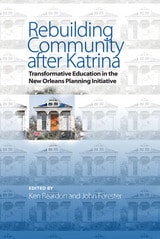
Transformative Education in the New Orleans Planning InitiativeKen Reardon
Temple University Press, 2015
Rebuilding Community after Katrina chronicles the innovative and ambitious partnership between Cornell University’s City and Regional Planning department and ACORN Housing, an affiliate of what was the nation’s largest low-income community organization. These unlikely allies came together to begin to rebuild devastated neighborhoods in New Orleans after Hurricane Katrina.
The editors and contributors to this volume allow participants’ voices to show how this partnership integrated careful, technical analysis with aggressive community outreach and organizing. With essays by activists, organizers, community members, and academics on the ground, Rebuilding Community after Katrina presents insights on the challenges involved in changing the way politicians and analysts imagined the future of New Orleans’ Ninth Ward.
What emerges from this complex drama are lessons about community planning, organizational relationships, and team building across multi-cultural lines. The accounts presented in Rebuilding Community after Katrina raise important and sensitive questions about the appropriate roles of outsiders in community-based planning processes.
Recovering Inequality
Hurricane Katrina, the San Francisco Earthquake of 1906, and the Aftermath of DisasterBy Steve Kroll-Smith
University of Texas Press, 2018
A lethal mix of natural disaster, dangerously flawed construction, and reckless human actions devastated San Francisco in 1906 and New Orleans in 2005. Eighty percent of the built environments of both cities were destroyed in the catastrophes, and the poor, the elderly, and the medically infirm were disproportionately among the thousands who perished. These striking similarities in the impacts of cataclysms separated by a century impelled Steve Kroll-Smith to look for commonalities in how the cities recovered from disaster. In Recovering Inequality, he builds a convincing case that disaster recovery and the reestablishment of social and economic inequality are inseparable.
Kroll-Smith demonstrates that disaster and recovery in New Orleans and San Francisco followed a similar pattern. In the immediate aftermath of the flooding and the firestorm, social boundaries were disordered and the communities came together in expressions of unity and support. But these were quickly replaced by other narratives and actions, including the depiction of the poor as looters, uneven access to disaster assistance, and successful efforts by the powerful to take valuable urban real estate from vulnerable people. Kroll-Smith concludes that inexorable market forces ensured that recovery efforts in both cities would reestablish the patterns of inequality that existed before the catastrophes. The major difference he finds between the cities is that, from a market standpoint, New Orleans was expendable, while San Francisco rose from the ashes because it was a hub of commerce.
Renew Orleans?
Globalized Development and Worker Resistance after KatrinaAaron Schneider
University of Minnesota Press, 2018
Urban development after disaster, the fading of black political clout, and the onset of gentrification
Like no other American city, New Orleans since Hurricane Katrina offers powerful insight into issues of political economy in urban development and, in particular, how a city’s character changes after a disaster that spurs economic and political transition. In New Orleans, the hurricane upset an existing stalemate among rival factions of economic and political elites, and its aftermath facilitated the rise of a globally oriented faction of local capital.
In Renew Orleans? Aaron Schneider shows how some city leaders were able to access fragmented local institutions and capture areas of public policy vital to their development agenda. Through interviews and surveys with workers and advocates in construction, restaurants, shipyards, and hotel and casino cleaning, Schneider contrasts sectors prioritized during post-Katrina recovery with neglected sectors. The result is a fine-grained view of the way labor markets are structured to the advantage of elites, emphasizing how dual development produces wealth for the few while distributing poverty and exclusion to the many on the basis of race, gender, and ethnicity.
Schneider shows the way exploitation operates both in the workplace and the community, tracing working-class resistance that joins struggles for dignity at home and work. In the process, working classes and popular sectors put forth their own alternative forms of development.
Resilient City
The Economic Impact of 9/11Howard Chernick
Russell Sage Foundation, 2005